
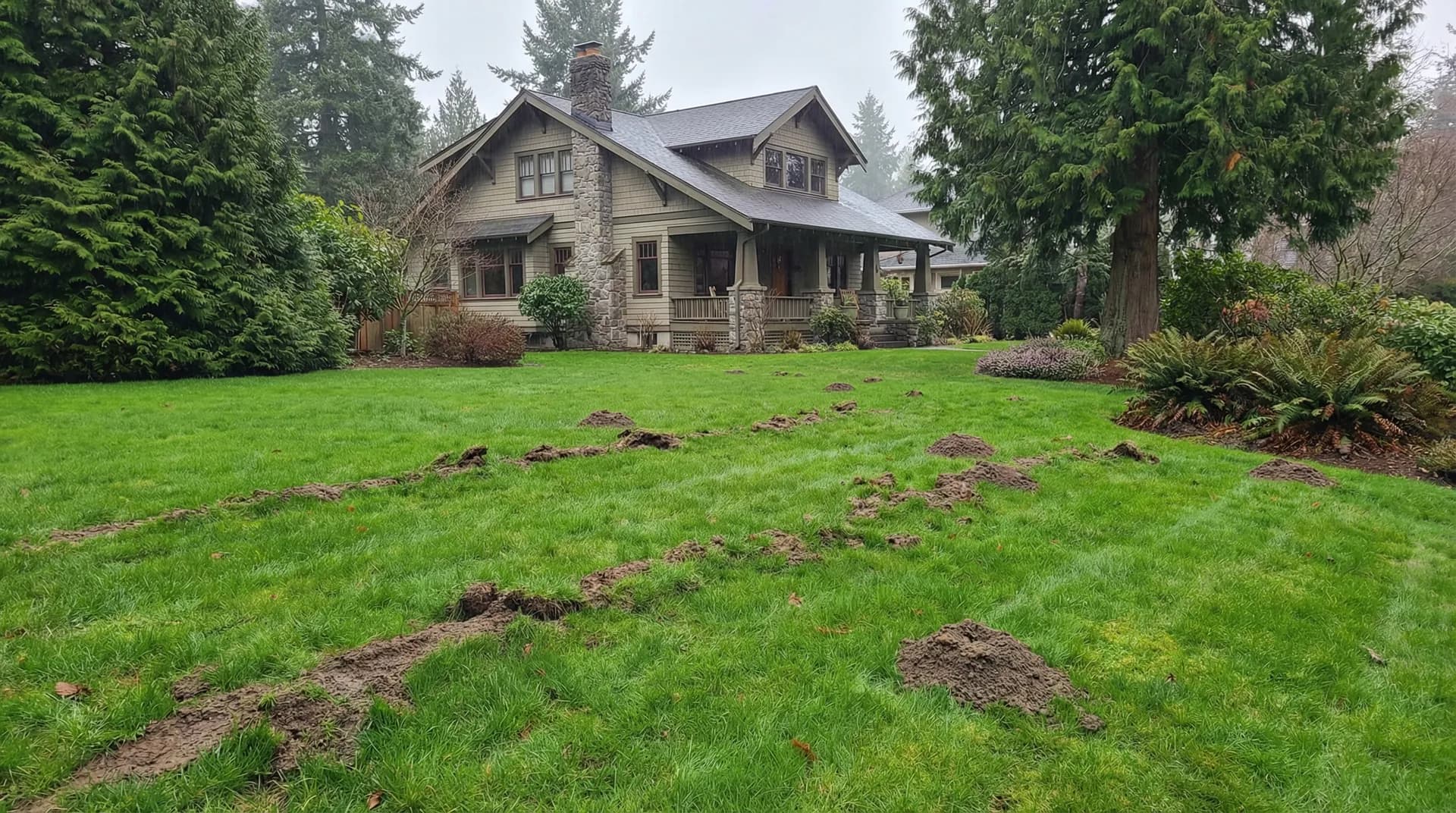
Mole Control in South Hill
South Hill sits on a glacial plateau 400 to 600 feet above the Puyallup Valley floor. That elevation doesn't protect it from moles. The Alderwood glacial till that underlies most of South Hill has a hardpan layer that traps moisture in the topsoil, and 65,000 residents maintaining irrigated lawns create earthworm-rich conditions that Townsend's moles can't resist. Got Moles has served South Hill since 2017.
Call (253) 750-0211219+ Five-Star Google Reviews·Chemical-Free·Proven Results
Got Moles provides professional mole control in South Hill, Washington. Chemical-free methods. Nearly 5,000 clients served since 2017. Call (253) 750-0211 for a free quote.
South Hill is Pierce County's largest unincorporated community, with over 64,000 people spread across the plateau above the Puyallup Valley. Sunrise, one of the area's master-planned communities, anchors the eastern side. The Meridian Avenue corridor handles the shopping and dining, and neighborhoods like Gem Heights, Manorwood, Lipoma Firs, and Silvercreek give families the suburban space they're looking for. The views of Mount Rainier from the plateau edge are some of the best in the county.
Why Moles Thrive in South Hill
The South Hill plateau is composed of Alderwood glacial till, a compacted soil with a dense hardpan layer sitting 2 to 4 feet below the surface. This hardpan is nearly impervious, which means rainwater and irrigation water pool in the topsoil above it rather than draining down. The result is consistently moist, earthworm-rich soil at exactly the depth moles tunnel. With 40-plus inches of annual rainfall and tens of thousands of irrigated residential lawns, South Hill is one continuous mole buffet from one end of the plateau to the other.
Moles in South Hill Neighborhoods
The Sunrise master-planned community on the eastern side sees moles at the boundary between developed lots and the remaining forest and open land. Gem Heights, in the northern section closer to Puyallup, has a mix of established yards with mature landscaping that produces heavy earthworm populations. Manorwood and Lipoma Firs, with their larger lots and wooded buffers between homes, provide the kind of habitat diversity moles exploit. Properties along the plateau edge where South Hill drops into the valley deal with moles moving upslope from the wetter terrain below. The Silvercreek area and neighborhoods near 152nd Street East see activity where residential development borders remaining agricultural parcels. Even the commercial strip along Meridian pushes moles into adjacent residential lots.
How We Help South Hill Homeowners
Year-Round Protection
$100/month
Our Total Mole Control Program keeps your yard protected all year. Regular visits, immediate response to new activity, and a report after every check.
Get Year-Round Protection→One-Time Removal
$450 flat rate
A focused, one-month eradication program for properties under 1 acre. 4-5 weekly visits. If we don't catch a mole, you only pay the $150 setup fee.
Get One-Time Removal→Commercial
Custom quote
Annual contracts for property managers, HOAs, sports facilities, and commercial grounds. Professional reporting, reliable scheduling.
Get a Commercial Quote→Local Tip
South Hill's hardpan layer means your lawn holds more moisture than you think, especially in the week after watering. If you're irrigating on a schedule, the soil at mole-tunnel depth may never dry out completely. That's why South Hill properties see mole activity even in summer when the surface feels dry.
How It Works
Call
Tell us about your property
Inspect
We assess the mole activity
Trap
Professional equipment on active tunnels
Report
Results after every visit
South Hill Mole Control FAQ
Why do I have moles when my property is on top of a hill?
South Hill's glacial till has a hardpan layer that traps moisture in the topsoil regardless of elevation. Your hilltop lot holds just as much water at tunnel depth as a valley property. Add irrigation, and the soil stays moist enough for earthworms and moles year-round. Elevation doesn't equal dry soil here.
My neighbor's yard is full of mole mounds and mine is clean. Will they come to my side?
Most likely, yes. Moles expand their tunnel networks into adjacent properties as they search for food. If your neighbor has active moles, yours is in the expansion zone. Getting ahead of it with our monitoring program means we catch them at the property line before they establish under your lawn.
I just had new sod installed on South Hill. How do I protect it?
New sod is a mole magnet. The freshly graded soil underneath is loose and easy to tunnel through, and the watering schedule required to establish new grass keeps the soil saturated. Call us at the first sign of a mound. Early intervention on new sod is critical because moles can destroy the root-soil contact your sod needs to establish.
Does the Meridian Avenue development push moles into residential areas?
Commercial development along Meridian displaces moles from construction sites into adjacent residential neighborhoods. If your property is within a few blocks of active construction or recently completed commercial projects, you may see an influx of moles that were displaced from that land. It's a temporary spike, but the moles don't leave on their own once they've found your yard.
How many moles are typically under a South Hill property?
Usually fewer than you'd expect. A single Townsend's mole can create an extensive tunnel network with dozens of mounds across a standard residential lot. Most South Hill properties we treat have one to three active moles causing all the visible damage. Removing even one mole often makes a dramatic difference.
Ready for Mole-Free Living in South Hill?
Call (253) 750-0211 or fill out the form below.
CALL (253) 750-0211Free inspection. No obligation.