
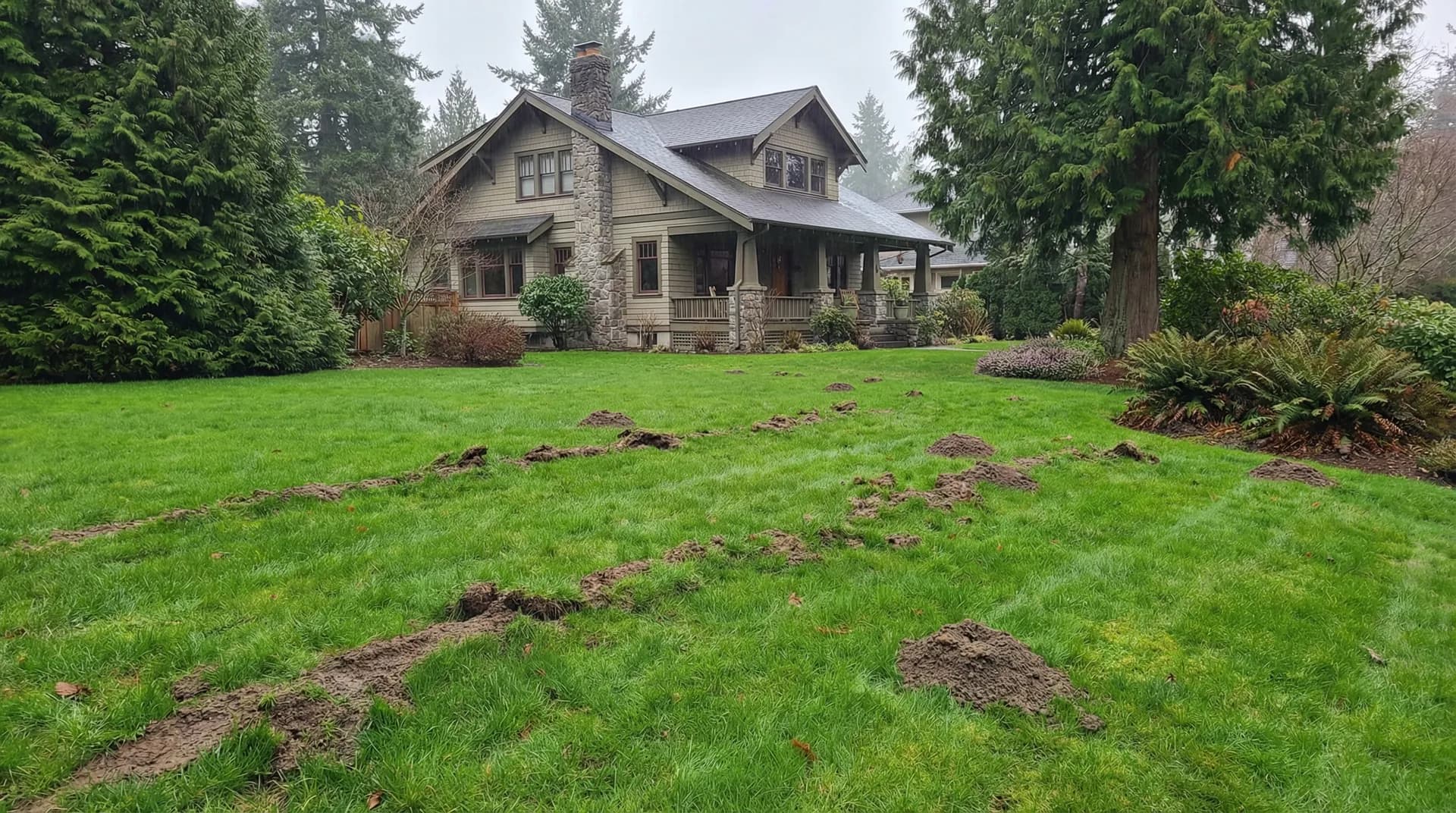
Mole Control in Fairfax
The Carbon River foothills country is wetter, wilder, and closer to the mountain than almost anywhere else Got Moles services. Properties tucked between Wilkeson, Carbonado, and the old Fairfax townsite deal with mole pressure that never really lets up because the soil and the climate here favor moles year-round. We work this corner of Pierce County the same way we work the rest of it — chemical-free trapping, no poisons, results you can see in the yard within days.
Call (253) 750-0211219+ Five-Star Google Reviews·Chemical-Free·Proven Results
Got Moles provides professional mole control in Fairfax, Washington. Chemical-free methods. Nearly 5,000 clients served since 2017. Call (253) 750-0211 for a free quote.
Fairfax itself is a near-ghost town on the Carbon River — a century-old coal and coke settlement between Carbonado and the Mount Rainier National Park boundary, now mostly remembered through the Fairfax Bridge on Highway 165 and the Foothills Trail corridor. The wider Carbon River foothills region that Fairfax anchors takes in Carbonado, Wilkeson, and the rural properties lining Pioneer Way and the road up to the Carbon River entrance — small communities that kept the history when the mines closed.
Why Moles Thrive in Fairfax
The Carbon River valley sits on a mix of alluvial deposits from the river, volcanic ash from Mount Rainier, and glacial till on the higher ground. That combination produces deep, loose, moisture-retentive soil that earthworms love and Townsend's moles tunnel through easily. Annual rainfall in the foothills pushes past 60 inches in wetter years — nearly double what Seattle gets — and the elevation keeps nights cool enough for the topsoil to stay damp even in August. Surrounding forest and undeveloped riverbank give moles unlimited staging ground before they push into cleared residential lots.
Moles in Fairfax Neighborhoods
Properties along Pioneer Way between Carbonado and the Fairfax Bridge sit closest to the river corridor and see the heaviest activity, because the alluvial soil along the Carbon stays workable through every season. Wilkeson's older residential streets, with their long-established lawns and mature fruit trees, have tunnel networks moles have used for decades. Carbonado yards backed by second-growth forest face constant reinvasion from the tree line. Rural parcels along the Foothills Trail extension face the same pattern — cleared, irrigated land next to undisturbed ground is exactly what draws moles in. Anywhere the road climbs toward the national park boundary, the mix of pasture, garden, and adjacent forest creates prime habitat.
How We Help Fairfax Homeowners
Year-Round Protection
$100/month
Our Total Mole Control Program keeps your yard protected all year. Regular visits, immediate response to new activity, and a report after every check.
Get Year-Round Protection→One-Time Removal
$450 flat rate
A focused, one-month eradication program for properties under 1 acre. 4-5 weekly visits. If we don't catch a mole, you only pay the $150 setup fee.
Get One-Time Removal→Commercial
Custom quote
Annual contracts for property managers, HOAs, sports facilities, and commercial grounds. Professional reporting, reliable scheduling.
Get a Commercial Quote→Local Tip
Foothills properties near the Carbon River should expect mole activity to spike in late spring as snowmelt raises the water table. Watch the lower, wetter parts of your lot first — that's where new tunnels appear before anywhere else.
How It Works
Call
Tell us about your property
Inspect
We assess the mole activity
Trap
Professional equipment on active tunnels
Report
Results after every visit
Fairfax Mole Control FAQ
Do you actually service this far out toward Mount Rainier?
Yes. We cover the full Carbon River corridor — Carbonado, Wilkeson, the rural addresses along Highway 165, and the properties up toward the park boundary. It's not a daily drive for us, but we schedule regularly in this area and Spencer knows the terrain.
Our property backs onto forest and the Foothills Trail. Will moles just keep coming?
They will. Forested parcels and trail corridors act as a permanent source of new moles. One-time removal clears what's in your yard now, but properties this close to undisturbed ground benefit more from our ongoing monitoring program than a single visit.
We get a lot more rain up here than Tacoma does. Does that change how moles behave?
Noticeably. Foothills properties stay wetter longer, which keeps earthworms active closer to the surface deeper into summer. Mole activity you'd see in April down in Puyallup, you'll still be seeing in July up here. Our approach factors in the longer active season.
Is trapping safe around the chickens and the garden?
Completely. Traps sit underground in active tunnels — nothing on the surface, no bait, no poison, no chemicals in the soil. Your garden, chickens, dogs, and kids are unaffected during and after treatment.
The Carbon River flooded part of our field last winter. Did that wipe out the moles?
Short-term flooding pushes moles to higher ground on your property rather than eliminating them. Once the water drops, they come back down. We often see a visible activity spike on flood-adjacent properties three to four weeks after the water recedes.
Ready for Mole-Free Living in Fairfax?
Call (253) 750-0211 or fill out the form below.
CALL (253) 750-0211Free inspection. No obligation.