
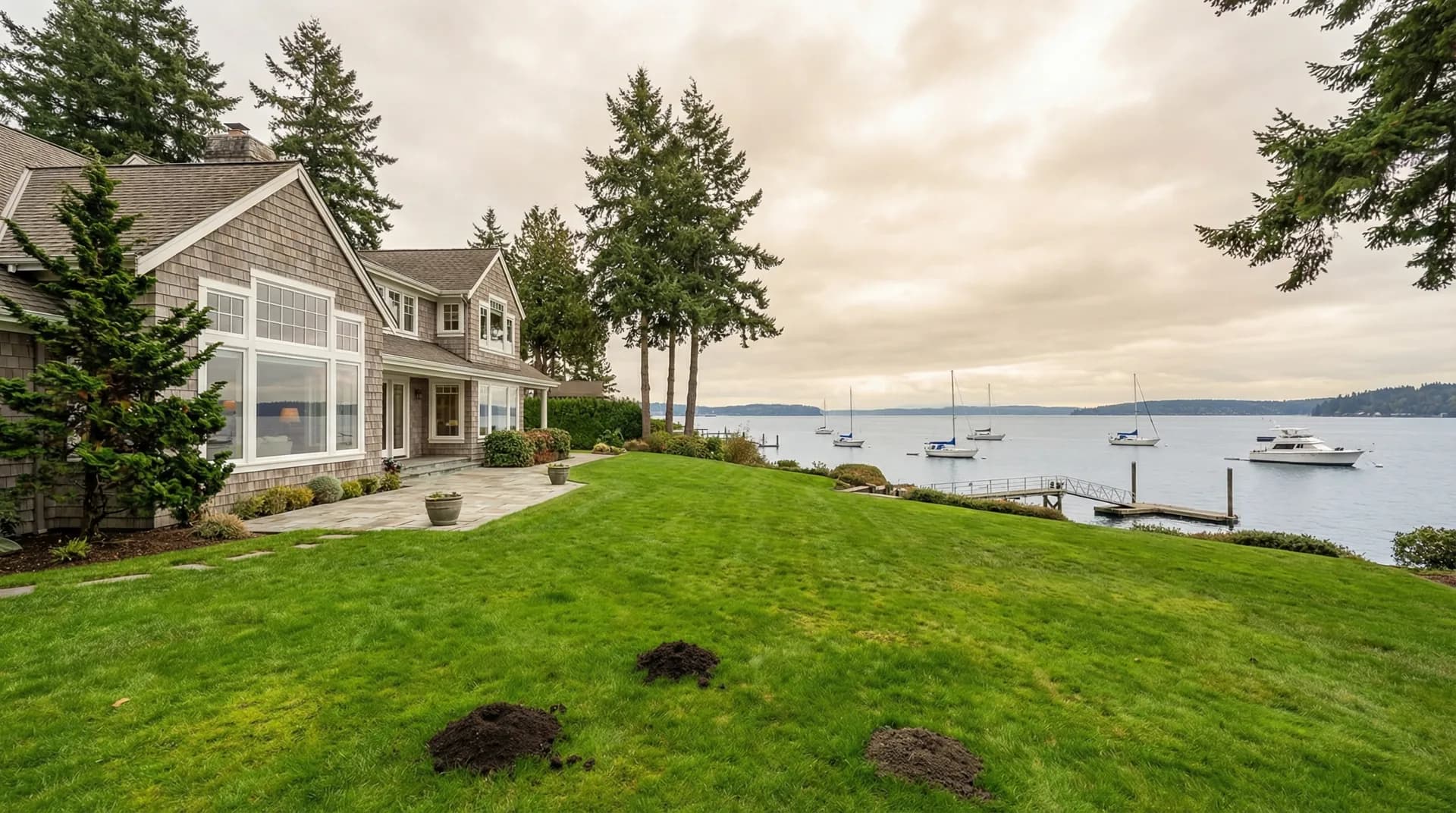
Mole Control in Poulsbo
Poulsbo sits at the head of Liberty Bay where Dogfish Creek meets the saltwater, and that convergence of fresh and marine water creates some of the wettest, most mole-friendly soil on the Kitsap Peninsula. Got Moles has served Poulsbo since 2017 with the chemical-free approach that works in the Kitsap's uniquely wet conditions.
Call (253) 750-0211219+ Five-Star Google Reviews·Chemical-Free·Proven Results
Got Moles provides professional mole control in Poulsbo, Washington. Chemical-free methods. Nearly 5,000 clients served since 2017. Call (253) 750-0211 for a free quote.
Poulsbo earned its nickname as Little Norway from the Scandinavian immigrants who settled here in the 1880s, and the heritage shows in the rosemaling on the downtown storefronts, the annual Viking Fest, and Sluys Bakery's legendary bread. Liberty Bay defines the town — the waterfront park, the marina, and the shops along Front Street all face the water. Dogfish Creek feeds into the bay, the surrounding forests keep the air clean, and the community of about 11,000 balances tourist appeal with genuine small-town life.
Why Moles Thrive in Poulsbo
Dogfish Creek and its tributaries drain into Liberty Bay through the center of Poulsbo, maintaining an elevated water table across the creek's floodplain and adjacent neighborhoods. The surrounding terrain is hilly, covered in glacial till soils with a clay-rich hardpan that traps moisture in the upper soil layers. Poulsbo receives 55+ inches of annual rainfall, and the marine influence of Liberty Bay keeps humidity high. The combination of creek drainage, marine moisture, glacial soils, and forested hillsides creates conditions where the soil at tunnel depth rarely dries out. Earthworm populations thrive year-round, and the moles follow.
Moles in Poulsbo Neighborhoods
The Vinland neighborhood north of downtown, with its established homes and forested lots, sees heavy mole activity. The mature landscaping and proximity to the surrounding forests provide both food sources and a constant supply of moles migrating from undeveloped land. Properties along Dogfish Creek deal with the creek's alluvial soil and elevated water table — some of the most active mole habitat in the city. Downtown-adjacent residential streets near Liberty Bay face marine-influenced moisture that keeps their soils wetter than properties on higher ground. The Poulsbo Village and North Kitsap High School area, with its mix of newer and established development, sees moles exploiting the transition between developed lots and the remaining forested parcels. The hillside neighborhoods along Hostmark Street and above the downtown waterfront have glacial till that traps moisture at tunnel depth. Noll Road and the neighborhoods east of town border forested areas that serve as permanent mole reservoirs.
How We Help Poulsbo Homeowners
Year-Round Protection
$100/month
Our Total Mole Control Program keeps your yard protected all year. Regular visits, immediate response to new activity, and a report after every check.
Get Year-Round Protection→One-Time Removal
$450 flat rate
A focused, one-month eradication program for properties under 1 acre. 4-5 weekly visits. If we don't catch a mole, you only pay the $150 setup fee.
Get One-Time Removal→Commercial
Custom quote
Annual contracts for property managers, HOAs, sports facilities, and commercial grounds. Professional reporting, reliable scheduling.
Get a Commercial Quote→Local Tip
Poulsbo's Scandinavian heritage includes some of the best-maintained gardens on the Kitsap Peninsula. Those well-watered, well-composted garden beds are magnets for earthworms, which makes them magnets for moles. If your garden beds are getting torn up from below, it's almost certainly moles tunneling through the enriched soil. Call before they spread to the lawn.
How It Works
Call
Tell us about your property
Inspect
We assess the mole activity
Trap
Professional equipment on active tunnels
Report
Results after every visit
Poulsbo Mole Control FAQ
Does Dogfish Creek make mole problems worse in Poulsbo?
Significantly. Dogfish Creek's riparian corridor is prime mole habitat, and properties within a few hundred feet of the creek see noticeably higher activity. The creek keeps surrounding soil saturated at tunnel depth year-round and provides a continuous travel corridor for moles moving between natural areas and residential lots.
I live in Vinland. Why are moles so persistent in this neighborhood?
Vinland's combination of mature trees, established landscaping, and proximity to surrounding forests creates ideal mole conditions. The deep organic topsoil supports dense earthworm populations, and the adjacent forest provides a constant supply of new moles. Ongoing monitoring is the most effective approach for Vinland properties because the source habitat never goes away.
Will moles damage my garden beds?
Moles don't eat plants — they're after earthworms and grubs. But their tunneling tears through root systems, dries out soil around plant roots, and creates pathways that voles use to access and eat bulbs and root vegetables. The indirect damage to gardens can be significant, especially in the rich, composted soil that Poulsbo gardeners tend to maintain.
Are there environmental concerns with mole trapping near Liberty Bay?
None. Our method uses mechanical body-gripping traps placed underground in active mole tunnels. No chemicals, no poison, nothing that enters the soil or reaches the water. Liberty Bay's marine ecosystem is completely unaffected.
My neighbor has moles too. Should we both get treatment at the same time?
Absolutely. Moles travel between adjacent properties through connected tunnel systems. Treating one yard while the neighbor's infestation continues means moles migrate back quickly. Coordinated treatment is faster, more effective, and often more affordable per property. We handle multi-property jobs regularly.
Ready for Mole-Free Living in Poulsbo?
Call (253) 750-0211 or fill out the form below.
CALL (253) 750-0211Free inspection. No obligation.