
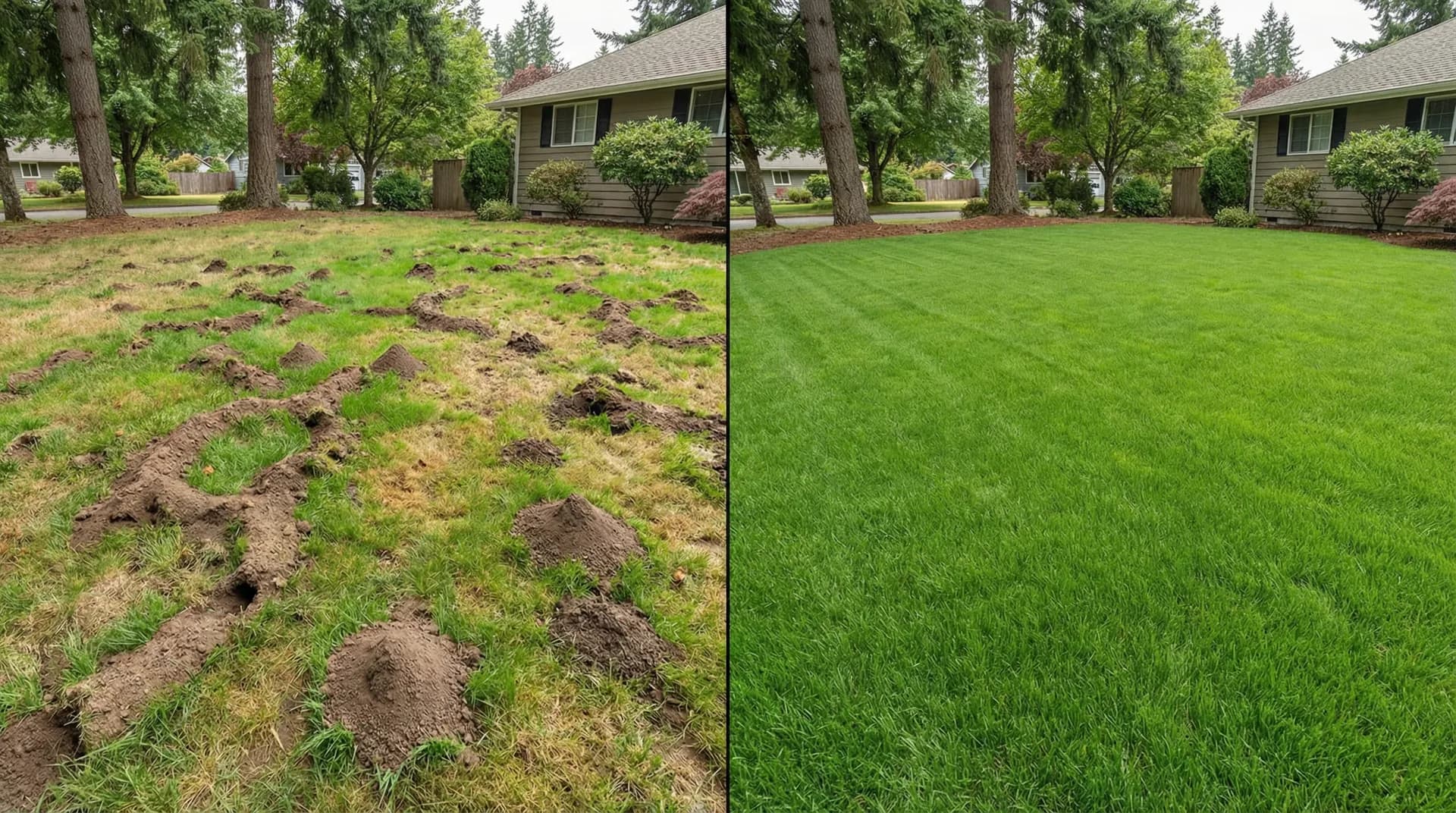
Mole Control in Tenino
Tenino's sandstone geology makes this small town unique in Thurston County. The quarry-influenced soils, Deschutes River proximity, and rural surroundings create mole conditions that differ from anywhere else in the region. Got Moles has the local knowledge and chemical-free methods to handle Tenino's specific soil challenges.
Call (253) 750-0211219+ Five-Star Google Reviews·Chemical-Free·Proven Results
Got Moles provides professional mole control in Tenino, Washington. Chemical-free methods. Nearly 5,000 clients served since 2017. Call (253) 750-0211 for a free quote.
Tenino calls itself the Stone City, and the name is earned. The town's sandstone quarries supplied building material across the Pacific Northwest in the late 1800s, and the quarry pool that remains is now the town's public swimming hole every summer. With fewer than 2,000 residents, Tenino is the smallest incorporated city in Thurston County. The Yelm-Tenino Trail ends here, the Deschutes River runs nearby, and the community carries its quarry heritage with genuine pride.
Why Moles Thrive in Tenino
Tenino's geology is unusual for the region. The Tenino Sandstone formation underlies much of the town, and where that bedrock is overlaid with glacial drift and alluvial deposits from the Deschutes River, the soil profile creates pockets of excellent mole habitat. The sandstone itself is impermeable, which means water that percolates through the topsoil hits the rock layer and pools above it — keeping the upper soil consistently moist at tunnel depth. With nearly 50 inches of annual rainfall and the Deschutes River maintaining an elevated water table in the valley, the conditions support healthy earthworm populations that moles depend on.
Moles in Tenino Neighborhoods
The residential areas near downtown Tenino, built on the deeper soils above the sandstone formation, see reliable mole activity where decades of landscaping have built up organic topsoil over the native substrate. Properties along the Deschutes River east of town deal with alluvial soil conditions similar to neighboring Rainier — soft, wet, and mole-friendly year-round. The neighborhoods near the old quarry areas have variable conditions depending on how close the sandstone bedrock is to the surface. Where the bedrock is shallow, moles concentrate in the deeper soil pockets between rock outcrops. Properties bordering the Yelm-Tenino Trail corridor see moles traveling along the trail's linear green space. The surrounding farmland and forested hillsides provide a steady supply of moles pushing into the town's small residential footprint.
How We Help Tenino Homeowners
Year-Round Protection
$100/month
Our Total Mole Control Program keeps your yard protected all year. Regular visits, immediate response to new activity, and a report after every check.
Get Year-Round Protection→One-Time Removal
$450 flat rate
A focused, one-month eradication program for properties under 1 acre. 4-5 weekly visits. If we don't catch a mole, you only pay the $150 setup fee.
Get One-Time Removal→Commercial
Custom quote
Annual contracts for property managers, HOAs, sports facilities, and commercial grounds. Professional reporting, reliable scheduling.
Get a Commercial Quote→Local Tip
Tenino's sandstone bedrock can be surprisingly close to the surface in some yards. If you've hit rock while digging a garden bed, that rock layer is actually concentrating mole activity into the deeper soil pockets on your property. Focus your attention on the areas where the soil is deepest — that's where moles will be.
How It Works
Call
Tell us about your property
Inspect
We assess the mole activity
Trap
Professional equipment on active tunnels
Report
Results after every visit
Tenino Mole Control FAQ
Does Tenino's sandstone geology affect how you trap moles?
It does. Where the sandstone bedrock is close to the surface, mole tunnels are compressed into a narrower soil layer. That actually makes them more predictable in some ways — moles have fewer options for where to tunnel. We read the soil depth across your property and place traps in the deeper soil pockets where moles are most active.
My property is near the old quarry. Do moles live in quarry areas?
Moles avoid the exposed rock and shallow soils right around the quarry, but properties nearby with deeper soil and established landscaping are fair game. The quarry creates an interesting dynamic where moles concentrate in the usable soil zones between rock features rather than spreading evenly across the area.
Is the Yelm-Tenino Trail bringing moles to my yard?
The trail corridor does serve as a travel route for moles. The undisturbed ground along the trail provides continuous habitat that connects natural areas to residential properties. If your yard borders the trail, new moles can arrive along that corridor. It's worth monitoring the trail-side edge of your property closely.
I'm on a large lot with both field and forest. Where should I focus?
Focus on the transition zones — where your maintained lawn meets the field or forest edge. That boundary is where moles cross from wild habitat into your yard. Protecting the perimeter of the area you care about is more effective and more affordable than trying to clear moles from the entire lot.
How is mole control in Tenino different from in Olympia or Lacey?
The main difference is soil composition. Tenino's sandstone substrate creates a different moisture and depth profile than the glacial outwash in Lacey or the alluvial soils in Olympia. Mole behavior adapts to local conditions, and so does our approach. The trapping method is the same — professional, chemical-free — but trap placement and spacing are tailored to what we find on your specific property.
Ready for Mole-Free Living in Tenino?
Call (253) 750-0211 or fill out the form below.
CALL (253) 750-0211Free inspection. No obligation.