
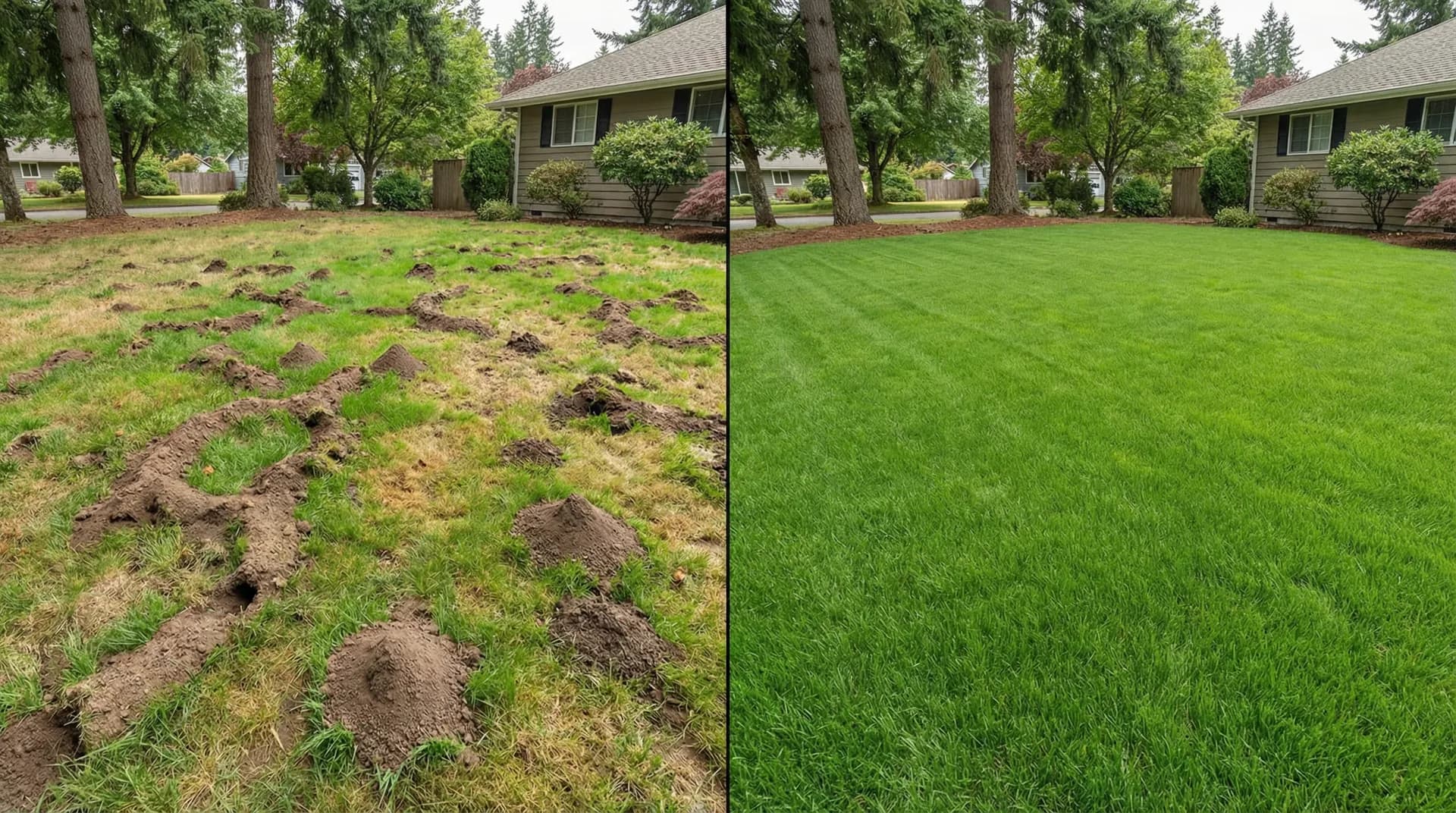
Mole Control in Rainier
Small town, big mole problems. Rainier's position along the Deschutes River, its rich valley soils, and its surrounding forest and farmland create ideal conditions for Townsend's moles. Got Moles brings the same professional, chemical-free service to Rainier that has worked across over 5,000 properties in Western Washington.
Call (253) 750-0211219+ Five-Star Google Reviews·Chemical-Free·Proven Results
Got Moles provides professional mole control in Rainier, Washington. Chemical-free methods. Nearly 5,000 clients served since 2017. Call (253) 750-0211 for a free quote.
Rainier is a small rural town of fewer than 2,000 people, tucked into the foothills where Thurston County meets the Deschutes River valley. It's the kind of place where everyone knows the volunteer firefighters by name, the annual Roundup celebration brings the whole town out, and the pace of life runs slower than anywhere in the county. Larger lots, open fields, and forested hillsides define the landscape.
Why Moles Thrive in Rainier
Rainier sits in the Deschutes River valley where alluvial deposits from the river mix with the glacial drift soils of the surrounding hills. The valley floor has deep, loamy soil that retains moisture well, while the hillsides drain into the valley and keep the water table elevated. The town gets close to 50 inches of rain annually, and the surrounding forest and farmland maintain consistently moist soil conditions. With large lots, less impervious surface than urban areas, and undisturbed habitat on all sides, moles have more room to establish extensive tunnel networks than in denser communities.
Moles in Rainier Neighborhoods
Properties along the Deschutes River corridor through town see the heaviest mole activity. The alluvial soil along the river is soft, deep, and stays wet even during summer dry spells. The residential streets near downtown Rainier, where older homes have established landscaping and mature trees, provide rich organic topsoil that supports heavy earthworm populations. Lots bordering the surrounding farmland face constant reinvasion — agricultural fields with minimal tillage are essentially undisturbed mole habitat. The hillside properties on the edges of town, where residential lots meet forest, deal with moles moving downhill from the wooded slopes into cleared yards. Even properties along the main highway corridor through town see activity where moles follow drainage ditches and utility easements.
How We Help Rainier Homeowners
Year-Round Protection
$100/month
Our Total Mole Control Program keeps your yard protected all year. Regular visits, immediate response to new activity, and a report after every check.
Get Year-Round Protection→One-Time Removal
$450 flat rate
A focused, one-month eradication program for properties under 1 acre. 4-5 weekly visits. If we don't catch a mole, you only pay the $150 setup fee.
Get One-Time Removal→Commercial
Custom quote
Annual contracts for property managers, HOAs, sports facilities, and commercial grounds. Professional reporting, reliable scheduling.
Get a Commercial Quote→Local Tip
In a small town like Rainier where lots are larger and neighbors are fewer, coordinating treatment with adjacent property owners makes a real difference. Moles move freely across unfenced rural lots, and treating one yard while leaving the next one untouched means reinvasion comes faster.
How It Works
Call
Tell us about your property
Inspect
We assess the mole activity
Trap
Professional equipment on active tunnels
Report
Results after every visit
Rainier Mole Control FAQ
My property is several acres. Do you handle larger rural lots?
Yes. We work on properties of all sizes across Thurston County, from small residential lots to multi-acre rural parcels. For larger properties, we focus the trapping effort on the areas you actually use and maintain — the lawn, garden beds, and landscaped areas — rather than trying to clear every acre.
Will moles keep coming from the forest next to my property?
Forest-adjacent properties in Rainier face ongoing reinvasion. The forest floor is permanent mole habitat, and moles naturally expand their territory into adjacent cleared land. Our monitoring program handles this by catching new arrivals at the property edge before they establish. It's the most cost-effective approach for rural properties with adjacent wild land.
Are moles worse near the Deschutes River?
Noticeably worse. The river's alluvial soil is everything a mole wants — soft, deep, moist, and loaded with earthworms. Properties within a few hundred feet of the Deschutes consistently see the highest mole activity in town. The farther uphill you go from the river, the less intense the pressure, though it never disappears entirely.
I have horses and livestock. Are your traps safe for animals in the field?
Our traps are placed underground inside active mole tunnels, not on the surface. Livestock, horses, and farm animals can't access them. This is a significant safety advantage over surface-applied poisons or above-ground traps that some DIY approaches use.
Does the farming activity around Rainier affect mole populations?
It does. Farmland that isn't heavily tilled provides stable mole habitat year-round. When fields are irrigated or when seasonal crops bring moisture and organic matter into the soil, mole populations in and around that farmland increase. Residential properties bordering active agricultural land are the first to see the overflow.
Ready for Mole-Free Living in Rainier?
Call (253) 750-0211 or fill out the form below.
CALL (253) 750-0211Free inspection. No obligation.