
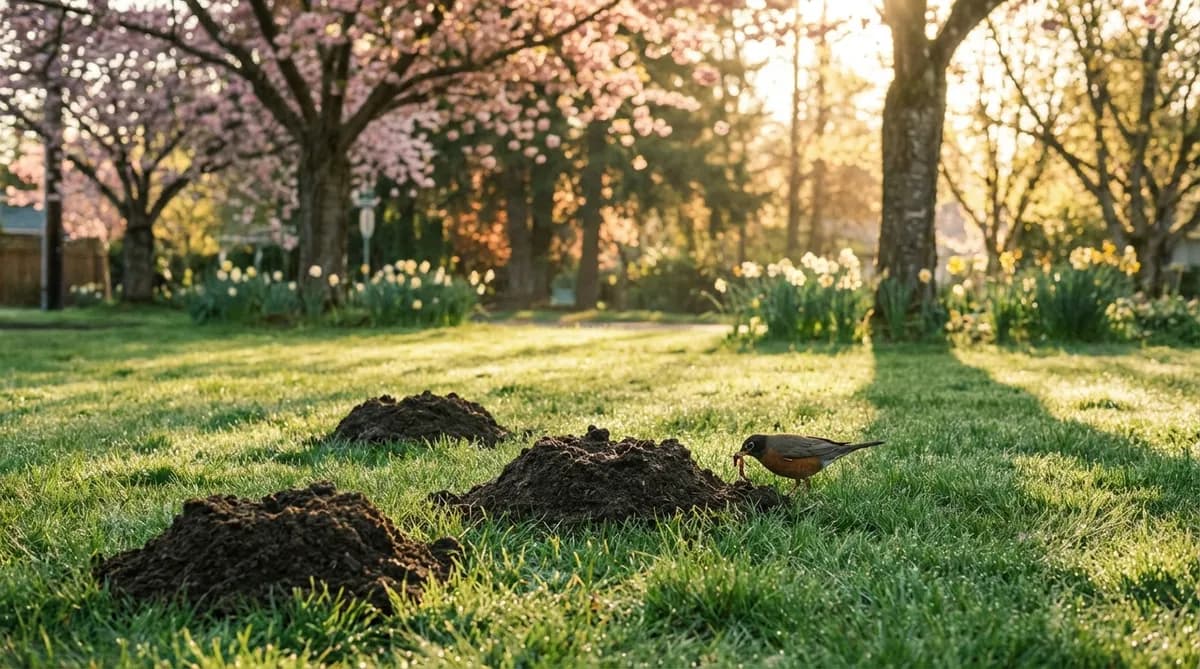
When Are Moles Most Active in Washington State?
Moles are active year-round in Washington State — they do not hibernate. Activity is most visible in spring (March-May) and autumn (September-November) when soil moisture peaks and earthworms move toward the surface. Peak mole complaint calls come in April and October across Western Washington. In mild, wet winters, mole damage can appear in any month of the year. Understanding the seasonal pattern helps homeowners know what to expect and when to act.
Moles Don't Hibernate in Western Washington
This is the single most important fact about mole activity in the Pacific Northwest: moles are active 365 days a year. They don't hibernate. They don't migrate. They don't take winter off.
All three of Washington's native mole species — Townsend's, Pacific Coast, and Shrew — stay active through the wet coastal winter. What changes is how visible their activity is. Moles dig at different depths depending on soil moisture, and the damage homeowners see on the surface varies dramatically between seasons even though the underground activity is continuous.
The driving factor is earthworms. Moles eat roughly 60-93% earthworms, and earthworm distribution in the soil column shifts with moisture. Wet ground = worms near the surface = moles near the surface = visible mounds and ridges. Dry ground = worms deep = moles deep = the lawn looks clear even while the mole is still working underneath. For the species breakdown, see What Species of Moles Live in Washington State?.
Spring (March-May) — Peak Visibility
Spring is when most Western Washington homeowners first notice mole damage. Three things happen simultaneously:
**Soil moisture peaks.** March through May averages the highest soil saturation of the year across King, Pierce, and Snohomish Counties. Seattle's rainfall averages 3.7 inches in March alone. Rich, saturated soil brings earthworms to within inches of the surface — and moles follow their food source up.
**Breeding season dispersal.** Townsend's and Pacific Coast moles mate in December-February and pups are born March-April. By May and June, juvenile moles are dispersing from their mothers' territories to claim their own ground. This is the single most predictable time of year for a new mole to appear on a previously-clear property.
**Active tunnel expansion.** The resident mole is pushing new surface runs as it searches for freshly-moving earthworms. Fresh mounds appear daily. A single Townsend's mole can produce 15-25 fresh mounds per week in peak spring conditions.
Spring is the busiest service season at Got Moles — call volume typically doubles between March and May. Properties near greenbelts, parks, or undeveloped land see the heaviest spring pressure because juvenile dispersers have more wild-ground source populations.
If spring mounds are appearing on your yard, don't wait. The mole will only expand its network, and new juveniles may be arriving on top of the existing resident. Start with One-Time Mole Removal or the year-round Total Mole Control Program.
Summer (June-August) — Deceptive Quiet
Summer activity fools most homeowners.
As the soil dries across June, July, and August, earthworms retreat to deeper, moister layers. Moles follow them down. Permanent tunnel systems run 8-20+ inches below the surface, and moles work those deeper runs without pushing fresh soil up to the top. The mounds stop appearing. The ridges stop spreading. The lawn looks clean.
Homeowners routinely interpret this as the mole having left or died. It hasn't. The mole is still there, still feeding, still maintaining its territory — just invisible from above.
Two exceptions:
**Irrigated lawns.** If you run sprinklers regularly, you're maintaining moisture that keeps earthworms near the surface. Mole activity on irrigated Western Washington lawns doesn't drop as dramatically in summer as it does on non-irrigated yards. Fresh mounds can continue through August on heavily-watered landscapes.
**Shaded or low-lying properties.** Yards that stay cool and damp through summer — north-facing slopes, properties near creeks or wetlands, lots with heavy tree cover — maintain mole-surface-activity year-round. The Seattle ship canal corridor, the lower Sammamish River, and similar micro-climates see less seasonal variation than typical suburban lots.
For most Western Washington properties, summer is a window where homeowners could remove the mole relatively easily (less active surface work means less confusion over tunnel routes) but often don't because the problem appears to have resolved on its own. It hasn't. Autumn proves it.
Autumn (September-November) — Second Peak
September rains return, and the 'new' mole problem emerges.
What's actually happening: the same mole that was underground all summer now has easy surface feeding conditions again. Earthworms move up, the mole follows, mounds reappear. Homeowners often assume it's a new animal. It's usually the resident that was always there.
Autumn also brings the second population dynamic of the year: juvenile moles from the spring breeding cycle are now fully grown and staking out their own adult territories. Some of them settle on properties that were previously stable. So you can get both effects at once — a returning resident AND a newly-established arrival.
Autumn service volume at Got Moles typically runs 70-80% of spring volume. Properties that 'resolved' in summer often call back in October when mounds reappear in the same locations. The cycle makes more sense once you understand it isn't two separate mole problems; it's one persistent one.
Practical implications:
- **Autumn removals work well.** The mole is actively using visible tunnels, which makes placement straightforward. - **Properties with spring history should expect autumn recurrence.** Plan for it. The Total Mole Control Program is specifically designed to catch each new wave within days rather than letting the yard damage accumulate. - **Don't wait for winter.** Autumn is the last clean window before the wet winter pattern starts mixing visible activity with high-moisture surface conditions.
Winter (December-February) — Still Active, Still Making Mounds
Western Washington winters aren't cold enough to stop moles. Sea-level soil temperatures stay above 35°F through most of the winter, the ground rarely freezes hard, and moisture is at its annual peak from major winter storms.
What you'll see:
- **Continued mound production.** Typically lower amplitude than spring or autumn but never zero. Mounds appear after every major rain event as the saturated soil pushes earthworms up and the mole surfaces to re-establish feeding runs. - **Shifts after flooding.** Major atmospheric river events (November-February) can force moles to shift to higher ground within the property. You may see new mounds in previously-clear areas and existing areas go quiet temporarily. - **Breeding activity.** December-February is mating season for Townsend's moles. Males extend their tunnels looking for females, which can produce a short-term surge of new tunnel construction.
Homeowners sometimes wait 'for better weather' to address mole problems, thinking summer or dry conditions favor trapping. The opposite is often true — winter moles are working visible, easy-to-read tunnel systems, and a professional trapper can identify and work active runs quickly in wet conditions.
Got Moles serves year-round. No seasonal closures. Wet weather adds boots and patience but doesn't change the methodology.
Daily Activity: When Within a Day Are Moles Most Active?
Within any given day, moles run on roughly 4-hour cycles — about 4 hours of active foraging, 3-4 hours of rest, around the clock. A single mole runs through six cycles every 24 hours, three of them during daylight.
Crepuscular preference means peak activity clusters at dawn and dusk. In Western Washington's long summer days, that pushes primary activity to roughly 5:15am-6:30am and 8:30pm-9:45pm. In short winter days, dawn and dusk activity shifts to roughly 7:30am-8:45am and 3:45pm-5:00pm.
Practically, this means mounds can appear at any hour. Homeowners often assume that finding a fresh mound at 2pm indicates a different mole than a mound that appeared overnight. It doesn't — the same mole works multiple cycles per day. See Are Moles Nocturnal? for the full daily activity breakdown.
For control: time of day doesn't matter much. Traps placed in active tunnels will catch the mole on its next cycle, usually within hours of placement. Tunnel reading matters; time of placement does not.
Regional Variations Across Washington State
Western vs Eastern Washington mole activity is dramatically different.
**Puget Sound lowlands and Pacific coast (Got Moles service area).** Year-round activity, peaks in spring and autumn, minimum variation between active and quiet periods. This is the pattern described throughout this post.
**Cascade foothills (Enumclaw, Buckley, North Bend).** Similar pattern to lowlands but with slightly more pronounced winter quiet as higher elevations see more freeze-thaw cycles. Still year-round active.
**East of the Cascades (Wenatchee, Yakima, Spokane region).** Much lower mole populations overall. Dry climate doesn't support the earthworm densities that Townsend's moles depend on. Occasional Pacific Coast mole populations in irrigated agricultural areas, but not the widespread problem it is west of the mountains.
**High elevations (Cascade passes, Olympic interior).** Essentially no residential mole activity. Above ~2,000 feet, conditions aren't right for the main species.
For homeowners in the Got Moles primary service area (King, Pierce, Snohomish, Thurston Counties), assume year-round mole pressure with March and October as the peak months. If you see fresh mounds, don't wait — the season will continue producing them until the mole is removed.
Got Moles Serves Western Washington
Got Moles is a mole-only specialist covering King, Pierce, Snohomish, and Thurston counties — the heart of Western Washington. We've trapped moles on nearly 5,000 properties since 2017, chemical-free, with 219+ five-star Google reviews across three local offices.
Local service areas include mole control in Maple Valley, Covington mole removal, and mole control near Mercer Island — plus every neighboring city on our service areas map.
If moles have moved into your yard, the fastest path to a solved problem is our Commercial Mole Control or a direct conversation: call (253) 750-0211 or use our contact form.
Frequently Asked Questions
Do moles hibernate in Washington?
No. Moles are active year-round in Washington State. They may dig deeper during dry summer months and during short winter freeze periods, but they never go fully dormant. Western Washington's mild, wet winters keep the soil above freezing and earthworms accessible, which keeps the moles working. Activity is less visible from above during July-August and during very cold winter weeks, but underground the mole is still feeding, still patrolling its tunnels, and still defending territory.
When is the worst time for moles in Seattle?
Spring (March-May) and autumn (September-November) produce the most visible mole damage due to peak soil moisture and juvenile dispersal cycles. April and October are typically the single worst months for new mound production across the Seattle metro area. If you start seeing fresh mounds in spring, expect the pressure to continue for 6-10 weeks before seasonal tapering begins.
Should I wait until spring to deal with moles I see in winter?
No. Winter is actually a fine time to remove moles — the tunnel systems are often easier to read when surface conditions are wet, and professional trapping works effectively in any season. Waiting lets the mole expand its network through winter, which means more damage when spring conditions bring even more active tunneling. Got Moles serves year-round specifically because there's no truly 'bad' season for removal.
Why did I stop seeing mounds in July — did the mole leave?
Almost certainly not. Summer dry conditions push earthworms (and therefore moles) to deeper soil layers where they don't produce surface mounds. The mole is still there, just working underground. If you stopped seeing mounds in July and don't see new ones by mid-September, consider the mole likely still resident — autumn rain will bring activity back to the surface.
What months are peak breeding season for Washington moles?
December through February for mating, with pups born March-April. Juvenile dispersal happens May-June. This is the reproductive rhythm for both Townsend's and Pacific Coast moles. Shrew moles breed on a different schedule (multiple times per year) but rarely affect residential lawns. See [How Many Babies Do Moles Have?](/how-many-babies-do-moles-have/) for the breeding detail.
Does rainfall timing affect mole mound production?
Yes, dramatically. A major Pacific Northwest rain event — 1+ inch of rain in 24 hours — often triggers a surge of fresh mound production within 48-72 hours as earthworms come to the surface and the resident mole follows. This is why fresh mounds commonly appear after atmospheric river events in winter, after the first autumn rains in September, and during the spring wet period. Dry weeks produce fewer mounds even during peak seasons.
Is there any time of year when moles are just less of a problem?
July-August for most Western Washington residential properties without irrigation. The dry surface conditions push moles deeper and the visible damage drops. That said, the mole population is unchanged — you just see fewer mounds during that window. For properties near greenbelts, parks, or creeks, there's no true 'off' season because source populations continue dispersing into your property year-round.
Related Services & Resources
Our Services
- Total Mole Control Program — $100/month year-round protection
- One-Time Mole Removal — $450 flat rate with guarantee
- Commercial Mole Control — annual contracts for property managers
Learn More
- How It Works — our 4-step process
- FAQ — 26 expert answers
- Service Areas — 77 cities across Western Washington
Spencer Hill
Spencer Hill is a US Army veteran and founder of Got Moles, a mole control specialist serving Western Washington. He has helped over 5,000 homeowners reclaim their yards using chemical-free, professional trapping methods.
Ready to Reclaim Your Yard?
Call (253) 750-0211 — we serve all of Western Washington.
CALL (253) 750-0211Free inspection. No obligation.