
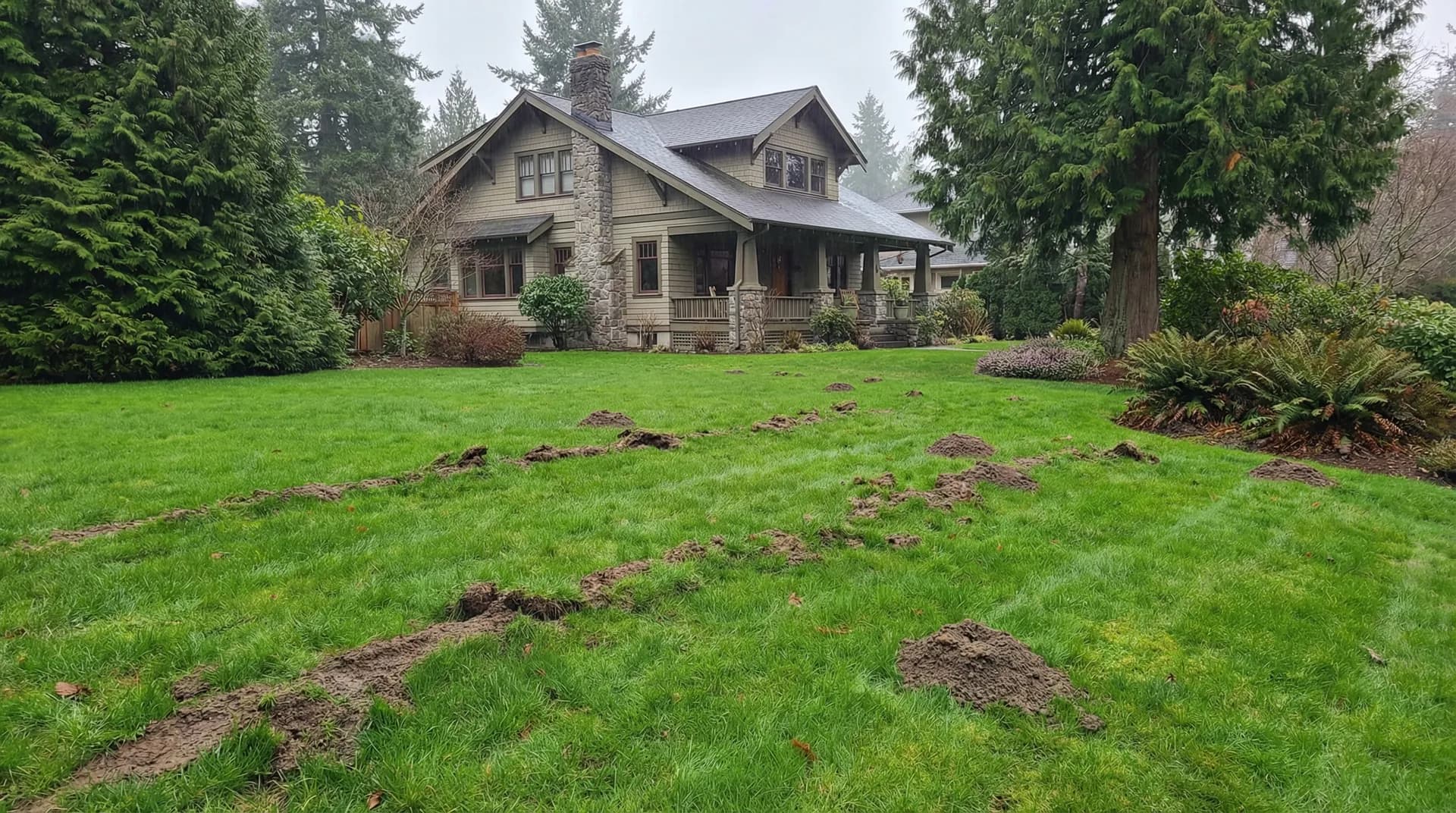
Mole Control in Fircrest
Fircrest is small, but its mature landscaping and decades of leaf litter accumulation make the soil here exceptionally attractive to Townsend's moles. Every yard in this 1.6-square-mile city is within a short tunnel's reach of another yard, which means moles move through Fircrest like it's one continuous property. Got Moles serves Fircrest with chemical-free methods safe for families and pets.
Call (253) 750-0211219+ Five-Star Google Reviews·Chemical-Free·Proven Results
Got Moles provides professional mole control in Fircrest, Washington. Chemical-free methods. Nearly 5,000 clients served since 2017. Call (253) 750-0211 for a free quote.
Fircrest packs a lot of character into 1.6 square miles. Originally developed in the 1920s by Edward Bowes and called Regents Park, the city named its streets after universities — Princeton, Dartmouth, Yale, Vassar, Stanford. The result is a walkable, tree-lined residential community sandwiched between Tacoma and University Place. Fircrest Pool, the small downtown along Regents Boulevard, and the mature landscaping on nearly every block give it a neighborhood feel that bigger cities can't replicate.
Why Moles Thrive in Fircrest
Fircrest's soil is glacial till and outwash similar to neighboring Tacoma and University Place, but the city's age and density of mature landscaping set it apart. Homes dating from the 1940s through 1960s mean 60 to 80 years of continuous organic matter accumulation in the soil. Large deciduous and conifer trees on nearly every property produce deep leaf litter and extensive root systems that build the rich topsoil layer earthworms thrive in. At just 1.6 square miles with no significant undeveloped buffers, Fircrest is essentially a continuous block of maintained, irrigated, earthworm-rich habitat. Rainfall around 38 inches annually keeps the soil moist year-round.
Moles in Fircrest Neighborhoods
The university-named streets in the original Regents Park section see heavy mole activity because the oldest landscaping produces the richest soil. Properties along Emerson Street and Alameda Avenue, with their deep setbacks and mature trees, have especially active mole populations. The Fircrest Golf Club creates a concentration of irrigated turf that serves as a mole reservoir for surrounding blocks. Homes near Fircrest Park and the pool area deal with moles moving between the maintained park grounds and residential yards. The boundaries with Tacoma to the north and University Place to the south show no break in mole activity — the moles move freely across city lines through connected underground tunnel networks.
How We Help Fircrest Homeowners
Year-Round Protection
$100/month
Our Total Mole Control Program keeps your yard protected all year. Regular visits, immediate response to new activity, and a report after every check.
Get Year-Round Protection→One-Time Removal
$450 flat rate
A focused, one-month eradication program for properties under 1 acre. 4-5 weekly visits. If we don't catch a mole, you only pay the $150 setup fee.
Get One-Time Removal→Commercial
Custom quote
Annual contracts for property managers, HOAs, sports facilities, and commercial grounds. Professional reporting, reliable scheduling.
Get a Commercial Quote→Local Tip
In a city this compact, your neighbor's mole problem is about to become yours. Fircrest yards are close enough that a single mole's tunnel network can span two or three properties. If you see mounds on a neighbor's lawn, it's worth getting an inspection on your own yard before the tunnels reach you.
How It Works
Call
Tell us about your property
Inspect
We assess the mole activity
Trap
Professional equipment on active tunnels
Report
Results after every visit
Fircrest Mole Control FAQ
My yard is tiny by Fircrest standards. Can I really have moles?
A single Townsend's mole can maintain tunnels across a small Fircrest lot with room to spare. The yard size doesn't matter. What matters is the soil condition, and Fircrest's mature landscaping creates excellent mole habitat regardless of lot size. We treat compact urban yards regularly.
The moles seem to come from the direction of the golf course. Is that likely?
Fircrest Golf Club's irrigated turf is prime mole habitat. The maintained fairways, greens, and rough produce dense earthworm populations that support a significant mole population. Properties surrounding the course are in the direct expansion path. Our monitoring program works well for golf-course-adjacent homeowners.
Should our neighborhood coordinate mole treatment?
In a city as compact as Fircrest, coordinated treatment between neighbors is one of the most effective approaches. Moles don't recognize property lines, and treating one yard while the neighbor's stays infested just delays the problem. We handle multi-property coordination and can schedule adjacent yards together.
Are there chemicals involved in your treatment?
None. We use professional body-gripping traps placed underground in active mole tunnels. No poison, no chemicals, no surface treatments. This is especially important in Fircrest where yards are compact and children, dogs, and cats are often in close contact with every part of the lawn.
How often would I need ongoing monitoring in Fircrest?
Given Fircrest's density and the constant mole movement between properties, monthly monitoring is our standard recommendation. The compact city means moles can recolonize a cleared yard within weeks from adjacent habitat. Monthly visits catch new arrivals before they establish full tunnel networks.
Ready for Mole-Free Living in Fircrest?
Call (253) 750-0211 or fill out the form below.
CALL (253) 750-0211Free inspection. No obligation.