
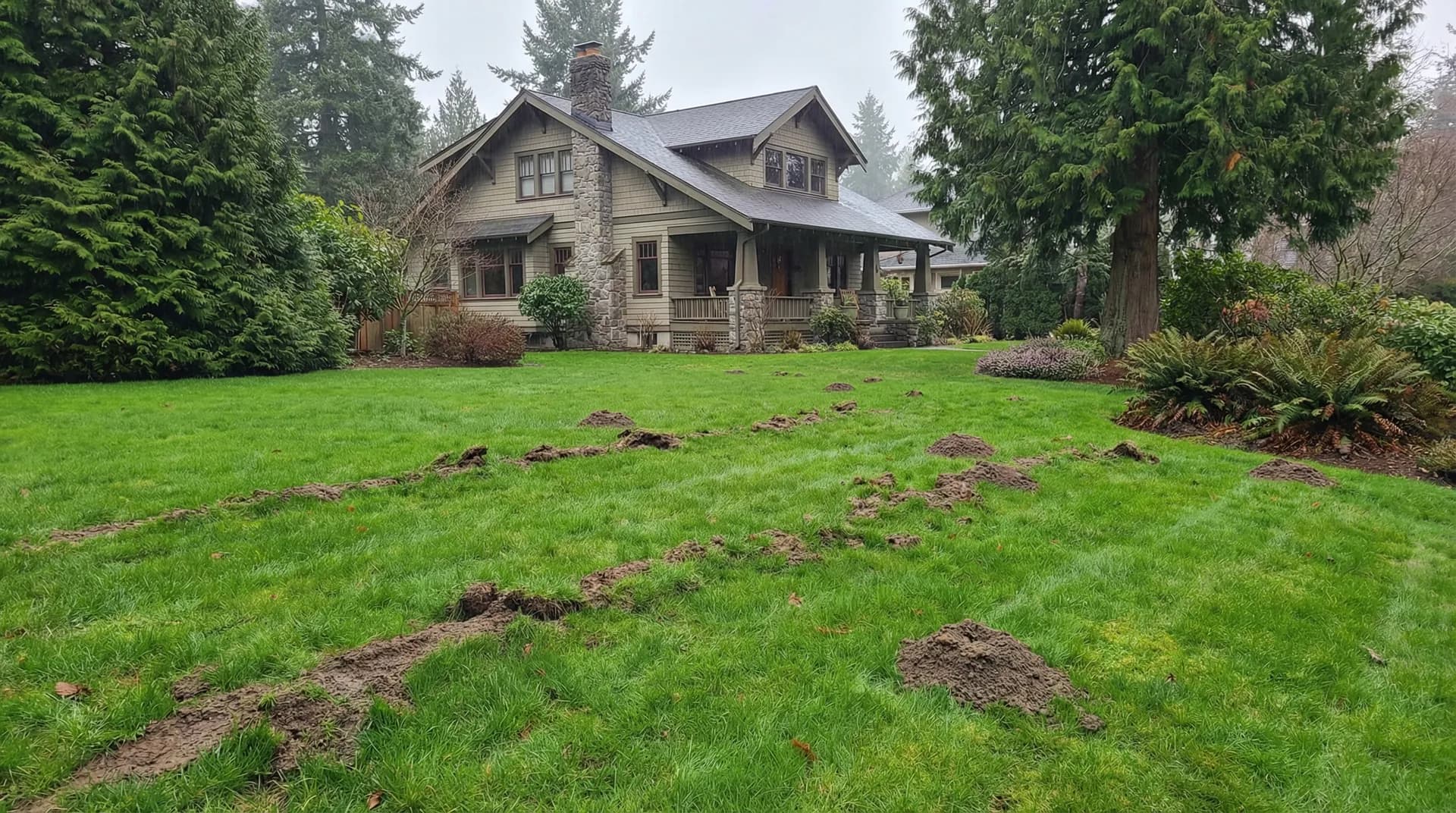
Mole Control in Parkland
Parkland's mid-century housing stock, mature tree canopy, and proximity to JBLM's undeveloped buffer zones create a perfect setup for Townsend's moles. Decades of leaf litter and organic matter have built up rich soil under the older neighborhoods, and the moles have been here as long as the houses have. Got Moles serves Parkland with chemical-free trapping safe for families and pets.
Call (253) 750-0211219+ Five-Star Google Reviews·Chemical-Free·Proven Results
Got Moles provides professional mole control in Parkland, Washington. Chemical-free methods. Nearly 5,000 clients served since 2017. Call (253) 750-0211 for a free quote.
Parkland is an unincorporated community shaped by Pacific Lutheran University at its center. PLU's 156-acre wooded campus gives the area a collegiate feel, and the surrounding neighborhoods range from the older mid-century homes near the university to newer development along the edges. Brookdale Golf Course to the east, the Cloverfield area's rural character to the south, and the Pacific Avenue commercial corridor to the north give Parkland distinct neighborhoods within a compact footprint.
Why Moles Thrive in Parkland
Parkland sits on glacial outwash deposits similar to neighboring Spanaway and Lakewood, with volcanic ash mixed into the upper soil layers. What distinguishes Parkland is the maturity of its landscape. The 1940s through 1960s housing stock means 60-plus years of tree canopy, leaf litter accumulation, and root system development, all of which create the deep organic soil layer that earthworms and moles prefer. PLU's 156-acre campus is a massive block of irrigated, maintained green space surrounded by mature forest. The JBLM buffer zone to the west provides permanent, undisturbed mole habitat with a constant supply pushing into residential areas.
Moles in Parkland Neighborhoods
Properties surrounding PLU's campus deal with moles moving between the university's manicured grounds and adjacent residential yards. The older homes along Garfield Street, Wheeler Street, and Park Avenue have some of the most established mole populations in the community because the soil has had decades to develop the organic richness moles need. Brookdale Golf Course on the east side creates a concentrated mole habitat that spills into Summit View and surrounding neighborhoods. The Cloverfield area in the south, with its larger lots and rural character, sees moles thriving in the undisturbed soil between properties. Neighborhoods along the JBLM boundary face constant reinvasion from the base's forested buffer zones.
How We Help Parkland Homeowners
Year-Round Protection
$100/month
Our Total Mole Control Program keeps your yard protected all year. Regular visits, immediate response to new activity, and a report after every check.
Get Year-Round Protection→One-Time Removal
$450 flat rate
A focused, one-month eradication program for properties under 1 acre. 4-5 weekly visits. If we don't catch a mole, you only pay the $150 setup fee.
Get One-Time Removal→Commercial
Custom quote
Annual contracts for property managers, HOAs, sports facilities, and commercial grounds. Professional reporting, reliable scheduling.
Get a Commercial Quote→Local Tip
If you live in one of Parkland's older neighborhoods near PLU, your soil probably has a thick organic layer from decades of leaf accumulation. That organic-rich soil produces more earthworms per square foot than newer developments. More earthworms means more moles. Getting ahead of the problem is more important here than in newer neighborhoods.
How It Works
Call
Tell us about your property
Inspect
We assess the mole activity
Trap
Professional equipment on active tunnels
Report
Results after every visit
Parkland Mole Control FAQ
I live near PLU. Does the campus affect mole activity in my neighborhood?
PLU's 156 acres of irrigated campus grounds and surrounding forest are significant mole habitat. Moles expand outward from the campus into adjacent residential properties, especially along the wooded corridors connecting the campus to neighborhood yards. Properties within a few blocks of campus see elevated mole activity compared to more distant areas.
My house was built in the 1950s. Is the soil different than newer neighborhoods?
Yes. Sixty-plus years of leaf litter, root decomposition, and organic matter accumulation have created a thicker, richer topsoil layer than you'd find in newer developments. That organic-rich soil supports denser earthworm populations, which means more food for moles and more mole activity. Older neighborhoods consistently see heavier mole pressure than recently built areas.
Are the moles coming from JBLM?
For properties on the western side of Parkland, yes. The undeveloped buffer zones around Joint Base Lewis-McChord are permanent mole habitat. Moles from those areas expand into the nearest residential neighborhoods, and Parkland's western edge is in the direct path. Our monitoring program is the best approach for JBLM-adjacent properties.
Will removing moles help my lawn recover from the tunneling damage?
Once the tunneling stops, most lawns recover within one growing season with normal watering and mowing. The raised tunnel ridges settle, the soil reconnects, and grass roots reestablish across the damaged areas. Heavy damage may need overseeding, but the lawn won't heal as long as active moles keep tearing through the root zone.
Do you handle moles near Brookdale Golf Course?
We serve many properties around Brookdale. Golf courses are prime mole habitat — irrigated turf, rich soil, and undisturbed ground around the fairway edges. Moles from the course regularly expand into adjacent residential lots. Homeowners near the course benefit most from our ongoing monitoring since the course ensures a constant supply of new moles.
Ready for Mole-Free Living in Parkland?
Call (253) 750-0211 or fill out the form below.
CALL (253) 750-0211Free inspection. No obligation.