
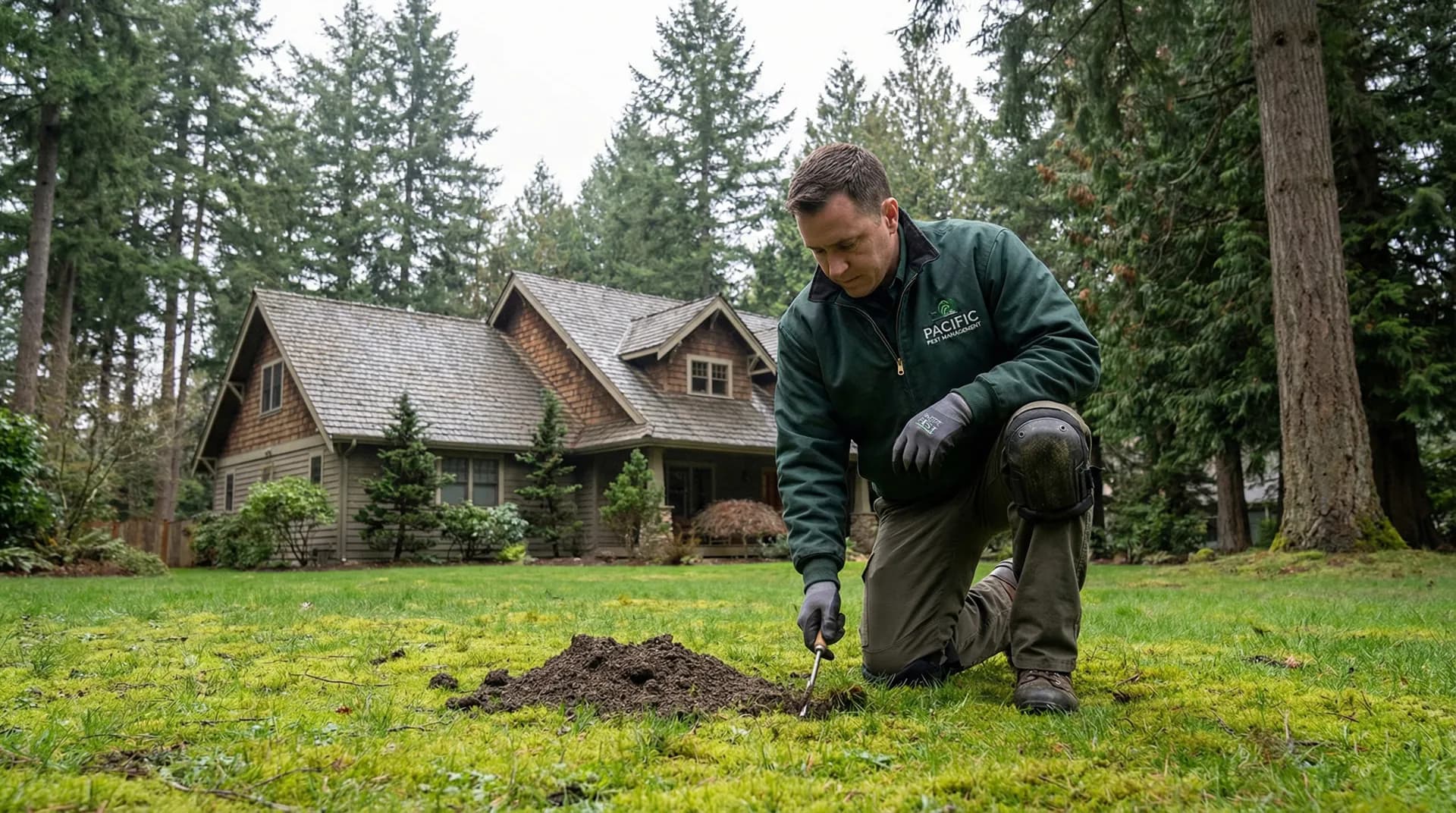
Mole Control in Mill Creek
A 535-acre nature preserve running through the center of a residential community. If you designed a city to produce mole problems, it would look a lot like Mill Creek. The preserve is a permanent, undisturbed mole habitat feeding every adjacent neighborhood. Got Moles has been protecting Mill Creek homes since 2017 with chemical-free methods that keep your investment safe.
Call (253) 750-0211219+ Five-Star Google Reviews·Chemical-Free·Proven Results
Got Moles provides professional mole control in Mill Creek, Washington. Chemical-free methods. Nearly 5,000 clients served since 2017. Call (253) 750-0211 for a free quote.
Mill Creek was designed from the ground up as a master-planned community, and it shows. The 535-acre nature preserve running through the center of town, the golf course, the Town Center with its walkable shops and restaurants, and miles of paved trails connecting neighborhoods — it all works together the way the planners intended. The tree canopy is mature now, the community is established, and Mill Creek consistently ranks among the most desirable places to live in Snohomish County.
Why Moles Thrive in Mill Creek
Mill Creek's nature preserve and golf course create over 700 acres of maintained or undisturbed ground within city limits — all of it prime mole habitat. The preserve's forest floor produces rich, organic soil with dense earthworm populations, while the golf course provides irrigated turf that moles exploit year-round. Alderwood glacial till underlies the entire city, with the hardpan layer trapping moisture in the topsoil. With 38 inches of annual rainfall and a mature tree canopy that shades the ground and reduces evaporation, the soil stays consistently moist across every neighborhood.
Moles in Mill Creek Neighborhoods
Properties directly bordering the nature preserve see the heaviest and most persistent mole activity in Mill Creek. The preserve acts as an inexhaustible mole reservoir — remove one and the next pushes out within weeks. Golf course-adjacent homes in the Country Club neighborhood deal with moles migrating from the irrigated fairways. The Town Center area, where development is more dense, still sees activity in the landscaped common areas and adjacent residential lots. Heron Park, Sunrise, and Gateway neighborhoods along the preserve's eastern edge face consistent pressure. The mature tree canopy throughout Mill Creek drops organic matter every fall, continuously enriching the topsoil and feeding the earthworm populations moles depend on.
How We Help Mill Creek Homeowners
Year-Round Protection
$100/month
Our Total Mole Control Program keeps your yard protected all year. Regular visits, immediate response to new activity, and a report after every check.
Get Year-Round Protection→One-Time Removal
$450 flat rate
A focused, one-month eradication program for properties under 1 acre. 4-5 weekly visits. If we don't catch a mole, you only pay the $150 setup fee.
Get One-Time Removal→Commercial
Custom quote
Annual contracts for property managers, HOAs, sports facilities, and commercial grounds. Professional reporting, reliable scheduling.
Get a Commercial Quote→Local Tip
Mill Creek's trail system connects neighborhoods through the nature preserve, and those trail corridors are mole corridors too. If your backyard meets a trail or preserve boundary, monitor the transition zone where maintained lawn meets natural ground — that's where moles cross over first.
How It Works
Call
Tell us about your property
Inspect
We assess the mole activity
Trap
Professional equipment on active tunnels
Report
Results after every visit
Mill Creek Mole Control FAQ
Every spring my yard fills with new mole mounds even though I had them removed last year. Is this a Mill Creek problem?
It's a Mill Creek pattern. The 535-acre nature preserve is a permanent source of new moles. When you remove the ones in your yard, replacements push out from the preserve within weeks or months. That's why we recommend ongoing monitoring for preserve-adjacent properties rather than one-time treatment.
I live near the golf course. Are the moles coming from there?
The golf course is prime mole habitat — irrigated, well-maintained turf over rich soil. Moles established on the course push into adjacent residential yards looking for territory. Properties in the Country Club area are among our most frequently serviced in Mill Creek.
My HOA manages the common areas. Should they be treating for moles too?
Yes, and many Mill Creek HOAs do. Moles in common areas migrate into individual yards. If your HOA isn't addressing mole activity in shared landscaping, it creates a recolonization source for every adjacent property. We work with several Mill Creek HOAs on community-wide programs.
Will moles damage the tree roots in my yard?
Moles don't eat roots — they eat earthworms and grubs. However, their tunneling can disturb shallow root systems and undermine newly planted trees. Established trees with deep roots are unaffected, but recently planted landscaping is more vulnerable.
We're building a new patio. Should we worry about moles underneath it?
Moles can tunnel under hardscape and emerge on the other side. A patio doesn't stop them — it just redirects tunneling. If you have active moles before construction, clear them first. The compacted base under a properly built patio is less attractive to moles, but they'll work around it.
Ready for Mole-Free Living in Mill Creek?
Call (253) 750-0211 or fill out the form below.
CALL (253) 750-0211Free inspection. No obligation.