
Mole vs Vole vs Gopher: How to Tell What's Destroying Your Lawn
Moles, voles, and gophers all damage lawns — but they're three different animals doing three different things, and the fix depends on which one you've got. Moles are insectivores that tunnel for worms, leaving volcano-shaped mounds and raised ridges. Voles are small rodents that eat plants, leaving narrow runway paths in the grass and chewed bark at the base of shrubs. Gophers are rodents that eat roots from below, leaving crescent-shaped mounds with a visible soil plug. In Western Washington, moles are everywhere, voles are common, and true gophers are rare — the Mazama pocket gopher is the only native species, and it's federally protected.
Why This Matters
If you're standing in your yard looking at damage and trying to figure out what caused it, you already know the animals aren't cooperating. They don't come out when you're watching. You see the aftermath — mounds, tunnels, dead patches, ridges — and have to reverse-engineer the culprit.
Get this wrong and you'll spend money fixing the wrong thing. Grub killer won't touch a mole. Mole traps won't catch a vole. Gopher bait is pointless if what you actually have is a mole. We've seen homeowners in Sammamish and Puyallup spend months treating the wrong animal.
Here's the field guide we use when we show up to a new property — the same one our technicians apply on every inspection.
The One-Look Identification
Moles are insectivores, 6 to 9 inches long, with large paddle-shaped paws turned outward. They eat earthworms and grubs. They push up volcano-shaped mounds with no visible plug and leave raised ridges across the lawn. You almost never see them above ground.
Voles are small rodents, 4 to 6 inches long, with small normal-looking paws. They eat grass, plant roots, and bark. They don't make mounds. They wear narrow runways into the grass. You'll often see them above ground, especially in winter.
Gophers are larger rodents, 6 to 12 inches long, with long claws. They eat roots and tubers from below. Their mounds are crescent or fan-shaped with a visible soil plug on one side. They rarely surface. In Western Washington, they're nearly absent — only one native species exists here, and it's federally protected.
Print that, walk your yard, match the signs. If you still can't tell, the sections below go deeper.
Mole — The Tunneling Insectivore
A mole is not a rodent. It's an insectivore, closer on the family tree to a shrew or a hedgehog than to a mouse. That matters because the entire strategy for dealing with a mole depends on what it's actually doing underground — and it's not after your plants.
What a mole looks like if you ever see one: 6 to 9 inches long, dense and heavier than it looks, velvety dark gray or black fur, massive shovel-shaped front paws turned outward, tiny eyes concealed in the fur, a pink hairless snout covered in microscopic sensors. The Townsend's mole — the biggest species in North America — lives right here in Western Washington.
What a mole eats: earthworms, mostly. Between 55 and 93 percent of a mole's diet is earthworms. A single Townsend's mole eats 60 to 80 percent of its body weight every day. After that, grubs, beetle larvae, centipedes, and slugs. Moles do not eat grass roots. They do not eat bulbs. They do not eat your vegetables.
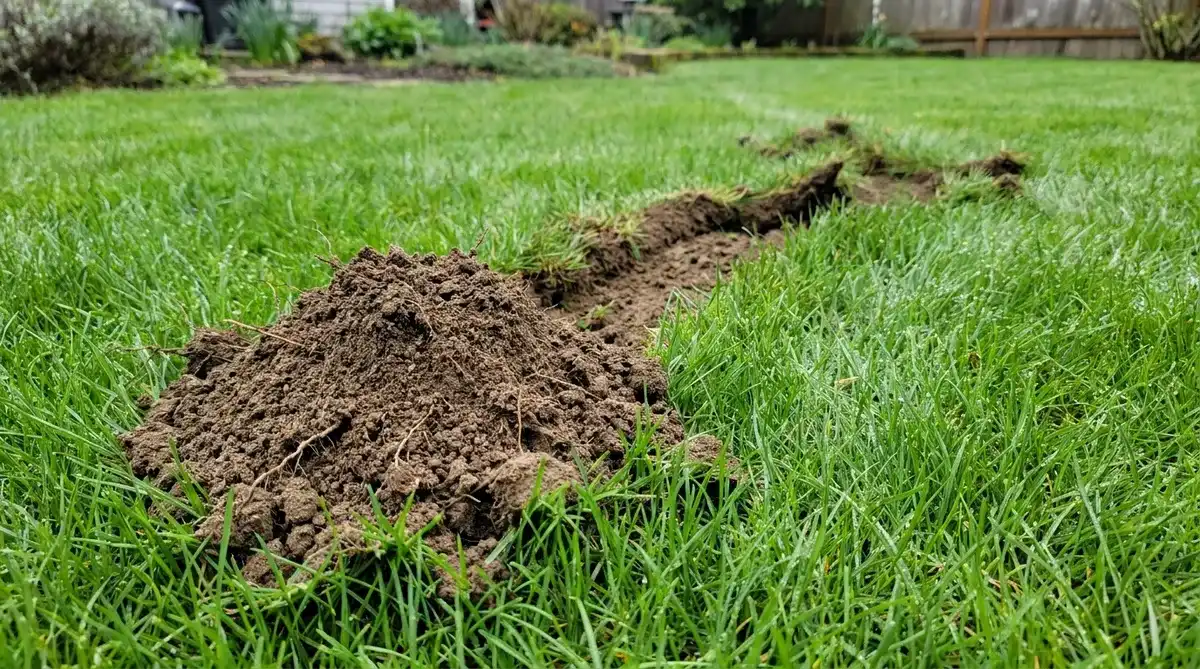
What a mole leaves on your lawn: volcano-shaped mounds where excavated soil has been pushed straight up from deep tunnels, with no visible plug or hole. Raised ridges snaking across the lawn — these are shallow feeding tunnels, 1 to 4 inches below the surface. Soft, spongy patches where tunnels have partly collapsed underfoot.
The big misconception: one mole looks like a dozen. A single Townsend's mole can tunnel up to 18 feet per hour. A yard covered in mounds is almost always one or two moles working overtime — not an infestation.
Vole — The Grass-Eating Rodent
Voles are small rodents — about the size of a large mouse — that eat plants. That one sentence explains most of what you need to know.
What a vole looks like: 4 to 6 inches long, stocky, small ears mostly hidden in fur, short tail, small dark eyes, grayish-brown fur. You'll actually see voles above ground — unlike moles, which almost never surface. In winter, voles are especially active at dawn and dusk.
What a vole eats: grass, grass roots, plant stems, seeds, bark, tubers, and bulbs. This is the rodent homeowners blame the mole for. If your tulip bulbs disappeared, if the bark is stripped off your young fruit tree at the base, if grass is dying in patches from the roots up — you have voles, not moles.
What a vole leaves on your lawn: narrow runways worn into the grass, about 1 to 2 inches wide, often most visible after snowmelt or a rainy spell. No mounds — voles don't build mounds. If you're seeing mounds, it's not a vole. Chewed bark at the base of shrubs and young trees, usually within a few inches of the ground. Small burrow entrances at the edges of the yard, often near dense ground cover.
The common confusion: voles happily use mole tunnels. A mole excavates, a vole moves in, and the vole eats your plants while the mole takes the blame. When you see tunnel damage AND chewed plants, you often have both.
Gopher — Rare in Western Washington
Most identification articles skip this part. Pocket gophers are common in the Midwest, the Plains, and parts of Eastern Washington. But in Western Washington — King, Pierce, and Snohomish counties — gophers are rare.
The only native gopher here is the Mazama pocket gopher. It's federally listed as threatened under the Endangered Species Act and state-listed as threatened by Washington Department of Fish and Wildlife. It's found in a handful of prairie locations in Thurston and Pierce counties, not on typical residential lawns.
If you think you have a gopher in your Bellevue or Sammamish yard, you almost certainly don't.
What a gopher leaves if you actually have one: crescent-shaped or fan-shaped mounds — not round volcanoes like moles — with a visible soil plug on one side. The plug is the tell. A gopher seals its tunnel entrance with a plug of soil. A mole doesn't. Damage to root systems of perennials, shrubs, and young trees from below ground. Plants wilting or dying without any visible above-ground cause.
What to do if you suspect a Mazama pocket gopher: don't trap or poison it. Contact Washington Department of Fish and Wildlife. The species is legally protected, and wildlife agencies can advise.
For the rest of Western Washington, if you're seeing mounds, it's a mole.
Damage Patterns — What Each One Leaves Behind
Here's the field version. Walk your yard with this.
Raised ridges across the lawn, soft underfoot, often with small mounds nearby: mole. The ridges are shallow feeding tunnels. The mounds are dump sites from deeper runs.
A lawn covered in volcano-shaped mounds with no plug, appearing in a cluster or a line: mole. A line of mounds often follows a deep tunnel used as a highway between feeding grounds.
Narrow paths worn into the grass, most visible after snow or rain, no mounds: vole. These are the vole's surface runways.
Bark chewed off the base of a young tree or shrub, especially after winter: vole. Bark is winter food when plants are dormant.
Dying plants, wilting perennials, or tulip bulbs that never came up: likely vole. Possibly gopher if you're somewhere gophers actually exist, but in Western Washington, bet on vole.
Both ridges AND chewed plants: both animals, often sharing tunnels. This is common.
Why Moles and Voles Often Show Up Together
A mole digs the tunnels. A vole uses them.
Moles are territorial. A healthy lawn typically hosts one or two moles defending a feeding territory. Voles, on the other hand, are social and prolific. A vole population can reach a dozen or more on a single property.
When the mole excavates a fresh tunnel, the vole moves in. The vole gets access to grass roots and stems with less digging effort. The mole keeps working for worms, doesn't care about the vole, and the homeowner watches the lawn fall apart.
This is why "get rid of moles and voles leave too" is wrong. Removing the mole doesn't remove the vole. They're separate problems that require separate fixes.
What to Do Based on What You've Got
Just moles: professional trapping is the only method consistently shown to work — see How to Get Rid of Moles in Your Yard for the full playbook. Repellents, sonic spikes, and home remedies have little to no scientific support. Washington State University's Extension Service is explicit about this: castor oil and similar repellents are "not consistently effective."
Just voles: snap traps baited with peanut butter, placed along active runways, are the most reliable DIY option. Keep ground cover and mulch pulled back from tree trunks. Remove dense winter weed cover that voles use as protection. Voles breed fast, so act quickly.
Both moles and voles: address the mole first. Once the mole is removed, the vole loses its tunnel system and becomes easier to manage. This is the order we recommend on every property where both are present.
Something that looks like a gopher: in Western Washington, almost certainly a mole. If you're near protected prairie habitat in Thurston County and see crescent-shaped mounds with plugs, call Washington Department of Fish and Wildlife before doing anything.
Western Washington Specifics
Three mole species live in the area we serve — Townsend's mole (the big one, on open lawns), Pacific Coast mole (smaller, in brushier properties), and the shrew mole (tiny, active above ground, mostly in wooded edges). Any of them produces the damage homeowners notice, though Townsend's is the one most likely to chew up a suburban lawn.
Three vole species are common locally: the meadow vole, Townsend's vole, and creeping vole. All three eat plants. All three use existing tunnels. All three breed year-round in the mild Western Washington climate.
True pocket gophers — the kind that build crescent mounds with plugs — are not a concern on typical residential properties west of the Cascades. Western Washington's climate, soil, and protected habitat structure favor moles and voles, not gophers.
Got Moles serves Pierce, King, and Snohomish Counties. We specialize in one animal — moles — because that's where the real work is in this region. For vole issues, we can refer homeowners to general pest control operators who handle rodents. We don't do gopher work because, in our service area, there isn't any to do.
The Bottom Line
If you're in Seattle, Bellevue, Sammamish, Tacoma, Puyallup, or anywhere across the Puget Sound lowlands:
Mounds without plugs plus raised ridges means mole. Narrow runways plus chewed plants means vole. Both kinds of damage means both animals, often sharing tunnels. Crescent mounds with plugs is unlikely here, and possibly a protected species — call Washington Department of Fish and Wildlife.
Match the damage to the right animal, then match the fix to the damage. That's how you save a month of frustration and a hundred dollars in products that don't do anything.
If it's a mole — that's what we do, and the only thing we do. Our One-Time Mole Removal and Total Mole Control Program are built for Western Washington properties specifically. If you're not sure what you've got, send us a photo via the contact page and we'll tell you.
Local Mole Control Across King, Pierce, and Snohomish
Got Moles is a mole-only specialist covering King, Pierce, Snohomish, and Thurston counties — the heart of Western Washington. We've trapped moles on nearly 5,000 properties since 2017, chemical-free, with 219+ five-star Google reviews across three local offices.
Local service areas include mole control in Kent, Enumclaw mole removal, and mole control near Burien — plus every neighboring city on our service areas map.
If moles have moved into your yard, the fastest path to a solved problem is our One-Time Mole Removal or a direct conversation: call (253) 750-0211 or use our contact form.
Frequently Asked Questions
How do I tell if I have moles or voles?
Moles leave volcano-shaped mounds and raised ridges across the lawn but don't eat plants. Voles leave narrow runway paths worn into the grass, chewed bark on young trees, and damaged roots — but no mounds. If you see mounds, it's a mole. If you see chewed plants and paths but no mounds, it's a vole. Both at once is common because voles use mole tunnels.
Are gophers common in Western Washington?
No. The only native gopher species west of the Cascades is the Mazama pocket gopher, which is federally threatened and state-listed as threatened. It lives in a few protected prairie locations in Thurston and Pierce counties, not on residential lawns. If you think you have a gopher in King, Pierce, or Snohomish County, it's almost certainly a mole.
Why are there mounds in my yard even though I don't have moles?
If there are mounds, you have moles. A single Townsend's mole can tunnel up to 18 feet per hour and create dozens of mounds across a yard — making one animal look like an infestation. Mounds without visible plugs are nearly always moles. Mounds with plugs would suggest a gopher, which is rare here.
Do moles eat grass roots and plants?
No. Moles are insectivores. They eat earthworms, grubs, and insects — 55 to 93 percent of their diet is earthworms. If plant roots or bulbs are being eaten in a yard with mole tunnels, the culprit is almost always voles using the mole tunnels for access. That's one of the most common misidentifications we see.
Can I use the same traps for moles and voles?
No. Moles require subterranean traps placed in active tunnels at the correct depth and angle — a task that requires field experience to get right consistently. Voles are caught with small snap traps baited with peanut butter, placed along surface runways. The equipment, placement method, and technique are completely different.
Related Services & Resources
Our Services
- Total Mole Control Program — $100/month year-round protection
- One-Time Mole Removal — $450 flat rate with guarantee
- Commercial Mole Control — annual contracts for property managers
Learn More
- How It Works — our 4-step process
- FAQ — 26 expert answers
- Service Areas — 77 cities across Western Washington
Spencer Hill
Spencer Hill is a US Army veteran and founder of Got Moles, a mole control specialist serving Western Washington. He has helped over 5,000 homeowners reclaim their yards using chemical-free, professional trapping methods.
Ready to Reclaim Your Yard?
Call (253) 750-0211 — we serve all of Western Washington.
CALL (253) 750-0211Free inspection. No obligation.