
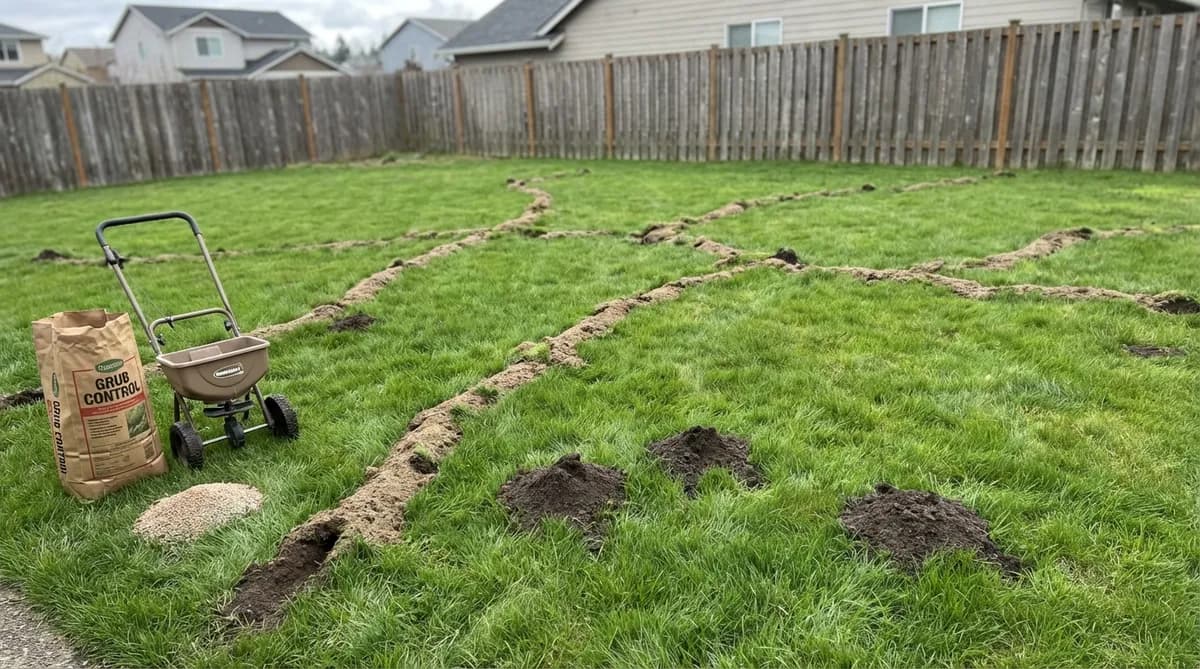
Does Grub Control Actually Get Rid of Moles? The Truth
No. Grub control does not get rid of moles. Moles eat earthworms as their primary food source — earthworms make up 55 to 93 percent of a mole's diet. Grubs are a small supplement, not the main course. Killing grubs removes a fraction of the food supply while leaving the earthworm buffet completely intact. Your moles aren't going anywhere.
Want moles handled for good, not just for now? Our recurring mole protection keeps your Western Washington yard covered with regular visits and a written report after every check.
The Myth
The idea sounds perfectly reasonable: moles eat grubs, so if you eliminate the grubs, the moles will starve and leave. Hardware stores sell grub killer right next to mole repellents. Lawn care companies sometimes recommend grub treatments as part of a mole control strategy. The internet is full of advice saying "get rid of the grubs and the moles will follow."
The problem isn't the logic. The problem is that it's built on a wrong assumption about what moles actually eat.
Why People Believe It
Moles do eat grubs. That part is true. If you dig up a section of lawn with mole activity, you'll likely find both earthworms and grubs in the same soil. It's natural to assume both are equally important to the mole's diet.
Grub damage is also visible and well-known. Japanese beetle grubs, European chafer grubs, and crane fly larvae all damage lawns by eating grass roots. When a homeowner sees grub damage and mole damage in the same yard, the connection seems obvious. Kill the grubs, fix both problems at once.
And grub treatments work — at killing grubs. Products containing imidacloprid or chlorantraniliprole reliably reduce grub populations. The treatment does what it says. The mistake is assuming that fewer grubs means fewer moles.
What Moles Actually Eat
Earthworms dominate the mole diet. The numbers aren't close. Earthworms make up 55-93% of diet — the primary food and the reason moles are in your yard. Grubs and beetle larvae are just 5-20%, a supplement only. Other insects like centipedes and millipedes are 2-10%, eaten opportunistically.
A Townsend's mole — the primary species in Western Washington, including Seattle lawns — eats 60 to 80 percent of its body weight every single day. That translates to roughly 50 pounds of food per year, the vast majority of it earthworms.
The earthworm population in a healthy lawn is enormous. A single acre of good soil can support over 1 million earthworms. Killing every grub on your property barely registers as a change in the overall food supply available to the mole.
Why Grub Treatment Can Actually Make Things Worse
There's an irony most people miss. Applying grub killer can harm the beneficial organisms in your soil — including the earthworms you want to keep. Some broad-spectrum insecticides reduce earthworm populations along with grubs.
But earthworms recover. They breed faster than grubs in most conditions. Within a season, the earthworm population bounces back, and the mole's primary food source is fully restored.
You've also introduced chemicals into the soil that your pets and children walk on. Got Moles sees this frequently — homeowners who've applied multiple rounds of grub treatment, sometimes combined with castor oil and sonic stakes, and the moles are still there. The yard has been treated with three different products, and the mole is tunneling through all of it.
What Actually Removes Moles
The only method with consistent, documented results for mole removal is physical trapping. Not grub control. Not repellents. Not sonic devices.
Professional trapping works because it addresses the mole directly rather than trying to manipulate the environment. A mole that's been living in your yard for months has an established tunnel network, knows where the food is, and isn't going to leave because one part of its diet got slightly smaller. We see the same pattern on every professional mole trapping in Tacoma job we run — established moles outlast every grub product on the shelf.
Got Moles uses chemical-free trapping methods exclusively via One-Time Mole Removal and the Total Mole Control Program. No grub treatments. No poisons. No castor oil. Just targeted trapping backed by over 15 years of experience and nearly 5,000 properties served across Western Washington. Full diet breakdown in What Do Moles Eat?.
Why Washington Soil Makes Grub Control Particularly Pointless
The grub-control myth fails everywhere, but it fails especially fast in Western Washington because of local soil biology. Worth understanding if you've heard the pitch from a lawn-care company.
Earthworm populations in Puget Lowland soils — from Olympia and the South Sound up through King and Snohomish — are among the densest in North America. The combination of mild year-round temperatures, consistent moisture, and rich organic matter from decomposing Douglas fir and broadleaf litter supports earthworm densities of 100-500 individuals per square meter in healthy residential lawns. That's the food source moles are there for.
Grubs (white grub, European chafer, Japanese beetle larvae) exist in PNW lawns but at much lower densities — typically 5-30 per square meter even in heavily-infested areas. A grub-control treatment that kills all grubs reduces the available mole food by maybe 5-20%. The earthworm buffet is untouched.
Additionally, PNW rainfall affects grub-control chemistry. Many imidacloprid-based grub killers require 2-3 weeks of consistent soil moisture for effective uptake into grass roots where grubs feed. Heavy winter rain can leach the chemical below the effective zone before it works. Summer dry spells can concentrate the active ingredient and damage beneficial organisms. Neither scenario displaces the mole.
The lawn-care companies selling grub-plus-mole combo treatments aren't lying — their grub products do kill grubs. They're just treating a problem that isn't the mole problem. If you have confirmed grub damage to your lawn (visible brown patches, birds digging for grubs), grub control makes sense for the grub problem. For your mole problem, One-Time Mole Removal is the direct solution.
Serving Your Neighborhood
Got Moles is a mole-only specialist covering King, Pierce, Snohomish, and Thurston counties — the heart of Western Washington. We've trapped moles on nearly 5,000 properties since 2017, chemical-free, with 219+ five-star Google reviews across three local offices.
Local service areas include mole control in Tacoma, Sammamish mole removal, and mole control near Issaquah — plus every neighboring city on our service areas map.
If moles have moved into your yard, the fastest path to a solved problem is our Commercial Mole Control or a direct conversation: call (253) 750-0211 or use our contact form.
Get your Mole Risk Score in 2 minutes.
Free, personalized report on what is drawing moles to your yard — and how to stop them coming back.
Find my risk scoreFree. No call required. Takes about 2 minutes.
Frequently Asked Questions
If I kill all the grubs, will moles eventually leave?
No. Earthworms make up 55 to 93 percent of a mole's diet. Even if you eliminated every grub on your property, the mole still has an abundant food supply in the earthworm population. A healthy lawn with good soil will always have earthworms.
Do moles eat grubs at all?
Yes. Grubs, beetle larvae, and other soil insects are part of a mole's diet — roughly 5 to 20 percent. Moles eat them opportunistically while tunneling. But they're a supplement, not the main food source. Earthworms are the primary target.
Is grub treatment safe for pets?
Most modern grub treatments are considered low-toxicity for mammals when applied according to label directions. However, they do introduce chemicals into the soil. Got Moles uses only chemical-free trapping methods — zero products applied to your lawn.
What's the most cost-effective way to deal with moles?
Professional trapping. A grub treatment costs $30 to $80 per application and doesn't remove moles. Got Moles' one-time removal service is $450 flat rate (residential under 1 acre), includes 4-5 weekly visits, and comes with a guarantee.
Can I have grub treatment AND mole trapping?
Yes. If you have both a grub problem and a mole problem, you can treat grubs for the grub damage and hire a mole specialist for the moles. They're separate solutions for separate problems. The grub treatment won't help with the moles.
Related Services & Resources
Our Services
- Total Mole Control Program — $100/month year-round protection
- One-Time Mole Removal — $450 flat rate with guarantee
- Commercial Mole Control — annual contracts for property managers
Learn More
- How It Works — our 4-step process
- FAQ — 26 expert answers
- Service Areas — 77 cities across Western Washington
Spencer Hill is a US Army veteran and founder of Got Moles, a mole control specialist serving Western Washington. He has helped over 5,000 homeowners reclaim their yards using chemical-free, professional trapping methods.
Ready to Reclaim Your Yard?
Call (253) 750-0211 — we serve all of Western Washington.
CALL (253) 750-0211Free. No obligation.
Or get your free 2-minute Mole Risk Score for a personalized report on why moles target your yard.