
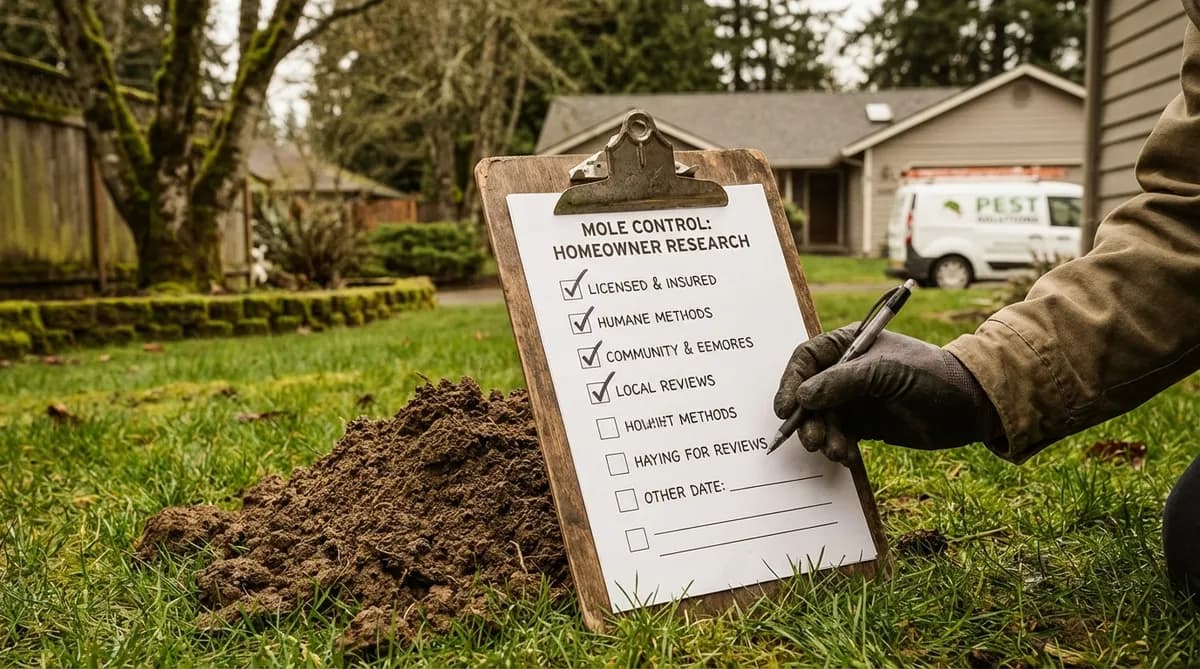
How to Choose a Mole Control Company: 7 Things to Ask
When hiring a mole control company in Washington, ask about their specialization (moles only vs general pest), pricing model (flat rate vs per-mole), guarantee terms, visit frequency, whether they provide written reports, and how long they've been in business. A mole specialist with transparent pricing and a results guarantee will almost always outperform a general pest company that treats moles as a side service.
Got active moles right now? Our one-time removal service clears the moles in your yard over 4–5 weekly visits — and if we don't catch one, you pay only the setup fee.
Why This Matters
You've got moles. You want them gone. You search online and find half a dozen companies that say they can help.
How do you pick the right one? Because the wrong choice means spending money, waiting weeks, and ending up right back where you started — with moles still in your yard and less patience than before.
Here are the seven questions that separate a good mole control company from a waste of your time.
1. Do They Specialize in Moles?
This is the single most important question. A company that handles ants, spiders, termites, rats, AND moles is spreading its attention across dozens of pest types. Their technician did a spider job this morning and a mole job this afternoon. That's not specialization — that's rotation.
A mole-only company has spent years perfecting one thing. Their technicians trap moles every day. They know Townsend's mole behavior, Western Washington soil patterns, and seasonal activity cycles inside out — and they actually cover the towns and neighborhoods you live in, whether that's Seattle mole control or a smaller community further out.
What to ask: "Is mole control all you do, or is it part of a wider pest control service?"
2. How Do They Price the Job?
There are two common pricing models, and they produce very different final bills:
Per-mole pricing: You pay a setup fee ($100-$150) plus a fee for each mole caught ($60-$80 each). Sounds cheap — until you find out you have five moles. A five-mole job at $130 + $80/mole = $530.
Flat-rate pricing: You pay a fixed price regardless of how many moles are on your property. Got Moles' One-Time Mole Removal is $450 flat rate for properties under 1 acre. One mole or six — same price.
The per-mole model also creates a bad incentive. The more moles on your property, the more the company earns. A flat rate means the company's incentive is to resolve the problem as quickly as possible.
What to ask: "Is your pricing per mole or flat rate? What's my maximum possible cost?"
3. Is There a Guarantee?
A company that guarantees results is putting their reputation on the line. A company that doesn't is asking you to take the risk.
Got Moles collects a $150 setup fee upfront. If we don't catch a mole during the service period, you pay only the setup fee. The remaining $300 isn't charged. That's not a promotional offer — it's how we've always operated.
What to ask: "What happens if you don't catch any moles? Do I still pay the full price?"
4. How Many Visits Are Included?
Mole control isn't a one-visit job. Moles respond to trapping by changing their behavior — shifting routes, digging deeper, moving to different parts of the yard. Effective control requires multiple visits with adjustments each time.
Got Moles includes 4-5 weekly visits in every one-time removal program. Each visit builds on the last — we learn how the moles on your property behave and adjust accordingly.
A company that offers a single visit and hopes for the best is guessing. A company that returns weekly and adapts is working.
What to ask: "How many visits are included? Do you adjust your approach between visits?"
5. Do They Provide Written Reports?
After a visit, you should know exactly what happened — not just "we came out and checked." A written report tells you: what was inspected, what activity was found, what was done, and what happens next.
Got Moles provides a written report after every single visit. You're never left wondering what's going on in your yard.
Companies that don't report are asking you to trust them without evidence. That's not how a professional relationship works.
What to ask: "Will I get a report after every visit? What does it include?"
6. How Long Have They Been Doing This?
Mole control is a craft. It takes years to develop the instinct for reading tunnel patterns, predicting mole behavior, and placing equipment in exactly the right spot. A company with a few months of experience is still learning — on your property.
Got Moles has served nearly 5,000 clients since 2017 across the communities we serve throughout Western Washington. Spencer Hill has over 15 years of personal mole trapping experience. That depth of knowledge is what makes the difference between a first-visit catch and weeks of empty traps.
What to ask: "How long have you been doing mole control specifically? How many properties have you serviced?"
7. Do They Offer Ongoing Protection?
Here's what most companies won't tell you: moles come back. A cleared yard is still attractive territory. New moles move in from neighboring properties, parks, and green corridors — often within a few months.
A one-time removal solves today's problem. Ongoing protection prevents tomorrow's. Got Moles' Total Mole Control Program ($100/month) provides year-round monitoring, immediate response to new mole activity, and a written report after every visit.
Not every company offers this. The ones that do are thinking about your long-term outcome, not just the next invoice.
What to ask: "What happens after the moles are removed? Do you offer ongoing protection?"
Red Flags to Watch For When Getting Quotes in Western Washington
Beyond the seven questions above, a few specific red flags come up repeatedly when Western Washington homeowners get competing quotes. Worth knowing before you commit.
Mole poison as the primary method. Any company pushing poison baits (Talpirid, bait worms, granules) as their main approach. Poison is less effective than trapping, creates secondary-poisoning risk for pets and local wildlife, and leaves residues in your soil. A reputable mole specialist uses physical trapping; poison is a red flag regardless of who's offering it.
Subcontracted technicians. Some pest companies book the sale in-house but dispatch a subcontractor you've never met to do the actual work. Quality varies dramatically. Ask directly: will the person who shows up be an employee of the company I'm paying, or a subcontractor?
Vague scope or 'we'll see what we find.' Quotes that don't specify included visit counts, equipment, cleanup, or guarantee terms. A professional quote should spell out exactly what you're buying.
No written report protocol. 'We'll let you know how it went' isn't a report. Reputable services document each visit in writing so you know what was done. If a company won't commit to written reports, their accountability is lower than it should be.
Pressure tactics or scarcity claims. 'Book today or prices go up next week' on a mole removal quote is unprofessional. Reputable Western Washington services have stable pricing and don't need urgency framing. If you're pushed to decide immediately, walk away and call someone else.
No local physical address. Some mole-control businesses are pure-online with no actual local presence. They may subcontract everything locally. Prefer companies with a documented address and track record in your actual region — Got Moles has served King, Pierce, Snohomish, and Thurston Counties since 2017 from Enumclaw-based operations, with 90+ Western Washington service areas listed openly on our site.
Missing Google presence. A mole control company with fewer than 20 Google reviews, or reviews concentrated in a short window (suggesting review-buying), is harder to verify. Reputable services in Western Washington have 100+ reviews accumulated over multiple years. Got Moles has 219+ five-star Google reviews across three locations.
Got Moles Serves Western Washington
Got Moles is a mole-only specialist covering King, Pierce, Snohomish, and Thurston counties — the heart of Western Washington. We've trapped moles on nearly 5,000 properties since 2017, chemical-free, with 219+ five-star Google reviews across three local offices.
Local service areas include mole control in Seattle, Bellevue mole removal, and mole control near Tacoma — plus every neighboring city on our service areas map.
If moles have moved into your yard, the fastest path to a solved problem is our Total Mole Control Program or a direct conversation: call (253) 750-0211 or use our contact form.
Get your Mole Risk Score in 2 minutes.
Free, personalized report on what is drawing moles to your yard — and how to stop them coming back.
Find my risk scoreFree. No call required. Takes about 2 minutes.
Frequently Asked Questions
What's the difference between a mole specialist and a general pest company?
A mole specialist does one thing — mole control. Every technician, every method, every visit is focused on moles. A general pest company rotates technicians across dozens of pest types. The specialist will almost always produce better results, faster, with fewer callbacks.
Should I get multiple quotes?
Getting two or three quotes is reasonable. Compare what's included, not just the headline price. A $290 per-mole quote can end up costing more than a $450 flat rate if you have multiple moles. Ask about visits, guarantees, and reports — not just the number.
How do I know if a company is any good?
Google reviews are the best signal. Look for volume (more reviews = more experience), consistency (all 5-star vs mixed), and specificity (reviews that mention actual results, not just "they were nice"). Got Moles has 219+ five-star Google reviews across three locations.
Related Services & Resources
Our Services
- Total Mole Control Program — $100/month year-round protection
- One-Time Mole Removal — $450 flat rate with guarantee
- Commercial Mole Control — annual contracts for property managers
Learn More
- How It Works — our 4-step process
- FAQ — 26 expert answers
- Service Areas — 77 cities across Western Washington
Spencer Hill is a US Army veteran and founder of Got Moles, a mole control specialist serving Western Washington. He has helped over 5,000 homeowners reclaim their yards using chemical-free, professional trapping methods.
Ready to Reclaim Your Yard?
Call (253) 750-0211 — we serve all of Western Washington.
CALL (253) 750-0211Free. No obligation.
Or get your free 2-minute Mole Risk Score for a personalized report on why moles target your yard.