
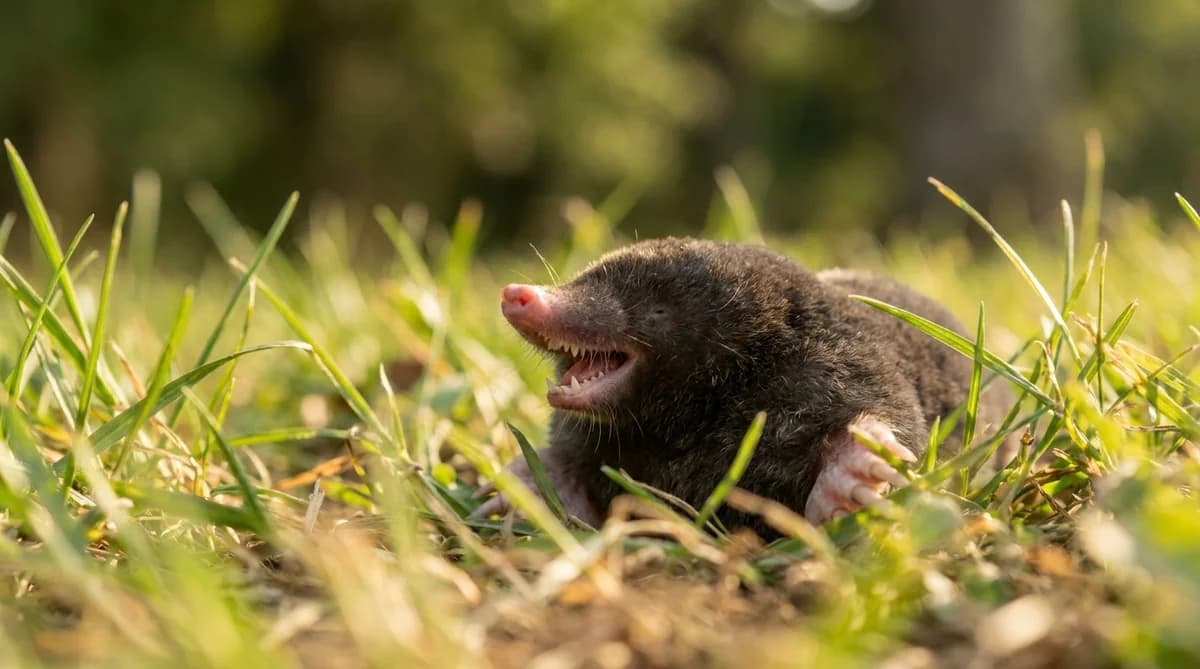
Do Moles Bite?
Moles can bite, but they almost never do. Their primary response to a threat is to dig or flee — biting is a last-resort defense that really only happens when a mole is physically restrained by a human hand. Mole bites don't carry rabies, they're not typically dangerous, and they're almost always avoided by not trying to catch a mole yourself.
Want moles handled for good, not just for now? Our year-round mole defense keeps your Western Washington yard covered with regular visits and a written report after every check.
Do Moles Bite Humans?
Yes — but it's rare enough that in 15 years of professional trapping across Western Washington, the bites we see are almost always on someone who picked a mole up with their bare hands.
Moles are solitary animals that spend most of their lives underground. They aren't territorial toward people and they aren't aggressive by nature. When a mole senses a human nearby — footsteps on a lawn, pressure on a tunnel ceiling — its first instinct is to dig deeper or retreat through an existing tunnel. A Townsend's mole, the largest species in the Pacific Northwest, weighs 4 to 5 ounces and measures 8 to 9 inches. It has no interest in confronting a person.
Bites happen when that retreat option is taken away. A mole that's been grabbed, stepped on accidentally, cornered in a half-filled tunnel by a pet, or handled without gloves will absolutely bite — the same way any cornered wild animal defends itself.
Why Do Moles Have Sharp Teeth?
For earthworms, not for fights.
A mole's diet is 55 to 93 percent earthworms, with the rest made up of grubs, centipede larvae, and small soil invertebrates. Those worms are muscular, slick, and constantly trying to wriggle free. A mole's teeth evolved for the specific job of hooking into worm flesh and keeping hold of it long enough to swallow.
The teeth are small — a full set in a Townsend's mole is about the size of a grain of rice — but they are sharp and pointed. They aren't defensive weapons. A mole doesn't go on offense against predators or people; it just moves through the soil faster than any of them. The teeth exist because worms are harder to catch than they look.
Are Mole Bites Dangerous?
Almost never.
Moles don't transmit rabies (there are no documented cases in North America), don't directly transmit Lyme disease (ticks do, and a tick from a mole is the risk — not the bite itself), and the puncture itself is small. A mole bite typically breaks the skin but doesn't cause tissue damage the way a dog or raccoon bite would.
Standard wound care handles it:
- Wash the wound thoroughly with soap and water. - Apply an antiseptic. - Cover with a bandage. - Watch for the normal infection signs — redness spreading outward, persistent swelling, pus, fever — and see a doctor if any appear.
If you have any concern about tetanus status, a doctor visit for a booster is reasonable. Beyond that, a mole bite is a minor wound, not an emergency.
How Do You Avoid Getting Bitten by a Mole?
Don't pick moles up. That's the whole rule.
We see three scenarios that put people at risk in Western Washington:
The curious homeowner. A mole turns up dead or injured on a lawn — usually after a cat has gotten to it — and someone picks it up bare-handed to move it. If the mole is still alive, even barely, it will bite.
The DIY trapper. Someone attempts to trap a mole without professional equipment and ends up trying to remove an injured but still-living animal by hand. Traps designed for the job work instantly; half-measures don't.
Pets and kids. Dogs especially will dig a mole out of a shallow tunnel and carry it in their mouths. We've seen a few cases where a child then picks up what the dog brought home. This is the one that matters most — keep kids and pets away from any mole a pet has handled until you're sure it's dead.
The professional approach is different. We don't handle moles with bare hands, we don't remove them while they're alive, and we don't set traps that leave a mole injured on the surface. See One-Time Mole Removal or the Total Mole Control Program for how we actually do the job.
Why Isn’t Professional Mole Control a Hands-On Activity?
Effective mole removal happens below ground, without anyone touching a live mole.
Professional methods — the kind Got Moles has used across nearly 5,000 Western Washington properties — are set inside active tunnels. They deliver an instant, humane result and the mole is already gone when equipment is retrieved. There's no holding, no wrestling, no bare-hand handling.
Chemical-free trapping is also what keeps the method safe for pets and kids on the lawn. No poisons to worry about, no bait that a dog might dig up, no residue on the grass. If you're seeing fresh mounds and wondering whether to try yourself or call someone, it's not a safety decision between two comparable options — one path involves potentially picking up a live wild animal and the other doesn't. For a broader take on what actually works, see How to Get Rid of Moles in Your Yard.
Bite Risk Across Washington Mole Species
Three mole species live in Washington State, and the bite risk is effectively the same across all three: near-zero if you leave them alone, near-certain if you pick one up.
Townsend's mole is the species you'll almost always find on a damaged residential lawn in Seattle, Bellevue, Tacoma, Sammamish, or anywhere in the Puget Lowlands. It's the largest North American mole and has the most substantial teeth. In practical terms, that just means a Townsend's mole bite will draw blood faster than a smaller species. Same underlying behavior though — retreat-first, bite only when restrained.
Pacific Coast mole is smaller and lives in mixed or drier habitats — more common on properties backing onto woods or undeveloped land, particularly around Enumclaw, Buckley, and the forested edges of the service area. Teeth are proportionally smaller. Bite scenarios are the same: handle a live one and it will defend itself.
Shrew mole is the oddball. Under an ounce, forest-floor dweller, unusually willing to forage above ground. Because shrew moles surface more often than their cousins, curious people and pets encounter them more often — but a shrew mole bite from that tiny mouth barely punctures skin. Still, don't pick any of them up. Full species breakdown at What Species of Moles Live in Washington State?.
Across all three, the safety message is identical: moles don't hunt humans, don't defend territory against humans, and don't want to be near humans. Almost every bite we've seen or heard about in 7+ years of Got Moles service calls traces back to someone handling a mole that was already injured or trapped somewhere it couldn't escape from.
Got Moles Serves Western Washington
Got Moles is a mole-only specialist covering King, Pierce, Snohomish, and Thurston counties — the heart of Western Washington. We've trapped moles on nearly 5,000 properties since 2017, chemical-free, with 219+ five-star Google reviews across three local offices.
Local service areas include mole control in Seattle, Bellevue mole removal, and mole control near Tacoma — plus every neighboring city on our service areas map.
If moles have moved into your yard, the fastest path to a solved problem is our One-Time Mole Removal or a direct conversation: call (253) 750-0211 or use our contact form.
What is drawing moles to your yard?
Free 2-minute Mole Risk Score with a personalized report on why moles keep coming back — and the chemical-free steps to stop them.
Find my risk scoreFree. No call required. Takes about 2 minutes.
Frequently Asked Questions
Can a dog get a disease from a mole it killed?
The mole itself is a very low disease risk, but the fleas, ticks, and mites a mole might carry are a higher one. If your dog has picked up or killed a mole, check them for ticks in the following days and keep up with standard flea and tick prevention. Wash your dog's mouth-area fur if possible. Most dogs who catch a mole are completely fine — just stay attentive to unusual behavior or skin irritation for a week or so.
Do I need a rabies shot if a mole bit me?
Almost certainly not. Moles are not considered a rabies risk in North America — there are no documented cases of mole-to-human rabies transmission. Rabies exposures typically involve bats, skunks, foxes, raccoons, or unvaccinated dogs. That said, any wild animal bite warrants a quick call to your doctor so they can assess your specific situation and tetanus status.
What if the mole is already injured and I want to help it?
The kindest thing you can do is leave it alone and call a wildlife rehabber or a professional. An injured wild mole brought indoors or handled is under extreme stress and will bite. If the mole has been clearly mortally wounded (typically by a pet), the humane answer is usually to let nature finish its course rather than intervene — most injured moles don't survive handling.
My child was bitten by a mole — what should I do?
Wash the wound thoroughly with soap and water, apply an antiseptic, bandage it, and call your pediatrician. They may recommend a tetanus booster depending on vaccination history. The bite itself is low-risk for disease, but medical consultation is always the right move for a child's animal bite. Also: how did the bite happen? If a pet brought the mole to the child, that's a conversation about pet supervision around wildlife going forward.
Do mole traps ever catch a mole alive?
Professional traps designed for moles work instantly — they're engineered specifically to avoid the live-capture scenario that leads to bites. Amateur traps and some store-bought products can leave a mole partly injured, which is one of the reasons DIY trapping leads to more bites than professional work. Proper equipment, correctly placed, eliminates the handling-a-live-mole problem entirely.
Related Services & Resources
Our Services
- Total Mole Control Program — $100/month year-round protection
- One-Time Mole Removal — $450 flat rate with guarantee
- Commercial Mole Control — annual contracts for property managers
Learn More
- How It Works — our 4-step process
- FAQ — 26 expert answers
- Service Areas — 77 cities across Western Washington
Spencer Hill is a US Army veteran and founder of Got Moles, a mole control specialist serving Western Washington. He has helped over 5,000 homeowners reclaim their yards using chemical-free, professional trapping methods.
Ready to Reclaim Your Yard?
Call (253) 750-0211 — we serve all of Western Washington.
CALL (253) 750-0211Free. No obligation.
Or get your free 2-minute Mole Risk Score for a personalized report on why moles target your yard.