
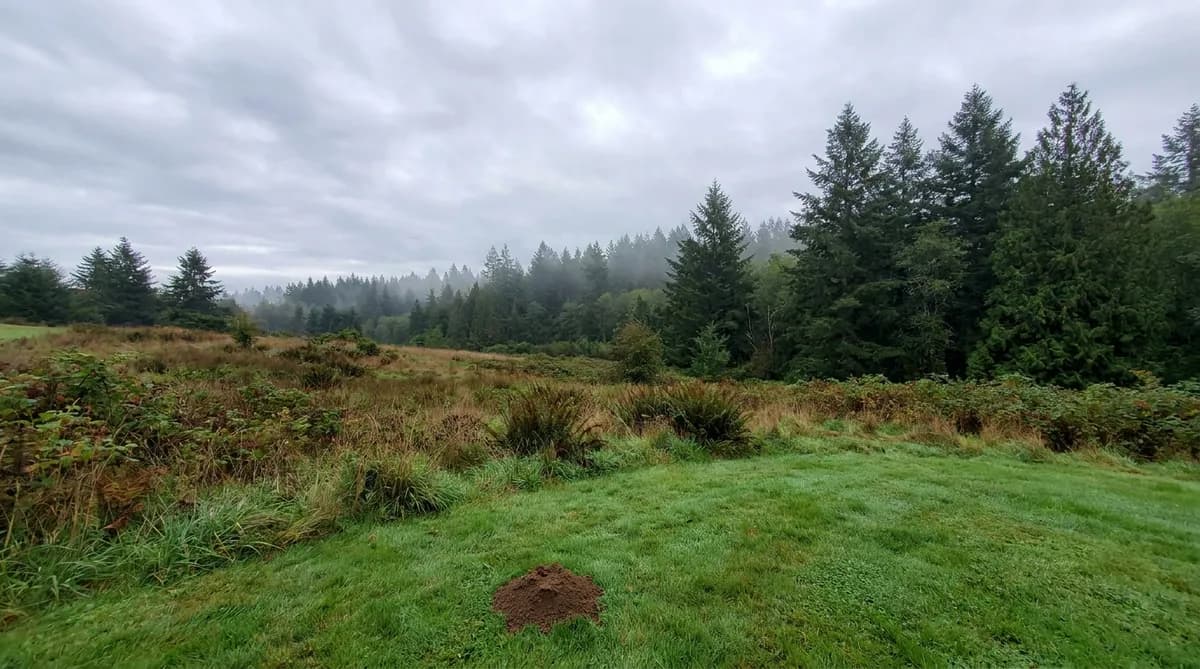
The 3 Mole Species in Washington State: A Homeowner's Identification Guide
Three mole species live in Washington State: the Townsend's mole (the biggest and most common), the Pacific Coast mole (smaller, broader habitat), and the shrew mole (tiny, often above ground). The Townsend's mole — the largest mole in North America — is the species most Western Washington homeowners are dealing with. All three live west of the Cascades in the wet Pacific Northwest lowlands. None live east of the Cascades in any numbers. Knowing which species is in your yard doesn't change the fix, but it explains the damage pattern, the activity timing, and why the mounds look the way they do.
Want moles handled for good, not just for now? Our Total Mole Control Program keeps your Western Washington yard covered with regular visits and a written report after every check.
Why It's Worth Knowing Which Species You Have
Every mole looks similar at a glance — small, velvet-dark, paddle-pawed, underground. But the three species in Washington behave differently enough that identification helps you predict what's going on.
The Townsend's mole digs deeper tunnels and pushes up bigger mounds. The Pacific Coast mole works shallower ground. The shrew mole is the odd one out — smaller, faster, and more likely to turn up above ground.
We've trapped all three across the service area. Most of what homeowners see is the Townsend's mole. But on brushier properties, wooded edges, and stream-bank lots, the other two show up often enough that it's worth being able to tell them apart.
Here's the field guide.
Got Moles by the Numbers
Three-species pattern recognition from one of Western Washington's most established mole-control specialists. The species ratios below come from direct trap-by-trap field counts.
5,000+ properties — inspected and trapped across King, Pierce, Snohomish, and Thurston counties since 2017.
219+ five-star Google reviews — across three Google Business Profile locations.
One species focus — mole control only. Eight years of catching and identifying every animal at the trap.
Zero chemicals — physical traps placed in active tunnels. Safe for pets, children, and pollinators.
Species 1: Townsend's Mole (Scapanus townsendii)
The most common species in Western Washington and the largest mole in North America.
Size: 8 to 9 inches long, 4 to 5 ounces (about 130 to 150 grams). Dense and compact — heavier than its size suggests. If you dig one up, it feels like holding a shot-put with fur.
Appearance: velvety dark gray to black fur, no natural grain — which means the fur can lay flat in any direction. This lets the mole move backward through tunnels as easily as forward. Tiny concealed eyes detect only light and dark, not shapes. Pink hairless snout covered in microscopic sensors (called Eimer's organs) that detect vibration and prey movement in the soil. Oversized paddle-shaped front paws turned outward for digging leverage. Short thick tail, mostly hairless.
Where it lives: Pacific coast lowlands from southwestern British Columbia down through Washington, Oregon, and into northwestern California. In Washington State, it's concentrated in the Puget Sound lowlands west of the Cascades — King, Pierce, Snohomish, Thurston, and the coastal counties. Not found east of the Cascades.
Preferred habitat: open areas with moist, well-drained soil rich in organic matter. Lawns, golf courses, parks, cemeteries, irrigated agricultural fields. The key factors are soil moisture and earthworm density.
Tunnel system: multi-level. Permanent deep tunnels run 6 to 20 inches below the surface and serve as main highways between feeding grounds — reused day after day. Shallow feeding tunnels run 1 to 4 inches below the surface and are often visible as raised ridges. Deep tunnels can reach 10 feet or more when passing under obstacles like roads or foundations.
Mounds: large, volcano-shaped, no visible plug. A single Townsend's mole can tunnel up to 18 feet per hour and produce multiple mounds in a single session. One mole creates damage that looks like a dozen.
Breeding: December through March. Litters average 3 pups. Born in early spring.
If you're in Sammamish, Bellevue, Seattle, Tacoma, Puyallup, Auburn, or Renton: this is almost certainly the species in your yard. The volcano-shaped mounds across your lawn are Townsend's mole signature damage.
Spencer Hill, founder of Got Moles — over 8 years and nearly 5,000 Western Washington properties of field experience — observes: "Across our service calls in King, Pierce, Snohomish, and Thurston counties, the Townsend's mole accounts for over 90 percent of what we catch on residential lawns. If you have visible volcano mounds in lines or clusters across an irrigated suburban property, you can plan for a Townsend's. The other two species exist locally, but they're not the animal making the call."
Species 2: Pacific Coast Mole (Scapanus orarius)
The second most common species in the service area. Smaller, more versatile.
Size: 6 to 7 inches long, 2 to 3 ounces (roughly 60 to 80 grams). Noticeably lighter than a Townsend's. Tail is longer in proportion — about one-quarter of the body length.
Appearance: velvety dark gray to black fur, nearly identical to a Townsend's at a glance. Skull is relatively narrow and long — a detail only evident up close. Same paddle paws, same concealed eyes, same sensor-covered snout.
Where it lives: Washington, Oregon, and extreme southwestern British Columbia. Throughout western Washington, including King, Pierce, and Snohomish counties. More common in drier, brushier locations than the Townsend's.
Preferred habitat: broader tolerance than the Townsend's. Occupies drier, brushier, and wooded habitats in addition to open lawns. Found in nearly every habitat except wet, swampy ground. More common near wooded property edges, drier or sandier soils, and yards that are less irrigated.
Tunnel system: shallower and less extensive than the Townsend's. Operates effectively in tighter, more compacted soils that a larger mole would struggle with.
Mounds: smaller, flatter, less dramatic than Townsend's volcanoes. Still no plug.
Feeding: eats roughly twice its body weight in earthworms daily — proportionally more than a Townsend's. Occasionally forages on the surface in wet leaf litter at night, which is unusual for a western mole.
Breeding: January through March. Litters of 2 to 4, with litter size trending up as the female ages.
If your property backs onto woods, has drier or sandier soil, or has heavy tree cover with less lawn: there's a good chance this is the species you're dealing with. The smaller, flatter mounds are the giveaway.
Species 3: Shrew Mole (Neurotrichus gibbsii)
The smallest mole in North America. The odd one out in the family.
Size: 3 to 4 inches long, under 1 ounce. Roughly half the size of a Pacific Coast mole.
Appearance: dark brownish-black velvety fur, much smaller overall profile than the other two. Forepaws are smaller than the other moles — which produces noticeably smaller, flatter mounds when it does push soil up. Tail is relatively long for a mole, partially scaled, and hairy.
Where it lives: Pacific Northwest, from southern British Columbia through western Washington and Oregon into northwestern California. Throughout the Puget Sound region, most commonly in wooded, moist areas.
Preferred habitat: shady ravines, stream banks, moist second-growth forests, and wooded edges. Rarely found in the middle of open, irrigated residential lawns. More likely on properties that border woodland, have ravines, or have heavy tree cover.
Tunnel system: shallower and less extensive than both other species. Least likely to produce the kind of large-scale lawn damage Townsend's moles are known for.
Mounds: very small and flat — often mistaken for vole activity or no animal activity at all.
The unusual thing about shrew moles: they're frequently active above ground. Unlike Townsend's and Pacific Coast moles, which almost never surface, shrew moles forage on the surface in wet leaf litter, especially at night. They occasionally travel in small groups, which is unusual for moles. Their diet is broader too — earthworms, insects, AND some plant material.
If your property borders woodland, has a shady ravine, or sits near a stream: the shrew mole is possible. Look for very small mounds, signs of above-ground activity in leaf litter, or animals briefly seen moving at night.
Spencer Hill, founder of Got Moles — over 8 years and nearly 5,000 Western Washington properties of field experience — adds: "Shrew moles are the species most often misidentified. Frequently active above ground, mounds small and flat enough to look like vole activity, sometimes traveling in small groups. On wooded-edge or stream-bank properties, what looks like a vole problem can turn out to be a shrew mole. They are also the hardest of the three to catch — but on a residential lawn, the damage rarely justifies the trap effort."
Species Comparison at a Glance
Size: Townsend's (8-9 inches) > Pacific Coast (6-7 inches) > Shrew (3-4 inches).
Weight: Townsend's (4-5 oz) > Pacific Coast (2-3 oz) > Shrew (under 1 oz).
Typical location: Townsend's on open irrigated lawns. Pacific Coast on mixed/brushier properties. Shrew mole on wooded or stream-adjacent properties.
Mound style: Townsend's produces large volcanoes. Pacific Coast produces smaller and flatter mounds. Shrew mole mounds are tiny and barely noticeable.
Above-ground activity: never for Townsend's. Occasional night activity for Pacific Coast. Frequent day and night for shrew mole.
Breeding timing: Townsend's (Dec-Mar), Pacific Coast (Jan-Mar), Shrew mole (Feb-Apr).
Homeowner field ID: big mole with big volcano mounds = Townsend's. Smaller mole with flatter mounds = Pacific Coast. Tiny mole occasionally seen above ground = shrew mole.
Why Only the Western Side of the State?
All three species live only in western Washington. East of the Cascades, moles are essentially absent from the typical residential landscape.
The reasons come down to soil moisture and earthworm density. Moles need year-round soft, moist, worm-rich soil to feed themselves. The wet maritime climate west of the Cascades maintains that soil year-round. East of the Cascades, soils dry out seasonally, earthworm populations are sparser, and the habitat doesn't support moles the way the Puget Sound lowlands do.
For Washington homeowners in Spokane, Yakima, Tri-Cities, or Wenatchee: if something is mounding up your yard, it's probably not a mole. Pocket gophers, voles, and ground squirrels are more likely culprits on the east side. Different animal, different fix.
Does Knowing the Species Change the Fix?
Mostly no. The removal method — physical trapping placed correctly in active tunnels — works across all three species. What changes is what you're looking for.
For Townsend's: larger volcano mounds, deeper tunnels, bigger traps set at greater depths. Most common scenario. Most of our service work.
For Pacific Coast: smaller mounds, shallower tunnels, smaller trap sets. Common on brushier properties.
For shrew mole: rare to need trapping. Damage is usually minor and localized to wooded edges. Often the shrew mole isn't the source of complaint — it's the species people find while trying to identify a different animal.
Across all three: chemical-free physical trapping is the standard. Placement in an active tunnel at the correct depth is what separates a first-visit catch from weeks of empty traps. That's the part you can't read out of a species guide — it's field experience. See Best Mole Traps or How to Find Active Mole Tunnels if you're going DIY, or One-Time Mole Removal if you want it handled.
What This Means for Homeowners in Western Washington
Most of what you're dealing with is Townsend's mole. If your property is irrigated, suburban, and in a Puget Sound lowlands city, you can assume Townsend's until proven otherwise.
If your property is brushier, partially wooded, or has drier soil, Pacific Coast is a realistic possibility.
If your yard borders natural habitat and you're seeing small mounds or above-ground activity, the shrew mole is on the list.
If your damage is large volcano mounds in lines or clusters, raised tunnel ridges across the turf, and you live in King, Pierce, or Snohomish County — you have a Townsend's mole. That's who we're catching on 90%+ of Got Moles service calls.
The Bottom Line
Washington has three mole species, all in the western half of the state:
Townsend's mole is the largest, most common, and the species most homeowners in our service area are dealing with. Pacific Coast mole is smaller, works brushier and drier ground, and shows up often on rural and wooded-edge properties. Shrew mole is tiny, rare on open lawns, and mostly found near wooded areas and stream banks.
The fix for all three is the same: physical trapping, correctly placed, by someone who does it every day.
Got Moles serves Pierce, King, and Snohomish Counties with chemical-free mole removal via One-Time Mole Removal and the Total Mole Control Program. If you've identified the damage but aren't sure which species is responsible, we'll tell you on the inspection — and catch it regardless.
Mole Control Near You in Western Washington
Got Moles is a mole-only specialist covering King, Pierce, Snohomish, and Thurston counties — the heart of Western Washington. We've trapped moles on nearly 5,000 properties since 2017, chemical-free, with 219+ five-star Google reviews across three local offices.
Local service areas include mole control in Bothell, Maple Valley mole removal, and mole control near Covington — plus every neighboring city on our service areas map.
If moles have moved into your yard, the fastest path to a solved problem is our Total Mole Control Program or a direct conversation: call (253) 750-0211 or use our contact form.
Why is your yard a mole target?
Get your free 2-minute Mole Risk Score — a personalized report on what is drawing them in and how to make your property less attractive.
Find my risk scoreFree. No call required. Takes about 2 minutes.
Frequently Asked Questions
What's the most common type of mole in Washington State?
The Townsend's mole is by far the most common species homeowners encounter in Western Washington. It's also the largest mole in North America — 8 to 9 inches long, 4 to 5 ounces. If you're seeing volcano-shaped mounds and raised tunnel ridges across a suburban lawn anywhere in King, Pierce, Snohomish, or Thurston Counties, it's almost certainly a Townsend's mole.
Are there moles in Eastern Washington?
Not in any significant numbers. All three Washington mole species are limited to the western half of the state — west of the Cascade mountains. East of the Cascades, soils are drier, earthworm populations are sparser, and the habitat doesn't support moles the way the wet Puget Sound lowlands do. Homeowners in Spokane, Yakima, and the Tri-Cities dealing with yard damage are usually dealing with gophers, voles, or ground squirrels — not moles.
How do I tell a shrew mole from a Pacific Coast mole?
Size is the fastest tell. A shrew mole is 3 to 4 inches long and under 1 ounce — half the size of a Pacific Coast mole (6 to 7 inches, 2 to 3 ounces). The other major difference is above-ground activity: shrew moles frequently forage on the surface, especially in wet leaf litter, while Pacific Coast moles almost always stay underground. If you see a small dark animal moving above ground near wooded edges, it's likely a shrew mole.
Are Washington moles protected or endangered?
None of the three Washington mole species are listed as endangered or federally protected. They are legally classified as wildlife and can be controlled on private property. However, professional mole removal in Washington is performed under a state regulatory framework, and Got Moles uses methods that fit. We work within Washington's mole control regulations and use only chemical-free professional methods.
Does species identification matter for getting rid of moles?
Not really, for the fix itself. Physical trapping placed correctly in active tunnels works across all three Washington species. What species identification changes is your expectations: Townsend's moles produce the biggest mound damage, Pacific Coast moles work smaller areas more quietly, and shrew moles rarely require professional trapping at all. If you're calling us, it's almost always a Townsend's and that's what we plan for.
Related Services & Resources
Our Services
- Total Mole Control Program — $100/month year-round protection
- One-Time Mole Removal — $450 flat rate with guarantee
- Commercial Mole Control — annual contracts for property managers
Learn More
- How It Works — our 4-step process
- FAQ — 26 expert answers
- Service Areas — 77 cities across Western Washington
Spencer Hill is a US Army veteran and founder of Got Moles, a mole control specialist serving Western Washington. He has helped over 5,000 homeowners reclaim their yards using chemical-free, professional trapping methods.
Ready to Reclaim Your Yard?
Call (253) 750-0211 — we serve all of Western Washington.
CALL (253) 750-0211Free. No obligation.
Or get your free 2-minute Mole Risk Score for a personalized report on why moles target your yard.