
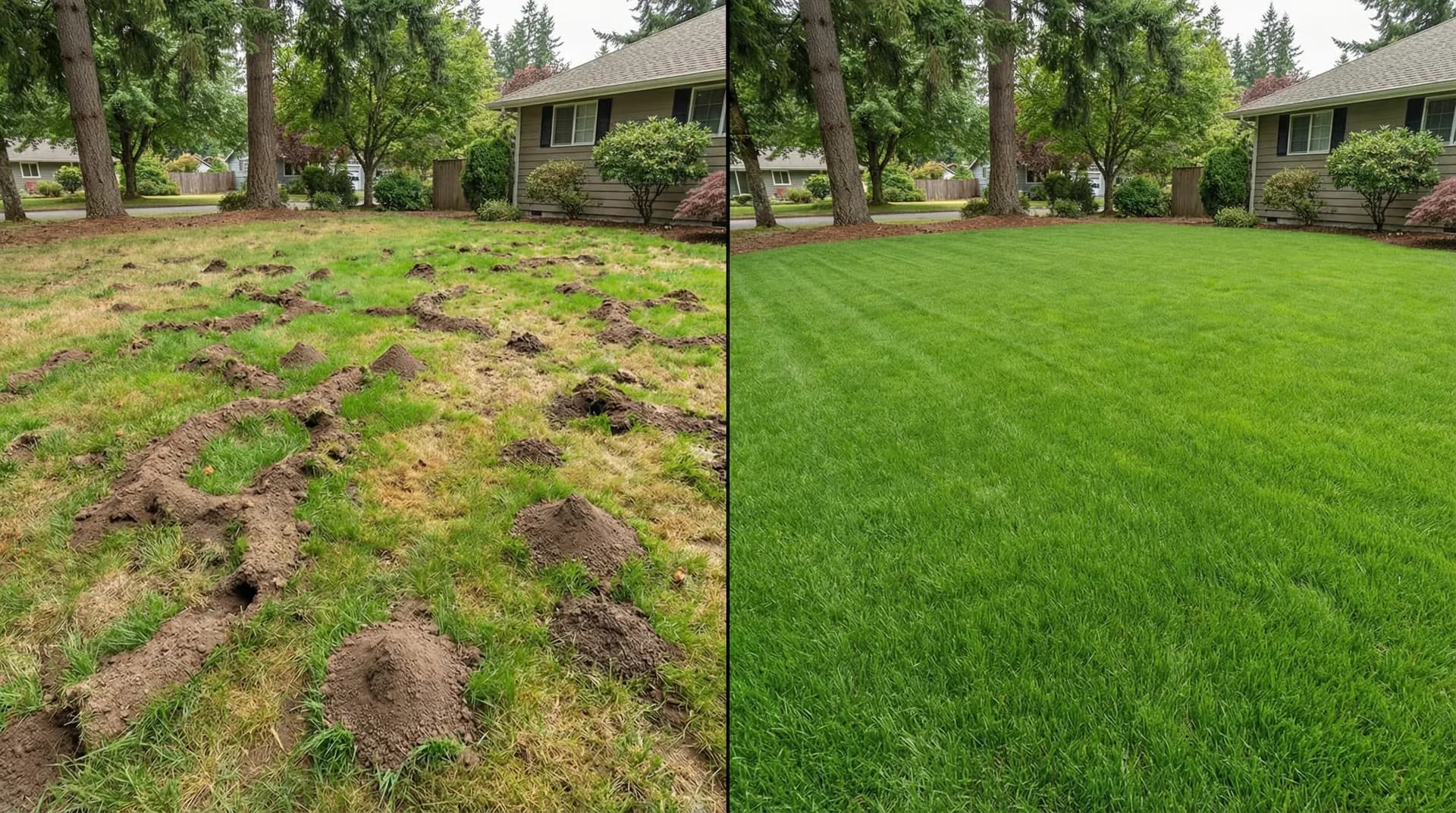
Mole Control in Yelm
Yelm's prairie soils tell a story that goes back to the glaciers. The flat, sandy outwash plain the town sits on was built by meltwater deposits thousands of years ago, and those same soils create some of the most consistent mole habitat in Thurston County. Got Moles brings chemical-free trapping to Yelm that works with prairie soil conditions, not against them.
Call (253) 750-0211219+ Five-Star Google Reviews·Chemical-Free·Proven Results
Got Moles provides professional mole control in Yelm, Washington. Chemical-free methods. Nearly 5,000 clients served since 2017. Call (253) 750-0211 for a free quote.
Yelm is prairie country. Sitting on the Nisqually Plain south of Olympia, the town of about 10,000 has a rural, independent character that sets it apart from its more suburban neighbors. The Yelm-Tenino Trail connects the community to the wider region, the Nisqually River defines the northern boundary, and the surrounding prairie and farmland give Yelm the kind of open-sky feel that's increasingly rare in Western Washington.
Why Moles Thrive in Yelm
The Nisqually Plain beneath Yelm is composed of glacial outwash — sandy, well-drained soils deposited by meltwater from retreating glaciers. These prairie soils are more porous than the heavier glacial till found at higher elevations, which means rainfall percolates quickly to tunnel depth and maintains consistent subsurface moisture. The Nisqually River to the north and its associated wetlands keep the regional water table accessible. Yelm's prairie ecology historically supported deep-rooted native grasses with rich organic soil horizons, and that legacy of organic material persists in residential topsoil. With nearly 50 inches of annual rainfall and soil that moles can tunnel through with minimal effort, the conditions are active year-round.
Moles in Yelm Neighborhoods
The residential neighborhoods along Yelm Avenue and near the town center sit on the deepest prairie topsoil, where decades of landscaping have enriched the native outwash with organic material. Moles are well established in these older lots. Properties along the Nisqually River corridor on the north side of town deal with alluvial soil that's softer and wetter than the prairie soils farther south, and mole activity there is consistently heavy. The newer subdivisions spreading east and south of town are built on native prairie outwash, and homeowners see moles arrive once irrigation and landscaping create the moisture levels these soils didn't naturally maintain. Areas near the Yelm-Tenino Trail see moles using the trail corridor as a travel route between natural areas and residential yards. Properties bordering the agricultural land surrounding town face reinvasion from the fields, where undisturbed soil supports established mole populations.
How We Help Yelm Homeowners
Year-Round Mole Control
$100/month
Our Total Mole Control Program keeps your yard protected all year. Regular visits, immediate response to new activity, and a report after every check.
Get Year-Round Protection→One-Time Mole Removal
$450 flat rate
A focused, one-month eradication program for properties under 1 acre. 4-5 weekly visits. If we don't catch a mole, you only pay the $150 setup fee.
Get One-Time Removal→Commercial Mole Control
Custom quote
Annual contracts for property managers, HOAs, sports facilities, and commercial grounds. Professional reporting, reliable scheduling.
Get a Commercial Quote→Local Tip
Yelm's prairie outwash drains fast on the surface, so your lawn may look dry while the soil at 6 to 12 inches is still holding moisture from last week's rain. Don't assume dry grass means no mole risk. Push a screwdriver into the soil — if it slides in easily past 6 inches, the conditions are right for moles.
How It Works
Call
Phone quote, no obligation
Book
Pay $150 setup. We schedule your first visit.
Trap
Tech inspects and sets traps on the first visit
Report
Weekly checks. Written report every visit.
Yelm Mole Control FAQ
I live on the prairie edge of Yelm. Is my mole problem going to be worse than in-town properties?
Properties bordering agricultural land or undeveloped prairie face higher reinvasion pressure because those open areas are established mole habitat. The moles expand into your yard when conditions are favorable. In-town properties with neighbors on all sides have some buffer, but still see activity. Prairie-edge lots benefit most from ongoing monitoring.
Does the Nisqually River affect mole activity in Yelm?
The Nisqually's influence extends well beyond its immediate banks. The river and its associated wetlands elevate the water table across the northern part of Yelm, keeping soil moist at tunnel depth even during drier months. Properties within a half mile of the river corridor see measurably higher mole activity.
My new construction home has moles already. How is that possible?
New homes on Yelm's prairie outwash often get moles within the first year or two of landscaping. The native soil was already suitable for moles, and adding irrigated lawn and garden beds raises the moisture level and earthworm population significantly. You've essentially improved the mole habitat. Early trapping prevents them from establishing a network.
Are the prairie soils around Yelm different from what you see in Olympia?
Yes. Yelm's glacial outwash soils are sandier and more porous than the glacial drift and alluvial soils in Olympia. Moles tunnel faster through Yelm's soils, which means they can cover more ground in less time. We adjust our trap placement and spacing to account for the way moles behave in these looser prairie soils.
Can I use the Yelm-Tenino Trail to tell if moles are active near my property?
The trail corridor does act as a mole travel route. If you see fresh mounds along the trail near your property, there's a good chance moles are active on your side of the boundary too. But don't rely on visible trail mounds alone — moles may already be in your yard tunneling below the surface.
Ready for Mole-Free Living in Yelm?
Call (253) 750-0211 or fill out the form below.
CALL (253) 750-0211Free quote. No obligation.