
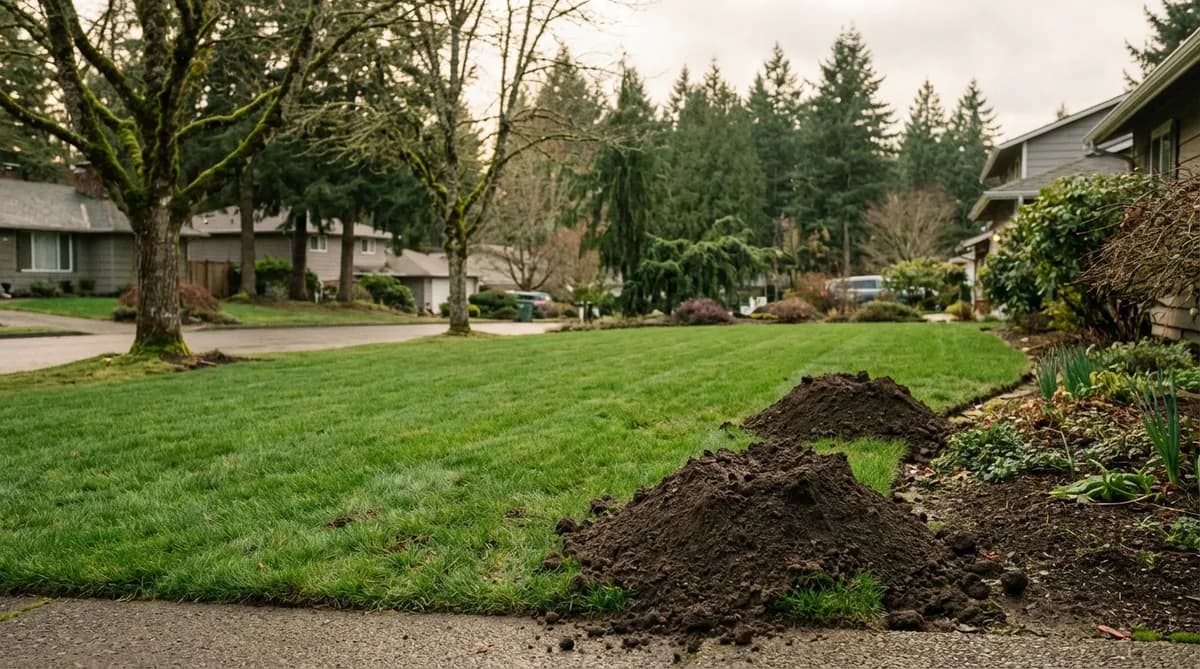
Why Do Moles Keep Coming Back After Treatment? The Biology of Reinvasion
Moles return to previously-treated properties because the conditions that attracted them — moist soil, dense earthworm populations, and available territory — remain present after the original moles are removed. In Western Washington specifically, the combination of year-round moisture, high mole density in wild ground, and existing tunnel infrastructure on the cleared property makes reinvasion predictable rather than random. One-time removal resolves the current infestation but does not prevent reinvasion. Year-round monitoring is the only method that keeps properties consistently mole-free. Most Got Moles clients see new moles 3-12 months after a one-time removal unless they're on ongoing protection.
Want moles handled for good, not just for now? Our all-season mole protection keeps your Western Washington yard covered with regular visits and a written report after every check.
You Didn't Do Anything Wrong
If your moles came back after treatment, it's not because the treatment failed. It's because mole biology works against one-time fixes.
The original moles were caught. The yard was clear. New moles moved in. Once you understand why it happens, the path to a real fix gets obvious.
This is the single most common frustration we hear from homeowners in Western Washington. A spring treatment clears the yard. By autumn — sometimes sooner — fresh mounds appear. The assumption is that the first treatment was somehow incomplete. It wasn't. It was a successful removal of the resident mole, followed by a new mole arriving to claim the territory. Both things are true. Both are expected. Understanding why gives you the information you need to plan real long-term control rather than a repeating cycle of call-outs.
Reason 1: Your Yard Is Still Attractive
The mole didn't pick your yard at random.
Whatever drew the first mole — moist loamy soil, dense earthworm population, irrigated lawn, proximity to wild ground, the specific soil type of the Puget Lowlands — none of that changed when the mole was removed. Your yard remains exactly what the next mole is looking for.
The dominant attractor in Western Washington is earthworm density. Western Washington soils have some of the highest earthworm populations in North America thanks to the combination of mild climate, consistent moisture, and rich organic matter in residential soils. Moles eat 55-93% earthworms. A Townsend's mole can eat 60-80% of its body weight in earthworms every day. Any lawn that supports healthy turf supports abundant earthworms, which means any maintained Western Washington lawn is prime mole habitat.
The secondary attractors: soft loamy or amended soil (easy tunneling), irrigation (maintains surface earthworm activity through summer), landscaped yards with mature trees (moisture retention and organic matter), and proximity to greenbelts, parks, or creeks (source populations of new moles).
You can't fix the underlying attractiveness without fundamentally changing what makes your yard pleasant to live with. You don't want to stop watering, amending soil, or maintaining the lawn to deter moles. The attractiveness is a feature, not a bug — and it's also why moles keep arriving.
Reason 2: Empty Territory Gets Claimed
Moles are solitary and territorial. Each adult mole defends roughly a quarter-acre of ground as its own network. When a resident mole is removed, the territory doesn't stay vacant for long.
Moles communicate territorial boundaries through scent-marking in their tunnels and through physical encounters at territory edges. When a resident disappears, neighboring moles detect the absence and expand their own territories into the vacated space. New juvenile moles dispersing from elsewhere in the neighborhood arrive and find a ready-made tunnel network they can occupy immediately.
In high-density Western Washington suburbs, the practical territory turnover is surprisingly fast:
- Properties adjacent to parks, greenbelts, or creeks: 1-3 months from clearance to reinvasion — common pattern for homes near Mill Creek and the wooded corridors that ring the Eastside - Dense suburban properties surrounded by other yards with moles: 3-6 months - Isolated properties with distance from wild ground and treated neighbors: 6-12+ months
Spencer has tracked this pattern across nearly 5,000 Got Moles service calls since 2017. Same yard, second mole within a year, is the median outcome for one-time removal on a typical Western WA residential lot near wild ground.
Reason 3: The Tunnel Network Is Still There
Here's the subtle mechanism that most homeowners don't realize: removing the mole doesn't remove the tunnels.
A Townsend's mole builds 200-300 feet of tunnel network on a typical residential property over the course of its residency. Permanent deep runs at 6-20 inches below the surface. Shallow feeding runs at 1-4 inches. Nest chambers. Surface access points. Years of tunnel construction, all of it underground, all of it intact after the mole is caught.
When a new mole arrives, it doesn't have to build from scratch. It can move into the existing tunnel network, patrol it for earthworms, and establish residency within days. This is why reinvasion happens faster than initial colonization — the new mole gets a pre-built highway system.
The tunnels themselves are essentially attractive infrastructure. If you could collapse and compact the entire tunnel network after a successful removal, reinvasion would take much longer. In practice, that's not feasible on a landscaped property. So the tunnels stay, and they get re-occupied.
This is why ongoing intervention works so well: if you catch the new mole within days of its arrival (before it fully establishes and expands the tunnel network), the yard stays effectively mole-free. If you wait weeks or months, the new mole does its own expansion and you're back to a full mole problem.
Reason 4: Spring and Autumn Dispersal Pressure
Mole reinvasion isn't spread evenly through the year. Two seasonal peaks concentrate most of the recolonization pressure.
May-June juvenile dispersal. Mole pups born in March-April leave their mothers' territories in May and June, searching for unoccupied ground to claim. If your yard was cleared in the spring before this wave, expect one or more juveniles to arrive and establish during this window. Properties near greenbelts, parks, and undeveloped land see the strongest juvenile dispersal pressure — Sammamish lots backing onto the plateau forest are a textbook example.
September-November autumn recolonization. Adult moles that have been working deeper tunnels through the dry summer re-emerge to active surface work as autumn rains return. Any yard cleared in summer that still has unclaimed territory will be colonized as source-population moles expand their range into the empty space.
These two windows account for the majority of reinvasion events we see at Got Moles. A spring one-time removal often holds through summer, then gets colonized in September-October. An autumn one-time removal may hold through winter, then get colonized in May during the juvenile wave.
The predictability of these windows is exactly what the Total Mole Control Program is designed around. Scheduled visits concentrate during these peaks so new arrivals are caught before they establish.
The Only Method That Stops the Cycle
If reinvasion is inevitable without ongoing intervention, the choice becomes: accept recurring mole problems with periodic one-time removals, or intervene continuously to prevent each new arrival from establishing.
Continuous intervention is exactly what the Total Mole Control Program (TMCP) provides.
How it works:
- Scheduled monthly visits across the full year, with visit frequency intensified during peak reinvasion windows (April-June and September-November). - Active tunnel monitoring — each visit checks for fresh activity across your property, including areas that appeared clear at the previous visit. - Immediate response to new arrivals — when new activity is detected, trap placement happens that visit rather than waiting for the problem to escalate. - Written reports after every visit so you always know what's happening on your property. - No extra charges for responding to new activity — the monthly fee covers it. - Same chemical-free methods as one-time removal — no poisons, safe for pets and kids.
Cost comparison. TMCP is $100/month ($1,200/year with $150 setup). A single one-time removal is $450. If you have a property that sees reinvasion once per year, two one-time removals equals $900 annually with two separate mole-damage windows between them. TMCP at $1,200 is $300 more, but eliminates the damage windows entirely. For properties near wild ground that see moles multiple times per year, TMCP is cheaper than the equivalent one-time cycle.
Who's a good fit:
- Properties near parks, greenbelts, creeks, or undeveloped land - Properties that have had moles return before after one-time removal - Properties with significant landscape investment (the cumulative damage from reinvasion cycles outweighs the cost of continuous protection) - Anyone who simply wants to stop thinking about moles entirely
Start with One-Time Mole Removal if this is a first encounter. Consider TMCP if you've been through the cycle before. Full side-by-side in Monthly vs One-Time Mole Control.
What Won't Stop the Cycle
A few common homeowner approaches that don't prevent reinvasion, based on what we see in practice.
Filling in the tunnels. Cosmetically helpful after the mole is removed, but doesn't significantly slow reinvasion. New moles don't need the existing tunnel network to arrive; they just exploit it if available.
Soil treatments (castor oil, sonic stakes, grub killers). None of these reliably deter moles from arriving or staying. See Do Mole Repellents Work? and Does Grub Control Stop Moles? for the detailed breakdowns of why.
DIY trapping cycles. Repeated DIY trapping catches the resident but doesn't prevent the next arrival any better than professional one-time removal does. Same reinvasion dynamics apply.
Hoping the moles don't come back this time. Hope isn't a strategy. In Western Washington's mole-dense environment, reinvasion is the default outcome. Planning for it is the only realistic approach.
Blaming the previous treatment. If your moles came back, the previous trapping didn't fail. It completed its scope (removing the current resident). Continuing to blame the trapper or the method misses the underlying biology. The new mole was always going to arrive.
Local Mole Control Across King, Pierce, and Snohomish
Got Moles is a mole-only specialist covering King, Pierce, Snohomish, and Thurston counties — the heart of Western Washington. We've trapped moles on nearly 5,000 properties since 2017, chemical-free, with 219+ five-star Google reviews across three local offices.
Local service areas include mole control in Snoqualmie, Black Diamond mole removal, Ravensdale mole control, and mole control near Seattle — plus every neighboring city on our service areas map.
If moles have moved into your yard, the fastest path to a solved problem is our Total Mole Control Program or a direct conversation: call (253) 750-0211 or use our contact form.
Get your Mole Risk Score in 2 minutes.
Free, personalized report on what is drawing moles to your yard — and how to stop them coming back.
Find my risk scoreFree. No call required. Takes about 2 minutes.
Frequently Asked Questions
Will moles come back after professional trapping?
Yes, often. Professional trapping removes the current moles from your property but doesn't stop new moles from claiming the territory. In Western Washington specifically, the dense mole population in surrounding wild ground and the attractiveness of maintained lawns mean reinvasion within 3-12 months is the typical pattern. Properties near parks or greenbelts see faster reinvasion. Isolated properties with treated neighbors see slower reinvasion. But without ongoing monitoring, reinvasion is usually a matter of when, not if.
How do I permanently get rid of moles?
There's no true one-and-done permanent fix in a mole-dense environment like Western Washington. The closest thing is continuous year-round monitoring that intercepts new moles within days of arrival before they establish tunnel networks. That's what the Total Mole Control Program does — $100/month keeps the property effectively mole-free on an ongoing basis. The honest framing: you're choosing between recurring one-time removals with damage between each cycle, or continuous coverage with no damage windows.
If I trap the moles myself, will they stay away?
Not permanently. The same reinvasion dynamics apply whether the original moles were caught by DIY or professional trapping. New moles arrive on the same biological schedule regardless of who trapped the previous residents. DIY trapping may save money on the initial removal, but it doesn't change the subsequent arrival pattern — and the yard still goes through the same damage cycles with each new resident.
How long does it typically take moles to come back?
3-12 months for most Western Washington residential properties. Properties immediately adjacent to parks, greenbelts, or creeks often see new activity within 1-3 months. Properties in dense suburban areas surrounded by other yards with moles typically see new activity within 3-6 months. Isolated properties with distance from wild ground and treated neighbors can go 6-12 months or occasionally longer. Seasonal timing matters — spring treatments often hold through summer, then face autumn reinvasion.
Does filling in the old tunnels help prevent new moles?
Marginally. The cosmetic benefit is real — flattening ridges and filling mounds restores the lawn's appearance. But new moles arriving after a successful removal don't strictly need the existing tunnel network to establish. They build their own if needed, or exploit existing tunnels if available. Filling tunnels slows reinvasion slightly but doesn't prevent it. If you do fill, focus on surface ridges that are damaging the lawn; deep tunnels aren't practically accessible.
Do my neighbors have anything to do with my mole problem?
Yes. Mole movement between properties is constant. If your neighbors' yards have moles, dispersing juveniles and expanding adults can arrive at your property from theirs. This is especially common in neighborhoods where most yards go untreated. A concentrated area where multiple neighbors all use professional mole control simultaneously reduces the source population and slows everyone's reinvasion rate — but that level of coordination is rare in practice.
Is the Total Mole Control Program actually cheaper than repeated one-time removals?
Depends on reinvasion frequency. A property that sees moles once every two years is cheaper to service with periodic one-time removals ($450 every 2 years = $225/year) than with TMCP ($1,200/year). A property that sees moles twice per year breaks even or saves with TMCP (two one-times = $900 vs TMCP $1,200, but TMCP also eliminates the damage windows that cost money to repair). For properties near wild ground seeing moles 2+ times per year, TMCP is the clear winner on direct cost and dramatically better on lawn damage avoided.
Related Services & Resources
Our Services
- Total Mole Control Program — $100/month year-round protection
- One-Time Mole Removal — $450 flat rate with guarantee
- Commercial Mole Control — annual contracts for property managers
Learn More
- How It Works — our 4-step process
- FAQ — 26 expert answers
- Service Areas — 77 cities across Western Washington
Spencer Hill is a US Army veteran and founder of Got Moles, a mole control specialist serving Western Washington. He has helped over 5,000 homeowners reclaim their yards using chemical-free, professional trapping methods.
Ready to Reclaim Your Yard?
Call (253) 750-0211 — we serve all of Western Washington.
CALL (253) 750-0211Free. No obligation.
Or get your free 2-minute Mole Risk Score for a personalized report on why moles target your yard.