
Can Moles Swim?
Moles can swim. Not well and not by choice, but yes — they paddle across water when they have to. Their dense fur repels water, their strong forelimbs translate into a functional dog-paddle, and they can cross a small pond, flooded ditch, or creek if survival demands it. In Western Washington, heavy rain flooding a tunnel network is the most common reason a mole ends up swimming.
Can Moles Actually Swim?
Yes. All three Washington mole species — Townsend's, Pacific Coast, and shrew mole — are capable swimmers. It's not their primary mode of travel, but it's a real ability.
The adaptations that make moles good diggers carry over into the water reasonably well. Dense, double-layered fur traps air and provides natural buoyancy. Powerful forelimbs that push soil translate into a strong paddle stroke. A mole in water looks like it's still digging — the same basic motion — just moving forward through a different medium.
Nobody's measuring mole swim speed in a lab, but field reports suggest Townsend's moles can cross 20 to 50 feet of water competently. Longer swims get harder quickly; moles tire and body temperature drops in cold PNW water.
Why Would a Mole Need to Swim?
Three main reasons in the real world.
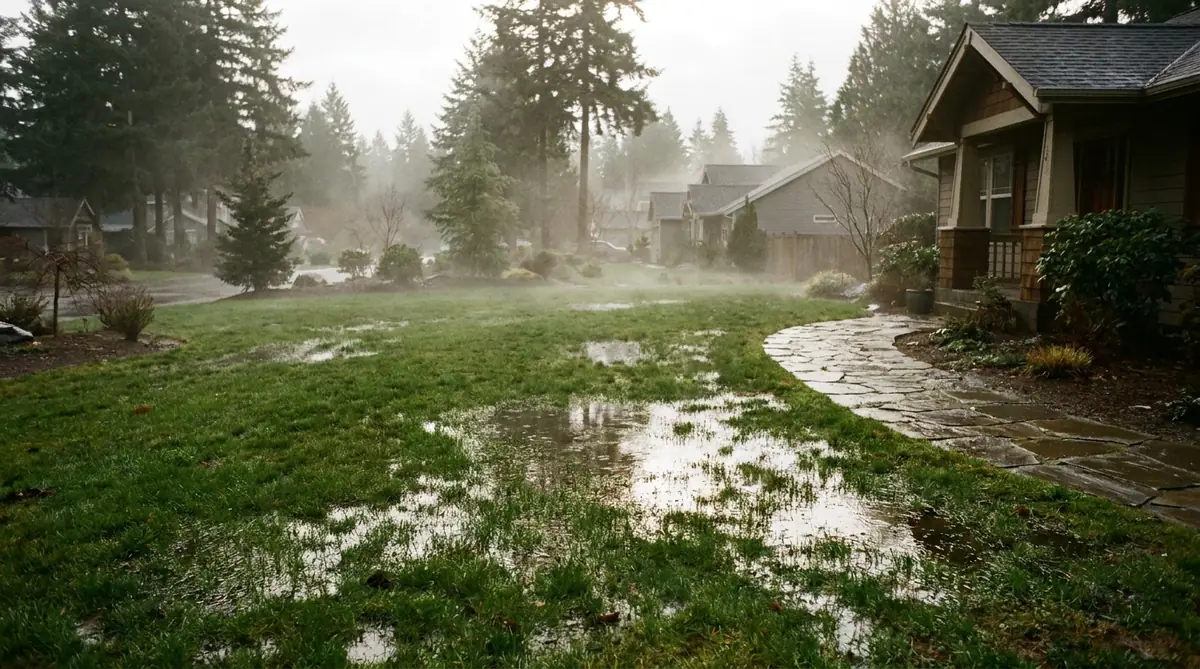
**Flooded tunnels.** This is the big one in Western Washington. We get 35 to 60 inches of rainfall per year, and heavy winter storms can saturate soil to the point where a mole's surface and mid-depth tunnels fill with groundwater. The mole either retreats to deeper tunnels (if they exist and also aren't flooded) or swims out to dry ground. After the 'atmospheric river' events the Puget Sound region has seen in recent years, we've received more than a few calls from homeowners who spotted a mole on a driveway or patio during flooding — surfaced from a waterlogged tunnel.
**Escape from a predator.** Coyotes, dogs, and occasionally raptors will pursue a mole that's been caught above ground. If water is nearby — a creek, a pond, a drainage ditch — the mole may take to it rather than face the predator.
**Accidental fall.** Moles surface briefly during juvenile dispersal (May/June, when young moles strike out for new territory) or when tunnels collapse. A mole pushed into water by terrain or by another animal will swim.
Does Water Keep Moles Out of a Yard?
No. A creek, pond, ditch, or stream is not a barrier to moles.
This is worth saying explicitly because some PNW homeowners assume their property is 'safe' from moles because it sits across a stream or drainage channel from wild ground. It's not. A mole will swim across moderate water gaps to reach attractive tunneling soil on the other side. Properties backing onto Ohop Creek, the Chehalis corridor, Thornton Creek, or any of the hundreds of named streams in Western WA are not insulated from mole colonization by the water itself.
What the water does is slow mole migration slightly — a mole isn't going to cross a creek casually — and give the homeowner a few extra weeks before new moles arrive after a clearing. But over months and years, the barrier isn't a barrier.
What Does Flooding Mean for Mole Control in Western WA?
Two practical implications for a yard.
**Wet seasons can shift mole activity suddenly.** In a dry summer, a Townsend's mole may be working deep runs under the lawn and producing few surface mounds. Hit that yard with a November atmospheric river and the mole gets pushed to shallower ground — and the surface mound count explodes overnight. Homeowners often call us after the first major winter storm because that's when the mole goes from invisible to obvious.
**Flooded tunnels don't kill the mole.** People sometimes hope a saturated yard will drown the mole out. Usually it doesn't; the mole relocates within the tunnel network or dig-swims to drier ground. If the yard re-saturates regularly, activity may drop seasonally but returns as soon as the soil drains. Long-term mole control needs to address the mole, not the water.
For the PNW specifically, see how seasonal activity plays out across the year in When Are Moles Most Active in Washington. For year-round coverage that rides out winter floods and spring dispersals, the Total Mole Control Program is built for exactly that.
Should You Worry About Moles in Ponds and Water Features?
Very rarely. Decorative ponds, swimming pools, and fountains aren't attractive to moles — there's nothing to eat, no soil to tunnel through, and the water barrier doesn't favor them. If you ever see a mole in a pool, it's almost certainly because the mole fell in and can't climb out. The humane move is to scoop it out with a long-handled net (don't touch it with bare hands — see Do Moles Bite?) and set it on soil away from the water.
The much bigger pond-adjacent concern is that the moisture around the pond edge supports high earthworm populations, which supports heavy mole activity in the surrounding lawn. Pond-adjacent yards are often among the most mole-heavy properties we work on. Got Moles handles pond-side properties routinely across Western WA — see One-Time Mole Removal for the approach.
Swimming vs Drowning: Seasonal Flood Pressure in Western Washington
Western Washington's wet winter creates a specific pattern of mole displacement that drier regions don't see. Major rain events in November, December, and January can saturate an entire tunnel network fast enough that moles have to make a real decision: retreat to higher sections of the system, climb to the surface and find new ground, or swim across flooded low spots.
Properties most affected are the predictable ones: river-corridor yards along the Snohomish, Stillaguamish, Puyallup, and Nisqually; low-lying flat ground near Kent Valley, Auburn, and the southern Puget Sound flats; any lot with poor drainage where water pools for days at a time. During a major atmospheric river event — the PNW storm pattern that can drop 3+ inches of rain in a day — entire lawns become temporarily uninhabitable for moles.
What actually happens: most moles survive. They are strong enough swimmers to cross flooded sections and they know their tunnel system well enough to find unflooded chambers quickly. What you see afterward is a shift in activity patterns — mounds appearing in different parts of the yard as the mole re-establishes surface access, or a brief quiet period followed by a surge as new moles (including juveniles displaced from neighboring properties) discover the available habitat.
The practical implication: winter flooding doesn't solve a mole problem. It moves it around temporarily. For properties with chronic high-water-table conditions, the Total Mole Control Program is specifically designed to stay ahead of reinvasion cycles that follow each weather event.
Local Mole Control Across King, Pierce, and Snohomish
Got Moles is a mole-only specialist covering King, Pierce, Snohomish, and Thurston counties — the heart of Western Washington. We've trapped moles on nearly 5,000 properties since 2017, chemical-free, with 219+ five-star Google reviews across three local offices.
Local service areas include mole control in Snoqualmie, Black Diamond mole removal, and mole control near Seattle — plus every neighboring city on our service areas map.
If moles have moved into your yard, the fastest path to a solved problem is our Commercial Mole Control or a direct conversation: call (253) 750-0211 or use our contact form.
Why is your yard a mole target?
Get your free 2-minute Mole Risk Score — a personalized report on what is drawing them in and how to make your property less attractive.
Find my risk scoreFree. No call required. Takes about 2 minutes.
Frequently Asked Questions
How long can a mole stay in water?
Not long. A few minutes of active swimming is the practical limit before a Townsend's mole tires and cold water starts affecting body temperature. Holding breath isn't really the limiting factor — moles aren't diving animals — it's the combination of energy cost and thermoregulation. A mole dropped into a pool will swim toward an edge immediately and needs a way out within a few minutes.
Do moles have webbed feet like otters?
Star-nosed moles (which don't live in Washington) have partially webbed rear feet and are genuinely semi-aquatic, often foraging for aquatic prey. Washington species — Townsend's, Pacific Coast, shrew mole — don't have webbed feet. They swim by paddling the same oversized forelimbs they dig with. Functional, but not graceful.
Can moles drown in their own tunnels?
Rarely. When a tunnel floods, most moles either climb out through an existing surface opening or swim to an unflooded section of the network. Very young moles (pups under six weeks old, in the nest in March-April) are more vulnerable — a sudden flood event during kitten season can kill a litter. Adult moles almost always escape.
Do moles live near water on purpose?
Not specifically, but properties near water tend to have higher soil moisture and richer earthworm populations, which means better mole habitat. So you'll often find heavier mole activity on a property that borders a creek, stream, pond, or drainage swale. The mole isn't there because it likes water; it's there because the ground is perfect for hunting worms.
My yard flooded — did it get rid of the moles?
Probably not. The mole almost certainly survived, either by retreating to unflooded tunnels or by swimming to higher ground on the same property. As soon as the soil drains, activity resumes — often with a surge of fresh mounds as the mole re-establishes its surface network. If the flooding seems to have stopped mole activity, there's usually a different explanation (seasonal quiet period, mole relocated temporarily, etc.).
Related Services & Resources
Our Services
- Total Mole Control Program — $100/month year-round protection
- One-Time Mole Removal — $450 flat rate with guarantee
- Commercial Mole Control — annual contracts for property managers
Learn More
- How It Works — our 4-step process
- FAQ — 26 expert answers
- Service Areas — 77 cities across Western Washington
Spencer Hill
Spencer Hill is a US Army veteran and founder of Got Moles, a mole control specialist serving Western Washington. He has helped over 5,000 homeowners reclaim their yards using chemical-free, professional trapping methods.
Ready to Reclaim Your Yard?
Call (253) 750-0211 — we serve all of Western Washington.
CALL (253) 750-0211Free. No obligation.
Or get your free 2-minute Mole Risk Score for a personalized report on why moles target your yard.