
Why Do Moles Make Molehills?
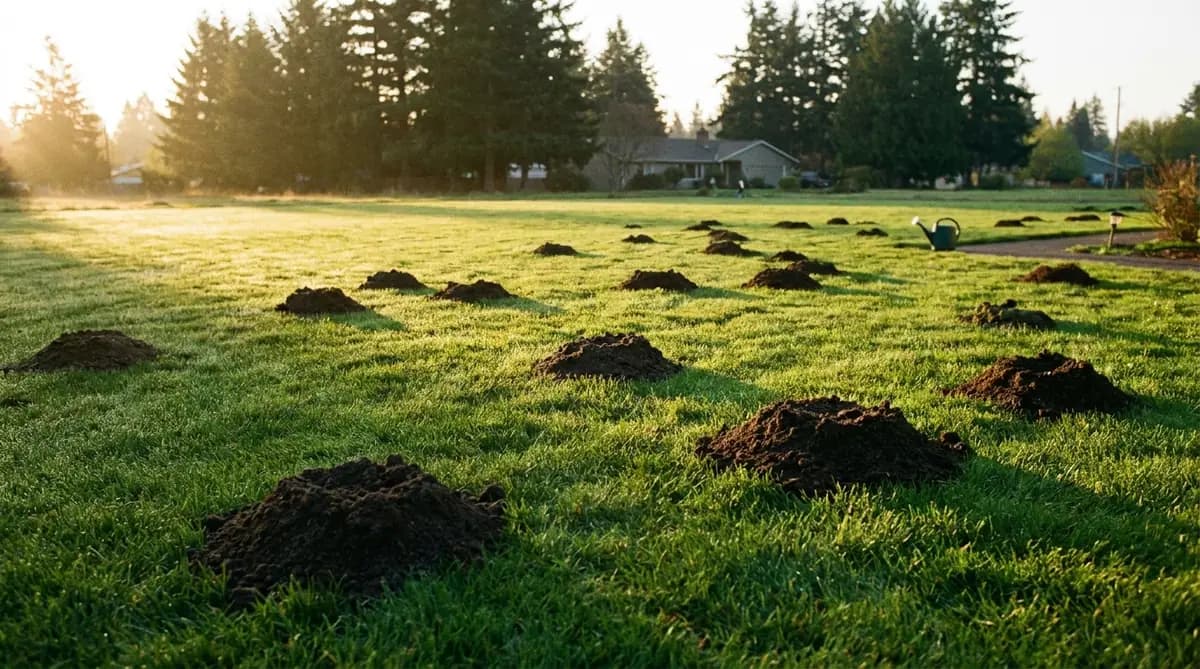
Molehills are dirt disposal. When a mole tunnels horizontally, the displaced soil has to go somewhere — so the mole pushes it up a vertical shaft to the surface and plugs the shaft from below. The volcano-shaped cone you see is yesterday's tunneling project piled above the new tunnel. Each mound marks a tunnel's location, but the mole is never inside the mound itself.
Want moles handled for good, not just for now? Our ongoing mole protection keeps your Western Washington yard covered with regular visits and a written report after every check.
Why Do Moles Make Molehills in the First Place?
Because soil has to go somewhere.
A Townsend's mole can dig 18 feet of tunnel per hour in soft Western Washington soil. Every inch of that tunnel displaces a volume of dirt — the mole literally can't fit through the tunnel while the soil is still in it. So the mole pushes the loose soil up a vertical shaft to the surface, out through the top, and plugs the shaft from below so the tunnel remains sealed and climate-controlled.
The mound is an unintended byproduct of the excavation. The mole doesn't 'make molehills' as a deliberate structure — it's dumping soil because there's nowhere else for it to go. From the mole's perspective, a molehill is a spoil pile. From the homeowner's perspective, it's a yard problem.
Where Do Molehills Appear on a Western WA Lawn?
Above active tunnels, often in clusters or lines.
The mound sits directly over the vertical disposal shaft, which connects to a horizontal tunnel a few to several inches below. Where a mole is actively extending a tunnel network, you'll see multiple mounds along the route — sometimes three, five, ten in a loose curving line. Each mound represents a dumping point during the tunnel's construction.
Townsend's moles tend to concentrate mounds along edges: foundation perimeters, fence lines, driveway borders, flower bed boundaries. These are the high-value tunneling zones because soil moisture and earthworm populations concentrate there. If you map the mounds on a paper sketch of your yard, you'll often see the mole's territory reveal itself — a connected network running the edges.
Why Do Molehills Appear Suddenly After It Rains?
Rain triggers a feedback loop that increases surface mound production.
When PNW soil gets saturated — and 35 to 60 inches of annual rainfall guarantees regular saturation — earthworms move toward the surface to avoid waterlogging the deeper layers where they live. That brings them into the top 1-4 inches of soil, right into the feeding zone where moles hunt. Mole activity surges because the prey surged.
More tunneling equals more soil displacement equals more mounds. A single storm followed by a day of mole activity can produce five or six fresh mounds where yesterday you had one. This is why Western Washington homeowners often report mole problems appearing 'out of nowhere' — it's not new moles moving in, it's existing moles shifting their activity upward in response to moisture.
Are Molehills a Sign the Mole Is Leaving or Staying?
Staying. Fresh mounds are the opposite of a retreat signal.
Active tunnel expansion — the work that produces new mounds — happens when a mole is colonizing or maintaining its territory, not when it's leaving. An abandoned tunnel network has no fresh mounds; old mounds slowly erode and grass grows back over the top. If you're seeing new mounds each week, the mole is actively resident and working the property.
The corollary: if you 'treat' the yard with castor oil, sonic stakes, vibrating spikes, or other repellents and the mounds stop, it's usually not because the mole left. It's because the mole moved its active tunneling to another part of the yard, often just ten feet over into untreated ground. Fresh mounds appear in the new location and homeowners assume a different mole. Usually it's the same animal.
How Do You Stop Molehills From Appearing?
Remove the mole. That's the only method that stops mound production.
Filling in existing mounds, rolling the lawn, or flattening ridges treats the visible symptom for a day — the mole is still underground and will produce new mounds by tomorrow. Repellents don't work reliably (see Do Mole Repellents Work? for the full breakdown of why). Grub killers don't starve the mole because grubs are only 5-20% of diet.
Professional physical trapping placed inside active tunnels catches the mole, and when the mole is gone, new mounds stop within days. Got Moles has refined this approach across nearly 5,000 Western Washington properties since 2017. For one-off mole clearance, see One-Time Mole Removal; for properties near wild ground that see repeated recolonization, the Total Mole Control Program is the year-round version.
When to Expect Peak Molehill Production in Western Washington
Mound production follows a seasonal rhythm tied to soil moisture and earthworm surface activity. Knowing the pattern helps set expectations for your specific part of the service area.
March through June — peak mound season. Spring rains bring earthworms up toward the surface, moles follow, and fresh mounds appear daily on affected lawns. Breeding season runs parallel, so juvenile moles dispersing to claim new territory add to the total mound count across the neighborhood. A single yard can go from zero visible activity to 20+ fresh mounds in a few weeks. This is when the majority of Got Moles service calls come in from Seattle, Bellevue, Sammamish, Tacoma, and the rest of the Puget Lowlands.
July through August — quieter at the surface. Drying soils push earthworms deeper and moles follow. Surface mound production slows noticeably on irrigated lawns, sometimes stopping entirely on non-irrigated ground. The moles are still there; they're just working deeper tunnels that don't produce mounds. Homeowners often assume the problem has 'resolved itself' during this window.
September through November — second peak. Autumn rains return, earthworms come back up, moles resume active surface work. The fresh mounds appearing in October and November are usually from the same moles that seemed 'gone' in August, plus any new juveniles that arrived during the summer's quiet.
December through February — steady but lower amplitude. Mound production continues year-round in Western Washington because the ground doesn't freeze hard. Winter cycle produces fewer total mounds than spring or autumn, but activity never stops. If your yard shows winter mounds, the mole has been there the whole time.
Mole Control Near You in Western Washington
Got Moles is a mole-only specialist covering King, Pierce, Snohomish, and Thurston counties — the heart of Western Washington. We've trapped moles on nearly 5,000 properties since 2017, chemical-free, with 219+ five-star Google reviews across three local offices.
Local service areas include mole control in Issaquah, Puyallup mole removal, and mole control near Federal Way — plus every neighboring city on our service areas map.
If moles have moved into your yard, the fastest path to a solved problem is our One-Time Mole Removal or a direct conversation: call (253) 750-0211 or use our contact form.
Why is your yard a mole target?
Get your free 2-minute Mole Risk Score — a personalized report on what is drawing them in and how to make your property less attractive.
Find my risk scoreFree. No call required. Takes about 2 minutes.
Frequently Asked Questions
How many molehills can one mole make?
Dozens per week during active tunnel expansion. On a quarter-acre Western WA lot, a single Townsend's mole in spring can produce 15-25 fresh mounds in a seven-day period. Over a full month of activity that's 60-100 mounds — which is why homeowners frequently think they have a whole population when it's actually one animal doing a lot of work.
Do all molehills connect to the same tunnel?
Usually yes, directly or indirectly. A mole on a residential lot builds one coordinated tunnel network over time, and most mounds mark disposal points for sections of that network. A few mounds may represent abandoned tunnel branches from earlier in the mole's residency, but the vast majority are connected to active runs the mole still uses.
What's inside a molehill?
Loose, finely churned soil from the tunnel below — no mole, no chamber, nothing structural. The vertical shaft connecting the mound to the tunnel is usually plugged from below with compacted dirt. Digging into a mound typically reveals the plugged shaft underneath, which is useful for confirming the mound is from a mole (volcano shape, plugged shaft) vs a gopher (fan shape, off-center hole).
Why are my neighbor's molehills bigger than mine?
Soil composition and tunnel depth. Deeper tunnels require larger disposal mounds because the shaft carries up more soil per excavation event. Wet, clay-rich soil produces taller, more conical mounds than dry sandy soil. Mound size is not a reliable indicator of mole size or mole count — it's a soil physics thing.
Can I just roll over the mounds with a lawn roller to fix the damage?
Temporarily. Rolling flattens the visible mound but doesn't address the mole underneath, so new mounds appear within days. It can help slightly with lawn re-establishment after the mole is removed, though overseeding and light topdressing are usually the better repair approach. Don't invest in equipment or repair effort until the mole is gone — the mounds come right back otherwise.
Related Services & Resources
Our Services
- Total Mole Control Program — $100/month year-round protection
- One-Time Mole Removal — $450 flat rate with guarantee
- Commercial Mole Control — annual contracts for property managers
Learn More
- How It Works — our 4-step process
- FAQ — 26 expert answers
- Service Areas — 77 cities across Western Washington
Spencer Hill is a US Army veteran and founder of Got Moles, a mole control specialist serving Western Washington. He has helped over 5,000 homeowners reclaim their yards using chemical-free, professional trapping methods.
Ready to Reclaim Your Yard?
Call (253) 750-0211 — we serve all of Western Washington.
CALL (253) 750-0211Free. No obligation.
Or get your free 2-minute Mole Risk Score for a personalized report on why moles target your yard.