
Best Mole Traps in 2026: What Actually Works (Expert Review)
The best mole trap is the one placed in the right tunnel. After 15+ years and nearly 5,000 properties, a $30 Victor scissor trap in a high-traffic deep run will outperform a $200 collection of gadgets scattered across surface tunnels every single time. The trap matters far less than the placement, the tunnel selection, and knowing what you're actually dealing with underground.
Got active moles right now? Our flat-rate mole removal clears the moles in your yard over 4–5 weekly visits — and if we don't catch one, you pay only the setup fee.
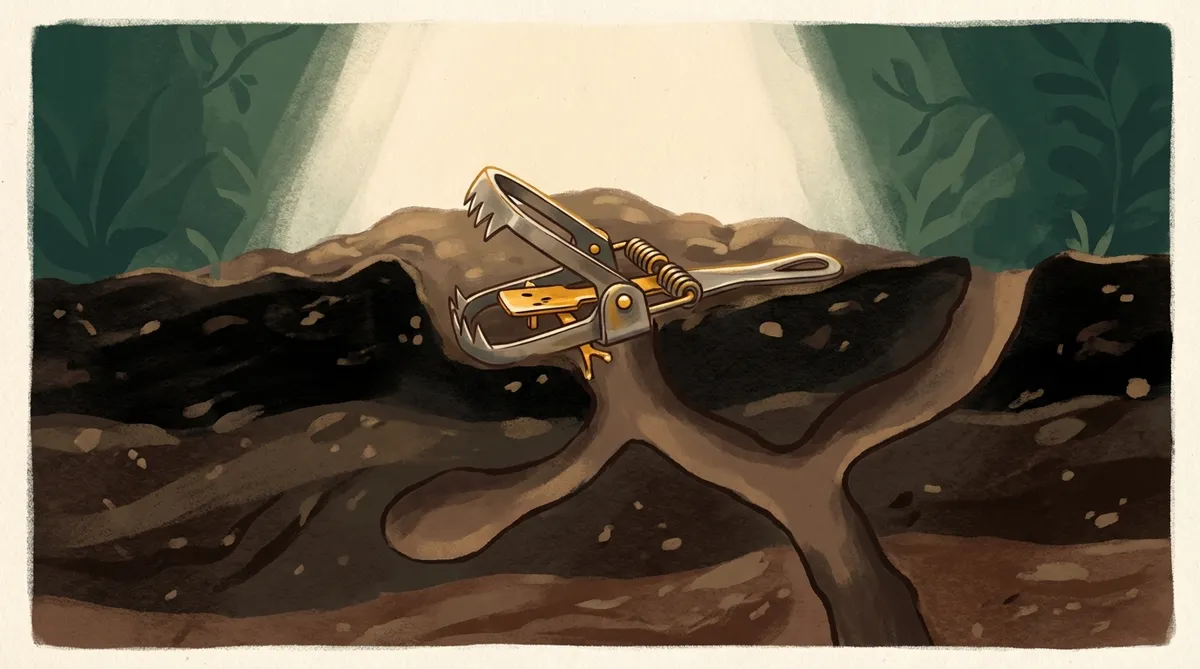
Scissor Traps: The Workhorse
The Victor Out O'Sight scissor trap is the most widely used professional mole trap in the Pacific Northwest. It works in the widest range of soil types, sets below the surface where pets and kids can't reach it, and delivers consistent results when placed correctly.
The scissor trap sits inside the tunnel itself. When a mole passes through and pushes against the trigger plate, the jaws close. Done right, it's deadly effective. Done wrong, the mole detects the disturbance and reroutes.
Pros: Works in clay, loam, and amended soils common across Western Washington. Below-ground placement keeps it hidden and safe. Durable and affordable at $15-30 per trap.
Cons: Requires digging into the tunnel and rebuilding it around the trap. Setting the spring takes hand strength and practice.
Harpoon Traps: Easiest for Beginners
The harpoon trap is the simplest to set. No digging. No tunnel excavation. You step on a surface tunnel to collapse it, place the trap over the compressed section, and the mole triggers it when it pushes back up.
The honest problem with harpoon traps: they target surface tunnels. And surface tunnels are the least reliable place to catch a mole. Many surface runs are feeding tunnels used once and never revisited. A Townsend's mole can dig 18 feet of new tunnel per hour. It may never come back through the run you just trapped.
Choker Loop Traps: Effective in the Right Hands
Choker loop traps use a wire loop that tightens around the mole as it passes through. These are effective in deeper runs, especially along foundations, fence lines, and walkways where moles travel repeatedly.
Pros: Excellent for deep runs along structures. Low profile once set. Works in firm, compacted soil.
Cons: More finicky to set than scissor or harpoon traps. Requires accurate identification of active deep runs.
Mole Bait vs. Mole Traps: Why We Don't Use Poison
Mole baits like Talpirid are shaped like earthworms and laced with bromethalin, a neurotoxin. Results are inconsistent — many moles detect the artificial bait and ignore it.
Bromethalin has no antidote. If a dog digs up and eats a bait worm, or eats a poisoned mole, the result can be seizures, paralysis, and fatal brain swelling. Zinc phosphide, another common mole poison, produces toxic gas in the stomach.
Got Moles uses only physical trapping methods. Zero chemicals. Zero poisons. Zero risk of secondary poisoning. Every property we work on is safe for dogs, cats, and children from day one — the same standard we apply across One-Time Mole Removal and the Total Mole Control Program.
Why Placement Beats the Trap Every Time
Four well-placed traps will outperform ten scattered across random surface tunnels. Every time.
Tunnel selection: Deep runs along foundations, fences, driveways, and garden borders are high-traffic highways moles use daily. Surface runs across the middle of your lawn are often used once.
Placement depth: Deep runs in Western Washington soils typically sit 6-20 inches below the surface. You need to find the actual tunnel depth at your specific set location.
Scent control: Moles are extremely sensitive to disturbance. A trap that smells like human hands will get avoided.
Never set a trap in a mound. Mounds are just dump sites. Always set traps at least 18 inches away from any mound, in a confirmed active tunnel run.
When DIY Trapping Works (and When It Doesn't)
DIY mole trapping can work. If you have a single mole, you can identify the active deep run, you set a scissor or harpoon trap correctly, and you check and adjust it regularly, you may catch it.
Where DIY falls short: Reading tunnel patterns takes experience. Moles respond to trapping attempts by rerouting, digging deeper, shifting to a different part of the yard. A professional adjusts. Most homeowners set a trap and wait.
Professional catch rates vastly exceed DIY because of experience reading tunnel patterns and adapting to mole behavior in real time. That's 15+ years of data across nearly 5,000 properties. Start with One-Time Mole Removal or see How to Find Active Mole Tunnels if you're staying DIY.
Which Trap Works Best in Different Washington Soil Conditions
Soil type significantly affects which trap performs reliably. Western Washington residential properties fall into three broad soil profiles, and the right trap differs for each.
Glacial till / heavy clay (much of Bellevue, Kirkland, Sammamish, Issaquah, Redmond). Compacted, dense, water-retentive soil. The top few inches can be workable over a harder subsoil layer. Scissor traps work well here — the tunnel walls hold shape during trap installation, and the dense soil blocks mole rerouting attempts reliably. Choker loop traps also perform well in clay along foundation edges. Harpoon traps are less effective because surface tunnels in heavy clay are often short-lived.
Alluvial clay and valley bottomland (Kent Valley, Puyallup Valley, Auburn flats, lower Snohomish corridor). Rich, soft, deep soil. Deeper runs possible, larger mound production. Scissor traps remain the most reliable choice; choker loops work on deep runs along any structural edge. Valley properties often have higher mole density (1-2 animals per yard vs 1 per multiple yards) so you may need more traps overall.
Amended garden soil and newer developments (much of South King County, new subdivisions across East Side, recently-developed lots). Loose, easy-tunneling soil added as topsoil during construction. Moles move quickly through these soils and tunnels can collapse during trap installation. Scissor traps still work but require more careful installation; fresh scent control matters more because soft soil reveals disturbance more readily.
Spencer's 15 years of Western Washington mole work means Got Moles technicians match trap choice to soil profile on sight. DIY-ers benefit from matching their approach to local soil conditions rather than following generic trapping advice.
Mole Control Near You in Western Washington
Got Moles is a mole-only specialist covering King, Pierce, Snohomish, and Thurston counties — the heart of Western Washington. We've trapped moles on nearly 5,000 properties since 2017, chemical-free, with 219+ five-star Google reviews across three local offices.
Local service areas include mole control in Issaquah, Puyallup mole removal, and mole control near Federal Way — plus every neighboring city on our service areas map.
If moles have moved into your yard, the fastest path to a solved problem is our Commercial Mole Control or a direct conversation: call (253) 750-0211 or use our contact form.
Get your Mole Risk Score in 2 minutes.
Free, personalized report on what is drawing moles to your yard — and how to stop them coming back.
Find my risk scoreFree. No call required. Takes about 2 minutes.
Frequently Asked Questions
What is the best mole trap for beginners?
The harpoon trap is the easiest to set — no tunnel excavation required. However, surface runs are often abandoned, so success rates are lower. If you're willing to learn proper tunnel prep, a Victor scissor trap will deliver better results.
Are mole traps safe for pets and children?
Underground traps like scissor and choker loop models are the safest because they sit below the surface. Harpoon traps sit above ground with exposed spikes. Mole poison baits are the biggest danger — bromethalin has no antidote and can be fatal to dogs.
Should I use mole bait or mole traps?
Traps. Mole baits are inconsistent because moles often detect and avoid artificial worm-shaped baits. Worse, baits containing bromethalin or zinc phosphide pose serious risks to pets. Traps are more effective, reusable, and completely nontoxic.
How many moles are actually in my yard?
Probably 1-2. A single Townsend's mole can tunnel 18 feet per hour and create mounds across an entire property in days. The damage looks like a dozen animals, but moles are territorial and solitary.
Related Services & Resources
Our Services
- Total Mole Control Program — $100/month year-round protection
- One-Time Mole Removal — $450 flat rate with guarantee
- Commercial Mole Control — annual contracts for property managers
Learn More
- How It Works — our 4-step process
- FAQ — 26 expert answers
- Service Areas — 77 cities across Western Washington
Spencer Hill is a US Army veteran and founder of Got Moles, a mole control specialist serving Western Washington. He has helped over 5,000 homeowners reclaim their yards using chemical-free, professional trapping methods.
Ready to Reclaim Your Yard?
Call (253) 750-0211 — we serve all of Western Washington.
CALL (253) 750-0211Free. No obligation.
Or get your free 2-minute Mole Risk Score for a personalized report on why moles target your yard.