
How to Find Active Mole Tunnels: The Step-by-Step Method Washington Pros Use
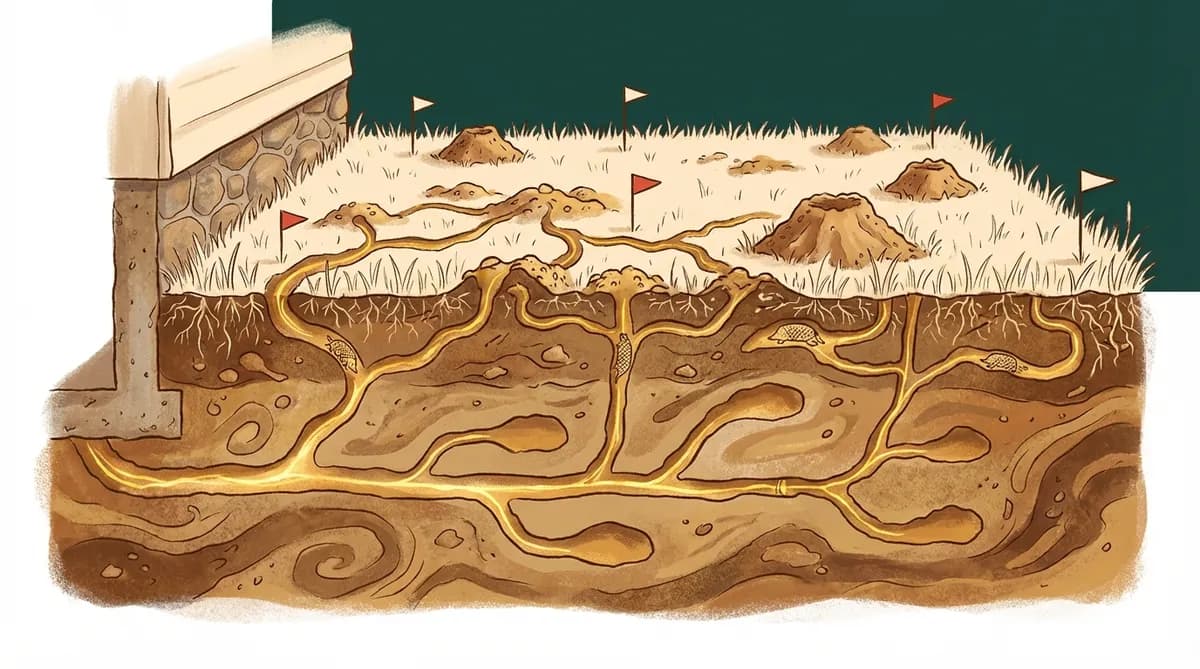
To find active mole tunnels, press down a short section of a raised tunnel with your foot, mark it with a flag, and check back in 24-48 hours. If the tunnel is pushed back up, a mole is actively using that run. If it stays flat, the tunnel has been abandoned. Focus your efforts on confirmed active runs — especially the deep runs along foundations, fences, walkways, and property edges, where Townsend's moles in Western Washington concentrate their daily patrol routes. This single skill separates successful mole trapping from weeks of empty traps.
Got active moles right now? Our one-time removal service clears the moles in your yard over 4–5 weekly visits — and if we don't catch one, you pay only the setup fee.
Why Finding Active Tunnels Matters More Than the Trap You Choose
Mole trapping is a placement problem, not an equipment problem.
A $30 Victor scissor trap placed in a confirmed active deep run will outperform a $200 collection of premium traps scattered across surface tunnels every time. The mole walks through active runs on a predictable schedule — typically 3-6 patrol cycles every 24 hours. A trap in that run catches the mole on its next cycle, often within hours. A trap in an abandoned or one-time-use tunnel sits empty for weeks.
This is the single most important insight in practical mole control, and it's the reason 15 years of experience matters more than the latest trap design. Got Moles has caught moles on nearly 5,000 Western Washington properties since 2017 using the same basic equipment homeowners can buy at any hardware store — the difference is knowing exactly where to put it.
The Three Kinds of Mole Tunnels
Every mole property has three distinct tunnel types, and knowing which is which determines where to place traps.
Deep runs (main highways). These sit 6-20 inches below the surface and serve as the mole's permanent infrastructure. You can't see them from above — no surface ridge, no visible evidence. They follow physical features: foundations, fences, walkways, driveways, garden borders, property lines. A single Townsend's mole uses the same deep run for months or years. These are the single highest-priority tunnels to find and trap. Roughly 70-80% of successful mole catches happen in deep runs.
Surface runs (feeding tunnels). The raised ridges across your lawn, typically 1-4 inches deep. Easy to see; easy to trap. But here's the trap: many surface runs are used once and abandoned. The mole pushed through the soft topsoil hunting earthworms, then routed differently next time. A trap placed in a random surface ridge catches nothing because the mole never comes back through. Only surface runs that connect to confirmed deep runs or follow structural edges are worth targeting.
Mole mounds. Not tunnels at all — just dump sites where the mole pushes excavated soil up to the surface from a deep tunnel. Moles are never in the mound. Setting a trap in a mound is the single most common DIY mistake. Always set traps 18+ inches away from any mound, in the horizontal run that connects beneath it.
This classification matters everywhere in Washington, but the details vary by soil type. Clay-heavy yards in Bellevue and Kirkland tend to have deeper permanent runs (10-15 inches) and sharper distinction between deep and surface. Sandy-loam yards in South King County or amended garden-soil yards in newer developments have shallower permanent runs (6-8 inches) and more diffuse tunnel structure. For more on depth patterns, see How Deep Do Moles Dig?.
Step-by-Step: The Professional Active-Tunnel Test
The core technique is the 'press and check' test. It's what professionals use, and it's what every DIY guide should open with.
Step 1: Walk your property and probe the edges first. Take a screwdriver, garden probe, or stiff wire. Focus on structural edges where deep runs concentrate: along foundation lines, fences, walkways, driveway edges, garden bed borders, and the base of retaining walls. Push the probe into the ground every 12-18 inches as you walk the edge. When the probe drops suddenly into a void (usually 4-20 inches down), you've found a tunnel.
Step 2: Repeat in the open lawn if needed. After the edges, probe near any fresh mounds. Look for straight-line patterns between mounds; deep runs often connect mound clusters. Probe perpendicular to the imagined line. When the probe drops, you've found the connecting tunnel.
Step 3: Collapse test sections. For each tunnel you find, collapse a small section (about 4-6 inches of the run) by pressing the probe through or stepping on it. Mark the spot with a garden flag or a stick. Pick 8-10 test spots across the property — more if you have a large yard.
Step 4: Wait 24-48 hours. Don't disturb anything. Don't mow, don't water, don't walk over the flagged areas. Moles patrol their main runs multiple times per day; a 24-hour window is enough for active runs to repair themselves.
Step 5: Check results.
- Pushed back up / repaired: Active run. The mole has been through. High-priority trap site. - Still flat: Abandoned or one-time-use run. Skip it. - Partially repaired: Low-traffic run. Possible to trap but lower priority. Re-test in another 48 hours to confirm.
Step 6: Prioritize and set traps. Active deep runs along structural edges are the highest priority. Active surface runs that connect to edge deep runs are the second priority. Active surface runs in open lawn are the lowest priority unless you've exhausted better options.
Where Moles Actually Concentrate Their Daily Patrol Routes
A Townsend's mole's deep run network on a typical Western Washington residential lot follows a predictable pattern. Knowing the pattern narrows your probe locations from 'the whole lawn' to 'these specific linear features.'
Foundation lines. The single most reliable location for deep runs. Moles follow foundations because the structural edge provides a navigation reference and the soil conditions along foundations tend to stay consistently moist. 60-70% of Got Moles traps on typical residential work sit within 24 inches of a foundation line.
Fence bases. Similar logic to foundations. The fence creates an edge the mole follows, and the protected soil along the fence base retains moisture. Common tunnel highway on suburban lots where neighboring yards separate by fencing.
Walkway and driveway edges. Paved surfaces disrupt soil conditions on one side but support earthworm habitat on the other. Moles frequently run along the soil side of driveways and walkways. Check both sides of any paved edge.
Garden bed borders. Amended garden soil against lawn edges creates a soil-type boundary that moles exploit. Deep runs often parallel landscape bed edges.
Retaining walls. Particularly in the hillier parts of Seattle, Bellevue, and Issaquah, retaining walls create prime tunnel highway locations. The compacted fill on one side and undisturbed native soil on the other creates an edge moles reliably follow.
Irrigation line paths. If you know where your sprinkler lines run, the disturbed soil along them often hosts mole traffic. Not guaranteed but worth probing.
Property line shrub edges. Hedge rows, ornamental tree lines, and landscape screens create natural soil-type boundaries. Mole runs often follow these.
Open lawn areas away from any structural edge are generally LOW probability for deep runs. Moles pass through them but don't establish highway routes across open grass. Save your probing for the edges.
Reading the Mound Pattern for Tunnel Location Clues
Fresh mounds are mostly dump sites, but their arrangement tells you about the underlying tunnel network.
Line patterns. Mounds arranged in a rough straight line almost always trace a deep run beneath. The mole was working along a permanent tunnel and pushed spoil up at multiple points. Probe between the mounds to find the connecting run.
Cluster patterns. A group of mounds in a small area often indicates a nest chamber or intensive feeding zone directly below. The tunnel network here may be complex and multi-level. Probe around the perimeter of the cluster to find access runs.
Isolated mounds. A single mound far from others is often from a brief excavation event — a mole broke through a new section and pushed spoil up once. Don't prioritize; the underlying tunnel may be one-time-use.
Radial patterns. Mounds radiating outward from a central point can indicate the center of a mole's territory. The nest chamber is often near the radial center, with feeding runs extending outward. Target the deep runs between the center and the outer mounds.
Fresh vs. old mounds. Fresh mounds have loose, dark, moist soil. Old mounds have dried out, weathered, and often grown over with weeds. Focus your probing on areas with fresh mounds — that's where the mole is currently working.
For more on what mole mounds look like and how to distinguish them from gopher or vole surface signs, see What Do Mole Holes Look Like?.
Common Mistakes Homeowners Make When Finding Active Tunnels
Five recurring DIY errors we see on nearly every Western Washington property when a homeowner has already tried finding active tunnels before calling us.
1. Testing only surface runs. Homeowners probe the raised ridges on their lawn because they're visible. But most traps in surface runs catch nothing. Deep runs along edges produce most catches. Shift probing to edges.
2. Testing too many spots at once. Flagging 30 test points across a yard dilutes attention. Test 8-10 spots, focus on edges, wait for results, then test more if needed.
3. Not waiting long enough. Checking back at 6 hours gives false negatives. Moles don't patrol every run every hour. 24-48 hours is the window. Shorter windows miss active runs; longer windows are unnecessary.
4. Disturbing test areas. Walking across flagged spots, mowing, or watering during the test invalidates the test. The mole detects the disturbance and routes around it. Leave the test area alone.
5. Trapping in the wrong part of an active tunnel. Even with a confirmed active run, placement within the tunnel matters. Traps should be set at the correct depth (matching the run), with the trigger positioned so the mole encounters it traveling in either direction, and with minimal soil disturbance during installation. Home-use trap packaging has instructions but getting the depth and orientation right takes practice.
If you've probed, tested, and trapped correctly for 2-3 weeks without results, the issue is likely placement technique rather than tunnel activity. At that point, bringing in professional service is usually more cost-effective than continuing DIY. See DIY vs Professional Mole Control for the cost-benefit.
When to Call a Professional
Professional help makes sense in these situations:
- Multiple active deep runs across the property. Indicates an established mole with a complex tunnel system. Working out the network takes time and technique; professionals resolve it faster. - DIY for 2+ weeks without a catch. If you've identified active runs and placed traps but aren't catching anything, the issue is placement technique — and it won't improve with more time. - Large property or commercial scale. Over half an acre makes DIY probing impractical. Professional approaches scale better. - Multiple moles suspected. Two separate active tunnel networks with no connecting runs indicates two moles. Coordinating simultaneous trapping across both networks is hard for homeowners. - Pets or kids changing the equation. The combination of DIY trap placement and dogs or children playing on the lawn adds complication. Professional under-surface placement is safer and less hassle.
Got Moles has been doing the probe-and-test process on Western Washington properties for 15+ years. Every service starts with the same active-tunnel identification — just with refined judgment built from thousands of repetitions. See One-Time Mole Removal for the single-campaign approach or the Total Mole Control Program for year-round coverage. Call (253) 750-0211 to discuss your property.
Local Mole Control Across King, Pierce, and Snohomish
Got Moles is a mole-only specialist covering King, Pierce, Snohomish, and Thurston counties — the heart of Western Washington. We've trapped moles on nearly 5,000 properties since 2017, chemical-free, with 219+ five-star Google reviews across three local offices.
Local service areas include mole control in Redmond, Bothell mole removal, and mole control near Maple Valley — plus every neighboring city on our service areas map.
If moles have moved into your yard, the fastest path to a solved problem is our Commercial Mole Control or a direct conversation: call (253) 750-0211 or use our contact form.
Get your Mole Risk Score in 2 minutes.
Free, personalized report on what is drawing moles to your yard — and how to stop them coming back.
Find my risk scoreFree. No call required. Takes about 2 minutes.
Frequently Asked Questions
How do I tell if a mole tunnel is active or abandoned?
Press down a 4-6 inch section of the tunnel and check back in 24-48 hours. If the tunnel is pushed back up, a mole is actively using it. If it stays flat after 48 hours, the tunnel is abandoned or one-time-use. Partially-repaired tunnels are low-traffic runs worth re-testing in another 48 hours.
What's the difference between a mole runway and a feeding tunnel?
A runway (deep run) is a permanent tunnel 6-20 inches deep that moles use as a daily highway — traveled multiple times per day for months or years. A feeding tunnel (surface run) is a shallow raised ridge 1-4 inches deep where the mole hunts earthworms. Many feeding tunnels are used once and abandoned. Deep runs along foundations, fences, and walkways are the highest-priority trap locations.
Where is the best place to set a mole trap?
In confirmed active deep runs — specifically along structural edges like foundations, fences, walkways, driveways, or retaining walls. Never set a trap in a mole mound; moles are never in mounds. Always place traps at least 18 inches away from any mound, in the horizontal tunnel that connects to the mound from below.
How many traps should I set on my property?
Start with 4-6 traps placed in confirmed active deep runs. More traps scattered across uncertain locations produce worse results than fewer traps in well-chosen spots. Got Moles typically runs 4-6 traps during the first visit on a quarter-acre residential property, adjusting placement each subsequent week based on mole response.
Do I need special equipment to probe for deep runs?
A stiff screwdriver, long garden probe, or 3/8-inch rebar works fine. Commercial 'mole probes' exist but aren't necessary. The probe needs to slide easily into soil and register a clear drop when it hits a void. Keep it clean and dry between probes to minimize scent transfer.
What if I probe and don't find any tunnels?
Either you're probing in the wrong areas (focus on structural edges rather than open lawn) or the mole's deep runs are deeper than your probe reaches. If you've thoroughly probed along all edges and still find nothing, the tunnels may be at 15+ inches — beyond comfortable probe depth for most hand tools. At that point, professional service is the practical next step.
Can I find mole tunnels without disturbing my lawn at all?
Mostly, yes. The probe-and-test method leaves minimal visible disruption — small holes from the probe heal in days, and the flagged test spots don't require digging. If you catch the mole within a few weeks, the lawn recovery is fast. The bigger 'disturbance' cost comes from letting the mole keep working rather than from the testing process itself.
Related Services & Resources
Our Services
- Total Mole Control Program — $100/month year-round protection
- One-Time Mole Removal — $450 flat rate with guarantee
- Commercial Mole Control — annual contracts for property managers
Learn More
- How It Works — our 4-step process
- FAQ — 26 expert answers
- Service Areas — 77 cities across Western Washington
Spencer Hill is a US Army veteran and founder of Got Moles, a mole control specialist serving Western Washington. He has helped over 5,000 homeowners reclaim their yards using chemical-free, professional trapping methods.
Ready to Reclaim Your Yard?
Call (253) 750-0211 — we serve all of Western Washington.
CALL (253) 750-0211Free. No obligation.
Or get your free 2-minute Mole Risk Score for a personalized report on why moles target your yard.