
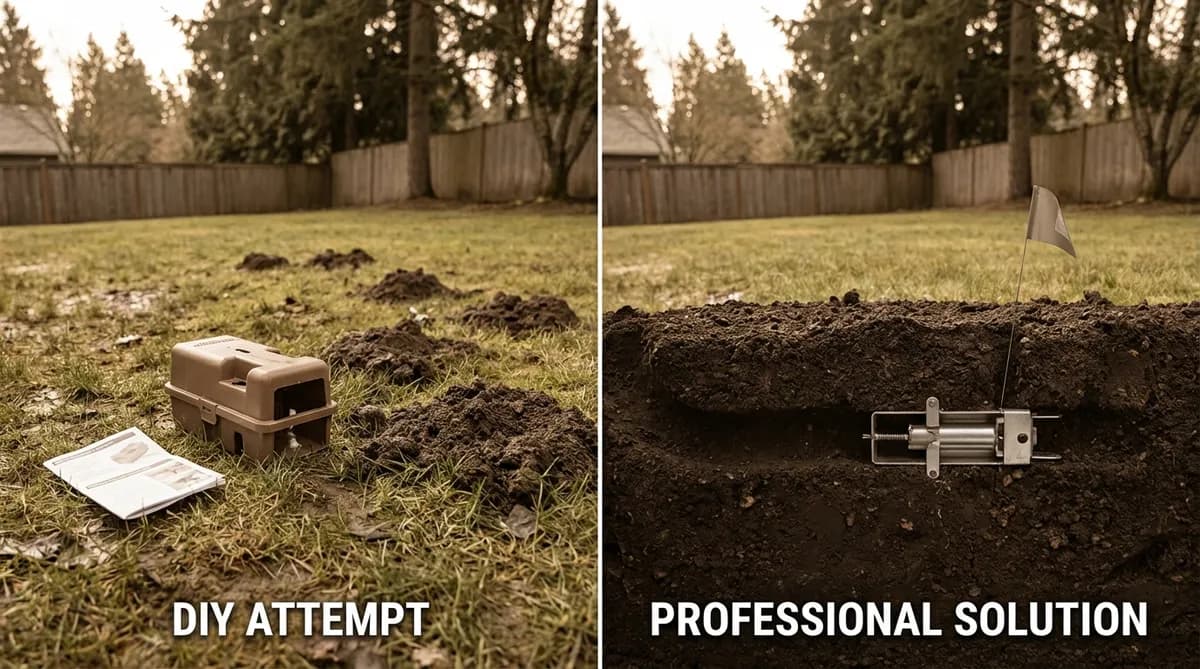
DIY Mole Traps vs Professional Mole Control: The Honest Cost-Benefit Analysis
Professional mole removal is more effective than DIY methods for most Western Washington homeowners. Store-bought traps can work in specific narrow situations — single mole, experienced user, small property, caught early — but have low success rates against established Townsend's mole populations because effective trapping depends on precise placement that requires years of field experience reading tunnel behavior. Professional mole control costs $450 flat rate at Got Moles; DIY products cost $50-$200+ directly, plus 6-12 weeks of homeowner time at market rates, plus accumulated lawn damage, plus often the professional call-out eventually. The honest framing is value per hour of homeowner attention, not sticker price per product.
Got active moles right now? Our flat-rate mole removal clears the moles in your yard over 4–5 weekly visits — and if we don't catch one, you pay only the setup fee.
What DIY Mole Control Actually Costs (The Honest Math)
The quoted DIY price is misleading because it counts only equipment purchases. Real DIY cost includes time, damage during the attempt, and (for most homeowners) the eventual professional call-out anyway.
Equipment purchases. Hardware store scissor traps $15-$30 each. Harpoon traps $20-$40. Repellent sprays $15-$30. Sonic stakes $20-$80. Grub control $30-$50. Typical homeowner stack across first 2-3 months of DIY attempts: $100-$250.
Time investment. Testing for active tunnels, setting traps, checking them, adjusting placements, researching forums when nothing works. Average active DIY attempt: 2-4 hours per week for 8-12 weeks. Total 16-48 hours of homeowner labor. At a conservative $50/hour personal time value, that's $800-$2,400 in real labor cost.
Accumulated lawn damage. During the 8-12 week DIY period, the mole continues tunneling. Fresh mounds accumulate. Surface ridges spread. A lawn that could have been saved by fast professional intervention sometimes requires reseeding ($200-$800) or sod repair ($500-$2,000) by the time DIY is abandoned.
The eventual professional service. Most homeowners who try DIY for 6+ weeks eventually call a professional. Got Moles service records show that roughly 60% of new clients have tried DIY for a meaningful period before calling. At $450 for one-time service, this is on top of DIY spending, not instead of it.
Total realistic DIY cost for an average Western Washington homeowner who eventually calls for help: $200 equipment + $1,500 time + $500 damage + $450 professional service = approximately $2,650 cumulative cost.
Direct professional service cost from day one: $450. Plus 1 month of service (weekly visits, minimal homeowner time required).
This isn't a case where DIY is unambiguously cheaper. For homeowners who value their time, DIY is often the more expensive path — it just looks cheap at the hardware store.
Where DIY Has a Real Chance of Working
We should be honest about the situations where DIY can succeed, because those exist.
Single mole on a small property. A quarter-acre or smaller lot with clear evidence of one resident mole (one active tunnel network, one cluster of mounds) is a manageable DIY target. If the mole has been there less than 2-3 weeks, the tunnel system isn't complex yet.
Experienced user who understands tunnel reading. A homeowner who has read through How to Find Active Mole Tunnels and Best Mole Traps, can correctly identify active deep runs along foundations, and has physical-trap experience from prior encounters (or willingness to practice) can succeed with DIY.
Fresh activity caught early. Mole problems caught in the first few weeks are easier to resolve than problems that have escalated over months. Fresh surface ridges, recent mounds, limited tunnel network development — all favor DIY success.
Willingness to invest 4-6 weeks of attention. DIY mole control isn't a one-weekend project. It requires consistent testing, adjustment, and patience. Homeowners who can sustain that attention level have better success than those looking for quick fixes.
Specific budget constraints. If professional service is genuinely unaffordable, careful DIY is better than no intervention. A methodical $50 DIY attempt beats doing nothing.
In these narrow situations, DIY success rates can reach 30-50% — real but not overwhelming. The flip side: DIY success rates on larger properties, established mole populations, multiple-mole situations, or first-time mole-control attempts are typically 10-20% or lower.
Why DIY Trap Success Rates Are Often Low
The problem with DIY mole trapping isn't the traps themselves. Hardware store scissor traps are the same basic equipment professionals use. The problem is everything around the trap.
Tunnel identification. Moles maintain three distinct tunnel types (deep runs, feeding runs, dump sites) and only one of them (deep runs, specifically active ones) is reliably worth trapping. Most homeowners place traps in visible surface ridges, which are often one-time-use feeding tunnels. Trap in the wrong tunnel, catch nothing.
Placement technique. Even within an active tunnel, placement details matter. Depth must match the tunnel. Orientation affects whether the mole triggers the trap. Soil disturbance during installation can alert the mole. Scent from human hands can cause avoidance. Every detail takes practice.
Adjustment cycles. Moles respond to trapping attempts by shifting behavior — digging deeper, routing around disturbances, using different tunnels. A trap that worked in the first location may stop working after a week because the mole has adjusted. Professional trappers adjust placements each visit based on mole response. Most DIY trappers set once and wait.
Patience vs optimism bias. Waiting 7 days for an empty trap and concluding 'this trap doesn't work' is a common DIY error. Mole trapping often takes 3-14 days in the best placements. Optimism bias leads homeowners to abandon traps that would have eventually succeeded, and to over-trust approaches (like repellents) that don't work at all.
Multiple animals in sequence. Even a successful DIY catch doesn't end the problem if juvenile dispersal brings new moles in. A homeowner who caught the first mole but didn't understand reinvasion can get frustrated when 'the moles come back' a few months later.
Scale. DIY works best on small problems. Larger properties, multiple moles, or complex tunnel networks exceed what a first-time trapper can efficiently address.
What Professional Service Adds (Beyond Just 'Skill')
The professional advantage isn't mystical. It's a specific set of inputs that compound into better outcomes.
1. Experience reading active vs abandoned tunnels. 15+ years of pattern recognition at Got Moles means faster, more accurate identification of where to place traps. What takes a homeowner hours of probe-and-test, a Got Moles technician resolves in minutes on inspection.
2. Weekly adjustment cycles. 4-5 visits over a one-month service period, with each visit adjusting placements based on what happened in the prior week. This iterative loop catches moles that single-placement attempts miss.
3. Proper trap inventory. We carry multiple trap types and sizes, and can match the trap to the specific tunnel conditions we find. DIY buyers typically have 1-2 traps of the same type.
4. No personal time cost. The service takes roughly 30-60 minutes of homeowner attention total across the month — agreeing to the work, confirming visit windows, reviewing reports. The work itself happens without your involvement.
5. Results guarantee. $150 setup fee is the only charge if we don't catch any moles during the service period. The remaining $300 is earned by producing results. This risk-sharing structure doesn't exist in DIY.
6. Chemical-free safety. Professional traps are set below the surface in tunnels, not on the surface where pets or kids might encounter them. No poisons, no residues, no secondary-poisoning risks. See Mole Control Safe for Pets for more.
7. Chained services. If the first mole is caught and a second arrives during the service window, we catch that one too within the original $450. Traveling through multiple mole events in one service isn't a cost multiplier; it's covered.
8. Escalation options. Unusual situations (large properties, multiple simultaneous infestations, commercial scale, chronic recurrence) can escalate to the Total Mole Control Program at $100/month for continuous coverage.
The Decision Framework: When to DIY vs When to Call
Based on the ~5,000 Got Moles service experiences, here's the honest decision framework:
Consider DIY first if:
- Small property (under half an acre) - Single mole, clear evidence of one tunnel network - Activity caught in the first 2-3 weeks - You have prior mole-trapping experience OR willingness to invest time in learning - Budget is a genuine constraint - You enjoy the challenge and have 4-6 weeks of attention to commit
Call a professional directly if:
- Multiple moles suspected - Property larger than half an acre - Activity has been ongoing for more than a month - Previous DIY attempts have already failed - You want the problem solved quickly with minimal time investment - Landscape investment is significant (repair cost exceeds service cost) - Pets or kids are a consideration (professional under-surface placement is safer) - You've had moles return before (indicates persistent pressure; TMCP is probably the right answer)
Try DIY for 2-3 weeks, then call if unresolved:
- You're unsure which camp you're in. Set a clear time budget. If you haven't caught the mole in 3 weeks of active trapping, the cost of continuing is higher than the cost of professional service. Most DIY attempts that convert to professional service convert around week 6-10 — meaning the homeowner spent many hours before making the call. Setting a shorter time limit (3 weeks) captures most of the DIY learning value without the sunk cost of extended failure.
The goal isn't to argue every homeowner needs professional service. The goal is an honest cost-benefit calculation that includes time, damage, and probability of success — not just the sticker price of a hardware store trap.
How Got Moles Handles the Work Differently
If you do call, here's what changes.
Visit 1 — Inspection + first placements. Walk the property, identify active vs abandoned tunnels, locate the resident mole's territory center, place initial traps in confirmed active deep runs. 30-60 minutes on site.
Visits 2-5 — Weekly monitoring and adjustment. Check traps, adjust placements based on catches or mole behavior shifts, add or remove traps as needed. 15-30 minutes per visit.
Reports after every visit. Written summary of what was found, what was done, what the next visit will address.
Chemical-free throughout. No poisons, no repellents, no residues. Physical traps placed below the surface.
Results guarantee. $150 collected upfront, $300 only charged if moles are caught during the service period.
Cleanup at end. All equipment retrieved, all test markers removed, lawn returned to the condition it was in minus the mole.
Transition to ongoing coverage (optional). If the property has persistent pressure, convert to TMCP for year-round monitoring and immediate response to new arrivals.
Nearly 5,000 clients across King, Pierce, Snohomish, Thurston, and adjacent counties since 2017. 219+ five-star Google reviews. Call (253) 750-0211 or book via contact form.
Local Mole Control Across King, Pierce, and Snohomish
Got Moles is a mole-only specialist covering King, Pierce, Snohomish, and Thurston counties — the heart of Western Washington. We've trapped moles on nearly 5,000 properties since 2017, chemical-free, with 219+ five-star Google reviews across three local offices.
Local service areas include mole control in Sammamish, Issaquah mole removal, and mole control near Puyallup — plus every neighboring city on our service areas map.
If moles have moved into your yard, the fastest path to a solved problem is our One-Time Mole Removal or a direct conversation: call (253) 750-0211 or use our contact form.
Get your Mole Risk Score in 2 minutes.
Free, personalized report on what is drawing moles to your yard — and how to stop them coming back.
Find my risk scoreFree. No call required. Takes about 2 minutes.
Frequently Asked Questions
Is professional mole removal worth the cost?
For most Western Washington homeowners, yes — when total cost (time + damage + eventual service) is honestly calculated. A professional service at $450 resolves the problem in one month with minimal homeowner attention. DIY attempts average 6-12 weeks and often lead to professional service eventually anyway. Homeowners who value their time at market rates typically come out ahead with professional service from day one. Genuine exceptions exist (single mole on small property caught fast, experienced user, tight budget), but those are the minority.
Why don't store-bought mole traps work?
They can — hardware store scissor traps are the same basic equipment professionals use. The problem is around the trap: correct tunnel identification (most homeowners trap wrong-tunnel type), precise placement (depth, orientation, scent control), and weekly adjustment based on mole response. Without these details, even good equipment sits empty. Professional success rates reflect experience reading mole behavior, not a proprietary tool.
Does castor oil work for moles?
Not reliably. Washington State University's Extension Service notes that castor oil repellents are 'not consistently effective' against moles. In practice, castor oil sometimes displaces moles to untreated parts of the yard — but displacement isn't removal. PNW rainfall washes the product out within weeks, and earthworms (the mole's food source) aren't affected. Chemical-free physical trapping is the only method with reliable, repeatable results.
How long should I try DIY before giving up?
Set a clear time limit of 2-3 weeks of active trapping (not passive waiting — active testing and adjustment). If you haven't caught the mole in that window, the cost of continuing exceeds the cost of professional service. Most DIY attempts that eventually convert to professional service convert around week 6-10, meaning the homeowner spent many more hours than necessary before calling. A shorter time limit captures most of the DIY learning without the sunk cost.
Can a handyman or general landscaper handle mole trapping?
Usually not effectively. Mole trapping is a specialist skill — reading tunnel patterns, understanding seasonal mole behavior, adjusting placements based on response. A landscape or handyman without mole-specific experience has DIY-level success rates at professional prices. The value of calling a mole specialist like Got Moles is the 15+ years of mole-specific experience, not general yard service capability.
What's the success rate for DIY mole trapping vs professional?
Rough estimates from field observation: DIY first-time success rate on a single mole situation ranges from 10-30% depending on user experience and situation complexity. Professional first-time success rate (within the one-month service window) at Got Moles is 95%+ across nearly 5,000 service records. The gap isn't about better equipment; it's accumulated expertise and weekly adjustment cycles.
Can I DIY and call Got Moles only if it fails?
Yes, and many clients do exactly that. There's no penalty for calling us after DIY has failed — we just handle the problem when you're ready. Worth noting: 4-8 weeks of DIY before calling usually means more tunnel damage and sometimes more moles by the time we arrive. Calling earlier reduces total damage and total cost. But 'try DIY, then call' is a valid strategy.
Related Services & Resources
Our Services
- Total Mole Control Program — $100/month year-round protection
- One-Time Mole Removal — $450 flat rate with guarantee
- Commercial Mole Control — annual contracts for property managers
Learn More
- How It Works — our 4-step process
- FAQ — 26 expert answers
- Service Areas — 77 cities across Western Washington
Spencer Hill is a US Army veteran and founder of Got Moles, a mole control specialist serving Western Washington. He has helped over 5,000 homeowners reclaim their yards using chemical-free, professional trapping methods.
Ready to Reclaim Your Yard?
Call (253) 750-0211 — we serve all of Western Washington.
CALL (253) 750-0211Free. No obligation.
Or get your free 2-minute Mole Risk Score for a personalized report on why moles target your yard.