
How Many Eyes Do Moles Have?
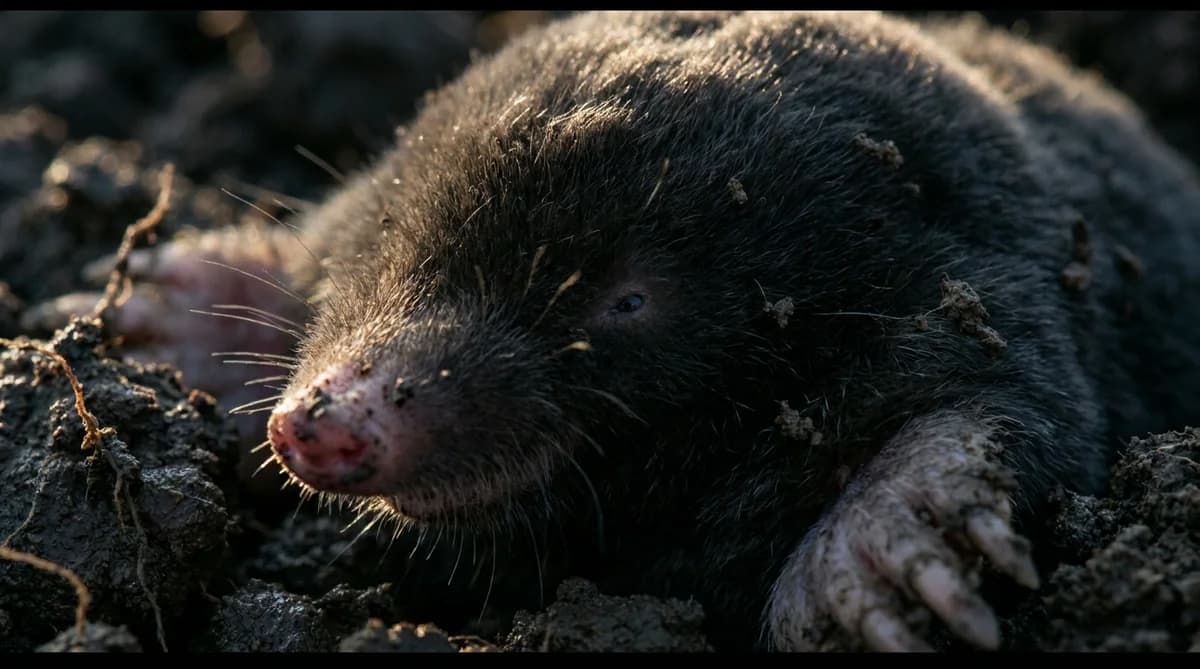
Moles have two eyes. Like most mammals, they have a pair — but they're about the size of a pinhead and often hidden under fur or a thin layer of skin. Mole eyes evolved to detect light, not to see detail. Nearly everything a mole does underground runs on touch, smell, and vibration instead.
Want moles handled for good, not just for now? Our all-season mole protection keeps your Western Washington yard covered with regular visits and a written report after every check.
Do Moles Have Eyes?
Yes. Moles have two eyes, the same as almost every other mammal. But they are so small and so well-hidden that plenty of people assume moles are eyeless — and one of the more common questions we get in our Western Washington mole trapping calls is whether moles even have eyes at all.
The confusion is fair. On a Townsend's mole — the largest species in North America and the one you almost certainly have if you're finding mounds in a Seattle, Bellevue, or Tacoma yard — the eyes are roughly the size of the head of a pin. They're set deep in the fur, often hard to spot even when you're holding the animal. On shrew moles, which are smaller still, the eyes are barely visible at all.
The eyes are there. They're just not doing much of the work.
Can Moles See?
Moles can detect light. That's about it.
After millions of years of evolution underground, their eyes have simplified down to the bare minimum needed to tell light from dark. Some species have a thin layer of translucent skin growing over the eyes altogether. The retina still fires when light hits it, but the lens doesn't focus sharp images the way yours does, and the brain isn't wired to process detail even if it did.
So moles aren't blind in a strict biological sense — they have functioning eyes and a working optic nerve. But they don't see shapes, they don't track movement visually, and they don't navigate by sight. For a related breakdown of what moles perceive and how it compares to human vision, see Are Moles Blind?.
Why Do Moles Have Eyes If They Can Barely See?
For a mole, the single most important thing its eyes do is warn it when something is wrong.
If a mole hits daylight, it has exposed itself — usually by accident, sometimes because a tunnel collapsed — and it's now extremely vulnerable. Coyotes, hawks, owls, domestic dogs, and even heron have all been documented taking surfaced moles. A split-second light-detection response tells the mole to reverse course fast and get back into the dirt.
That's the reason the evolutionary pressure to keep eyes at all hasn't disappeared. Light-sensing saves mole lives. Seeing color, depth, or detail would not.
How Do Moles Navigate if They Can't See Well?
Touch and smell carry the load.
A mole's snout is covered in extremely sensitive whiskers called vibrissae and — more importantly — specialized sensors called Eimer's organs. These microscopic domes, packed in the hundreds across the tip of the snout, detect the faintest air currents, soil pressure changes, and the vibrations earthworms produce as they move. Earthworms make up 55 to 93 percent of a mole's diet in Western Washington — the rest being grubs, centipedes, slug larvae, and the occasional insect — so tuning those sensors to worm-frequency was a survival requirement.
Their strong forelimbs are built for digging. Large, shovel-shaped paws let a mole tunnel through wet PNW clay soil at up to 18 feet per hour when the soil cooperates. Once a tunnel network is in place, the mole patrols it repeatedly, memorizing the route through touch. When a new worm falls through the soil into the tunnel, the mole often reaches it within minutes.
One species — the star-nosed mole — takes this further than any other mammal on earth. Its nose is ringed with 22 pink fleshy appendages covered in over 25,000 touch receptors. It can identify and eat prey faster than the human eye can follow. Star-nosed moles don't live in Washington, but they're proof of how far the mole family has leaned into touch over vision.
Do Washington's Three Mole Species Differ in Eye Size?
Slightly. All three species found in Washington State — Townsend's, Pacific Coast, and Shrew mole — follow the same basic pattern: tiny, deep-set, light-only eyes.
Townsend's mole is the largest species in North America at 8-9 inches long and 4-5 ounces. Its eyes are pinhead-sized and buried in velvety black fur. You have to part the fur to find them.
Pacific Coast moles are about two-thirds the size — 6-7 inches, 2-3 ounces — and have proportionally similar eyes. Identical function. Some individuals have a thin membrane of skin that grows over the eye entirely, which doesn't seem to affect their behavior because they weren't using vision to begin with.
Shrew moles are the smallest, under 4 inches total. Their eyes are so tiny that casual observers routinely miss them entirely. Unusual among moles, shrew moles forage above ground more often — in Western Washington, typically in wet leaf litter along wooded property edges. You'd think that would favor better eyesight, but their eyes remain the simplified mole version.
For a deeper look at the three species and how to tell them apart on your property, see What Species of Moles Live in Washington State? and the detailed Types of Moles in Washington guide.
Why Is Mole Control Important?
Moles are fascinating creatures, but they are also hard on a lawn. A single Townsend's mole in an active feeding cycle can throw up fresh mounds every day, collapse surface tunnels under foot traffic, and undercut irrigation lines and sprinkler heads. In the wet PNW soils between March and June — peak mole activity season — a small population can turn a $15,000 lawn into a minefield inside a few weeks.
The fix is rarely about repelling a mole. It's about removing it. Repellents, sonic stakes, castor oil, and grub killers don't work reliably on Townsend's moles — we've excavated enough treated yards across Seattle, Tacoma, and Enumclaw to be confident on that point. Chemical-free professional trapping is what gets results and what our Total Mole Control Program and One-Time Mole Removal services are built around.
If you're in Western Washington and you've got active mole damage — fresh mounds, raised tunnel ridges, kids dodging holes on the lawn — Got Moles handles it. Call (253) 750-0211 for a quote, or check our Service Areas page to confirm we cover your city.
Serving Your Neighborhood
Got Moles is a mole-only specialist covering King, Pierce, Snohomish, and Thurston counties — the heart of Western Washington. We've trapped moles on nearly 5,000 properties since 2017, chemical-free, with 219+ five-star Google reviews across three local offices.
Local service areas include mole control in Mercer Island, Snoqualmie mole removal, mole control near Black Diamond, Seattle mole control, and mole control in Bellevue — plus every neighboring city on our service areas map. Seeing fresh mounds already? Start with our guide on getting rid of moles in your yard.
If moles have moved into your yard, the fastest path to a solved problem is our One-Time Mole Removal or a direct conversation: call (253) 750-0211 or use our contact form.
Why is your yard a mole target?
Get your free 2-minute Mole Risk Score — a personalized report on what is drawing them in and how to make your property less attractive.
Find my risk scoreFree. No call required. Takes about 2 minutes.
Frequently Asked Questions
Are moles born with eyes?
Yes. Baby moles (called pups) are born with their eyes already present, just like adult moles. The eyes are closed at birth and open within the first few weeks, but they remain the same tiny, fur-covered, light-detecting organs throughout the mole's life. They never develop any further than that.
Can moles see the color of light or just brightness?
Research on mole vision suggests they can distinguish light from dark and likely pick up some changes in wavelength, but fine color discrimination appears to be minimal. Their retinas have reduced numbers of cone cells — the cells responsible for color vision in most mammals — and more rod cells, which specialize in low-light detection. Functionally, a mole likely experiences light as shades of brightness, not the color world you see.
Do moles have any other special senses besides touch and smell?
Moles have a very strong sense of touch through their whiskers, excellent underground hearing for low-frequency vibrations, and a specialized hunting technique called stereo smell — they sniff with each nostril independently, allowing them to triangulate the direction of prey odors in three dimensions. That stereo-smell ability is rare in the animal kingdom and is one reason moles find earthworms so efficiently in total darkness.
If I see a mole on the surface, something's wrong — right?
Usually, yes. Adult moles rarely surface voluntarily. Seeing one above ground typically means a tunnel collapsed, the soil dried too hard to dig through, the mole is dispersing to new territory (common for juveniles in late spring), or the animal is sick or dying. Shrew moles are the one exception — they forage on the surface regularly in wet PNW leaf litter and forest edges, but you'll almost never see a Townsend's or Pacific Coast mole above ground.
Does the fact that moles are nearly blind affect how we trap them?
Yes. Because moles navigate by touch and vibration rather than sight, trap placement is not about visual concealment — it's about tunnel reading. A professional trapper identifies active tunnels by feel, checks for fresh signs of movement, and positions the trap so the mole encounters it along its natural patrol route. A trap placed in the wrong tunnel simply gets ignored, no matter how well hidden it is. Knowing moles can't see changes nothing about the physical setup and everything about where it goes.
Related Services & Resources
Our Services
- Total Mole Control Program — $100/month year-round protection
- One-Time Mole Removal — $450 flat rate with guarantee
- Commercial Mole Control — annual contracts for property managers
Learn More
- How It Works — our 4-step process
- FAQ — 26 expert answers
- Service Areas — 77 cities across Western Washington
Spencer Hill is a US Army veteran and founder of Got Moles, a mole control specialist serving Western Washington. He has helped over 5,000 homeowners reclaim their yards using chemical-free, professional trapping methods.
Ready to Reclaim Your Yard?
Call (253) 750-0211 — we serve all of Western Washington.
CALL (253) 750-0211Free. No obligation.
Or get your free 2-minute Mole Risk Score for a personalized report on why moles target your yard.