
What Do Mole Holes Look Like?
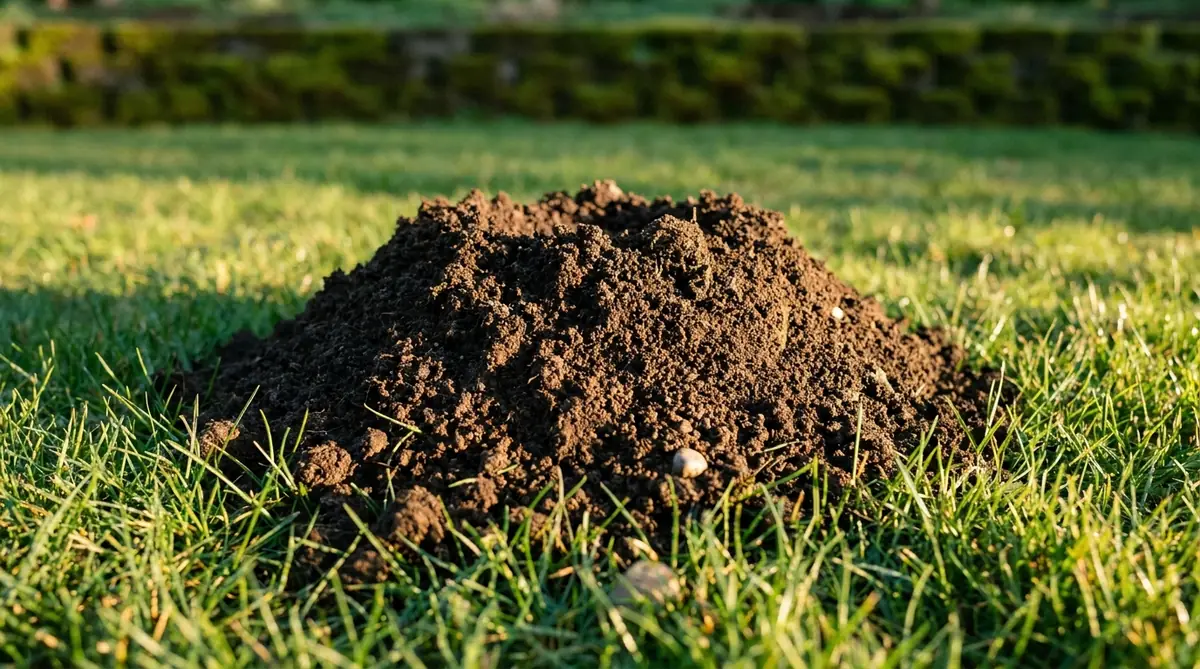
Mole holes don't look like open holes. They look like volcano-shaped mounds of loose, finely-churned soil — typically 4 to 8 inches across and 2 to 5 inches tall — with no visible entry. The mole plugs the opening with soil from below. Raised surface ridges are the other signature, tracing shallow feeding tunnels a few inches under the grass.
Want moles handled for good, not just for now? Our ongoing mole protection keeps your Western Washington yard covered with regular visits and a written report after every check.
What Do Mole Holes Actually Look Like on a Western WA Lawn?
Most people expect a hole. They see a mound and wonder where the hole is.
That's the confusing part about mole damage. Townsend's moles — the species on almost every Puget Sound lowland lawn — don't leave open holes. They push surplus soil from the tunnel up through a vertical shaft and then plug the shaft from below. What you see above is a volcano-shaped cone of finely churned soil, usually 4 to 8 inches wide at the base, 2 to 5 inches tall. No opening. No daylight into the tunnel.
In a King, Pierce, Snohomish, or Thurston County yard, mounds often appear in straight or curving lines — the surface evidence of a feeding tunnel running beneath. Where you see three or four mounds in a row, that's one mole working a route, not three moles.
How Do You Tell Mole Mounds from Gopher Mounds?
Shape and symmetry. Mole mounds are round, symmetrical volcanoes with the plugged shaft in the center. Gopher mounds are fan-shaped, with the opening off to one side and the loose soil spread in a crescent.
The practical answer for Western Washington: if you're in King, Pierce, Snohomish, or Thurston County, you almost certainly have moles. The Mazama pocket gopher is the only native gopher here and it's federally protected, rare, and confined to specific prairie pockets around Thurston. Ninety-five percent or more of "gopher-looking" damage west of the Cascades is actually Townsend's moles. For a full comparison including vole damage, see Mole vs Vole vs Gopher.
What About Raised Ridges Across the Lawn?
Those are surface tunnels — and they're the other classic mole signature.
Townsend's moles dig two kinds of runs. Deep permanent tunnels sit 6 to 20 inches below the surface and aren't visible from above. Surface feeding tunnels run only 1 to 4 inches deep, and the soil pushed up as the mole tunnels creates a raised ridge you can see and feel. Walk across an active feeding tunnel and it collapses slightly underfoot.
Surface ridges tend to follow edges — foundations, fence lines, driveway borders, flower bed perimeters. That's because edges concentrate the earthworm prey moles are hunting. If you see a ridge cutting diagonally across the middle of an open lawn, it's usually a single pass that the mole won't use again. Edge ridges are the ones that matter for identification and treatment.
Are Mole Holes a Sign of One Mole or Several?
Usually one. Sometimes two. Rarely more.
In our 15+ years of trapping across nearly 5,000 Western WA properties, the typical single-family yard has one resident Townsend's mole. A single mole can produce dozens of mounds over a few weeks because each tunnel gets worked, rerouted, and re-worked. The volume of surface evidence is misleading. It feels like an army; it's one animal doing a lot of work.
Two moles occur on larger properties, at neighborhood corners where two territories overlap, or during spring juvenile dispersal (May through June, when young moles strike out to find their own ground). Three or more on a residential lot is uncommon and usually means the property borders a park, forest edge, creek corridor, or farm.
Why Is Accurate Mole Hole Identification Important?
Because treatment is tunnel-specific, not mound-specific.
A mound is a dump site — the mole is never in it. Dropping a trap into a mound catches nothing. The working tunnels sit horizontally in the soil and connect the mounds together. A trap set in the active horizontal run, at the right depth, on a mole's normal patrol route, will catch the mole on its next cycle — usually within hours.
Reading which tunnels are active vs abandoned is the part that takes experience. Got Moles has done it across Seattle, Tacoma, Bellevue, Sammamish, Federal Way, and every other Western WA city enough times to do it quickly. See the approach at How to Find Active Mole Tunnels, or go straight to One-Time Mole Removal if you'd rather just have it handled.
How Mole Holes Differ by Washington Soil Type
The appearance of a mole mound varies with the soil conditions in your specific neighborhood. Three broad soil types dominate Western Washington residential properties, and each produces a slightly different signature.
Glacial till (most of the Puget Lowlands): Compacted, heavy, clay-rich soil laid down by Ice Age glaciers. Mounds here are moderate-sized, dense, and often clumpy — the mole is pushing up chunks rather than loose particles. Common in Bellevue, Sammamish, Kirkland, Issaquah, and much of the East Side. Mounds settle quickly after heavy rain and can turn into hardened cones if the weather dries them out.
Alluvial clay (valley floors and river corridors): Fine, silty, rich soil deposited by rivers. Mounds here are the biggest and fluffiest — loose particle structure means more volume of soil per tunnel the mole digs. Common in the Kent Valley, Puyallup Valley, the lower Snohomish River corridor, and the flats around Auburn. These are also the properties with the highest earthworm densities and therefore the heaviest mole activity.
Amended garden soil (landscaped subdivisions): Topsoil added during construction, often trucked in from elsewhere. Mounds here are very loose and easy to push up — moles move through amended soil fast. New construction developments across the East Side and South King County commonly sit on this profile. The mole activity often gets blamed on 'new lawn' conditions but it's really the amended soil moving moles through faster than native ground would.
Knowing your soil type helps you interpret what you're seeing, but it doesn't change the control approach. All three profiles respond the same way to professional trapping in active tunnels.
Serving Your Neighborhood
Got Moles is a mole-only specialist covering King, Pierce, Snohomish, and Thurston counties — the heart of Western Washington. We've trapped moles on nearly 5,000 properties since 2017, chemical-free, with 219+ five-star Google reviews across three local offices.
Local service areas include mole control in Kirkland, Redmond mole removal, mole control near Bothell, and Bellevue mole control — plus every neighboring city on our service areas map. Once you have confirmed it is moles, our guide on removing moles from your lawn covers your options.
If moles have moved into your yard, the fastest path to a solved problem is our Total Mole Control Program or a direct conversation: call (253) 750-0211 or use our contact form.
Get your Mole Risk Score in 2 minutes.
Free, personalized report on what is drawing moles to your yard — and how to stop them coming back.
Find my risk scoreFree. No call required. Takes about 2 minutes.
Frequently Asked Questions
Why are there no visible holes in my mole mounds?
Because moles plug the vertical shaft from below after pushing the loose soil up. Unlike gophers, which leave a visible opening off to one side, moles seal the shaft with a core of packed dirt. The mole is working horizontally underground and only uses the shaft as a disposal chute.
How many mole mounds equals one mole?
Varies with season and soil, but a single Townsend's mole in active feeding mode typically produces 5 to 20 mounds per week. Over a month that can look like 40+ fresh mounds on a quarter-acre lot. Don't count mounds to estimate mole population — assume 1 mole unless the yard is larger than half an acre or borders wild ground.
What does a collapsed mole tunnel look like?
Soft, sunken strips running across the lawn, typically 2 to 4 inches wide and a few feet to many feet long. You can sometimes see a faint line of dying grass directly over the tunnel because the roots have been severed. If you press the tunnel flat with your foot and it pops back up within 24 hours, the tunnel is active.
Do mole holes cause lawn damage beyond the cosmetic?
Yes. Surface tunnels separate grass roots from the soil below, which kills strips of lawn. Mounds smother turf underneath and introduce loose soil that weeds colonize readily. In irrigated lawns, tunnel networks can undermine sprinkler heads and create dry patches where water drains into empty tunnels instead of soaking the grass root zone.
Can I just fill the mounds in to fix the problem?
Fills the visible damage for a day — new mounds appear the next day because the mole is still there. Dirt fill doesn't address the mole. The only fix that sticks is removing the mole. See [One-Time Mole Removal](/services/one-time-mole-removal/) for the chemical-free professional approach, or the [Total Mole Control Program](/services/total-mole-control-program/) if your property borders wild ground where new moles will keep arriving.
Related Services & Resources
Our Services
- Total Mole Control Program — $100/month year-round protection
- One-Time Mole Removal — $450 flat rate with guarantee
- Commercial Mole Control — annual contracts for property managers
Learn More
- How It Works — our 4-step process
- FAQ — 26 expert answers
- Service Areas — 77 cities across Western Washington
Spencer Hill is a US Army veteran and founder of Got Moles, a mole control specialist serving Western Washington. He has helped over 5,000 homeowners reclaim their yards using chemical-free, professional trapping methods.
Ready to Reclaim Your Yard?
Call (253) 750-0211 — we serve all of Western Washington.
CALL (253) 750-0211Free. No obligation.
Or get your free 2-minute Mole Risk Score for a personalized report on why moles target your yard.