
What Attracts Moles to Your Yard?
Moles are drawn to yards with moist, loose soil and abundant earthworms. Four factors overwhelmingly predict mole activity in Western Washington: soil moisture (from rainfall + irrigation), earthworm density, soft organic soil layers, and proximity to wild ground. Most maintained PNW lawns check every box, which is why mole problems here are more about 'when' than 'if'.
Want moles handled for good, not just for now? Our Total Mole Control Program keeps your Western Washington yard covered with regular visits and a written report after every check.
What Attracts Moles to a Western Washington Yard?
Four conditions, in order of importance:
Earthworm density. Earthworms make up 55 to 93 percent of a Townsend's mole's diet. A lawn that supports high earthworm populations attracts moles. Period. This is the foundational driver — without the worms, everything else is secondary.
Soil moisture. Worms need moist soil; moles need the same soil to tunnel efficiently. Western Washington's 35 to 60 inches of annual rainfall plus standard lawn irrigation keeps soil in the 'ideal' range for both species most of the year.
Soft, loose organic soil. Moles tunnel fastest in loamy soil with high organic content. Beautifully maintained lawns with amended topsoil, mulch beds, and compost-rich garden areas provide exactly that. Compacted clay, gravel, and hardpan resist tunneling; rich loam invites it.
Proximity to wild ground. Forested edges, creek corridors, parks, undeveloped lots, and pasture surround many Puget Sound neighborhoods. Those spaces host resident mole populations that continuously disperse into adjacent maintained lawns. A property that backs onto Cougar Mountain, Bridle Trails, or any of the region's hundreds of urban greenbelts faces ongoing recolonization pressure.
Why Are Maintained Lawns More Attractive Than Untended Ground?
Counterintuitive but true — a well-cared-for lawn is often more attractive to moles than scruffy or wild ground.
Reasons: irrigated lawns stay moist longer into the dry season, amendments and compost applied to premium lawns increase earthworm biomass, and the act of maintaining soft soil (aeration, topdressing, overseeding) keeps the tunneling medium easy. A homeowner who's invested in their landscape has inadvertently optimized it for moles.
This is why Eastside communities like Sammamish, Bellevue, Kirkland, Redmond, and others see heavier mole activity than some of the surrounding rural ground. The mole is selecting for earthworm-rich moist loam, and the premium landscapes deliver it in abundance. The investment in the lawn doesn't deter mole colonization; it subsidizes it.
Which Lawn Habits Increase Mole Attraction Without You Realizing?
A few common PNW practices raise the risk:
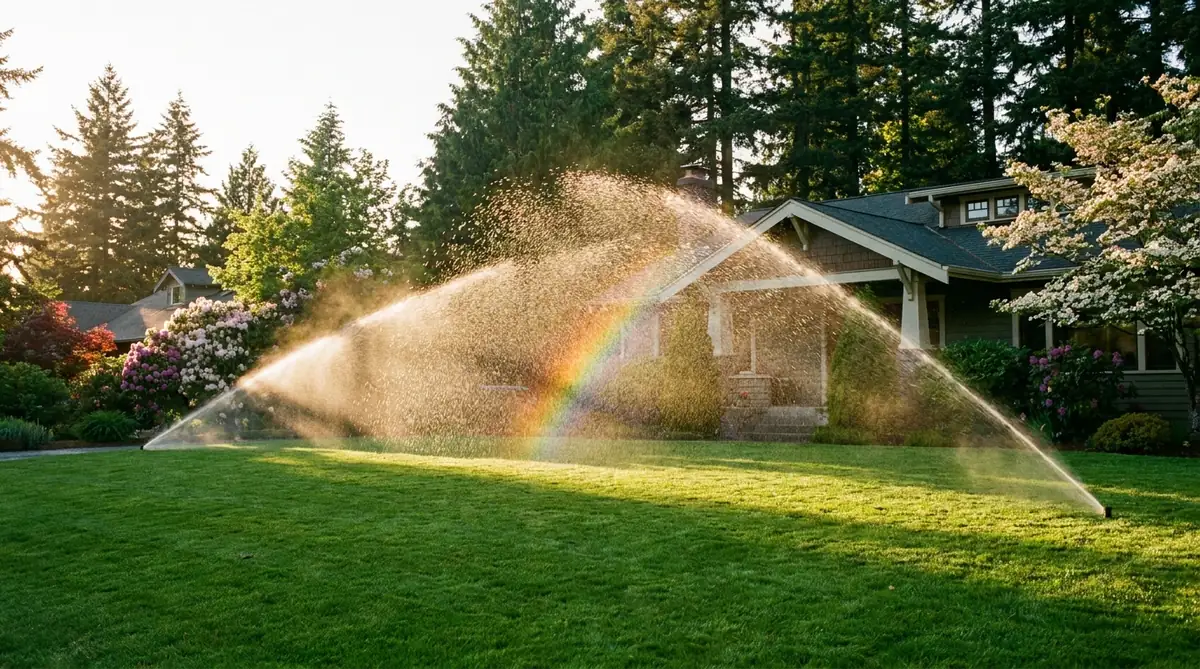
Overwatering. More water than the grass actually needs (which is easy to do with Washington's natural rainfall on top of automated irrigation) creates persistent soil saturation, peaks worm activity, and peaks mole activity. If your sprinklers run daily in summer, they're probably running more than the lawn needs.
Thick mulch beds. Deep mulch layers retain moisture and harbor worm and grub populations. Edges of mulch beds are prime mole tunneling zones.
Frequent aeration and topdressing. These services keep the soil soft and easy to tunnel through. Worth continuing for lawn health, but worth understanding as a mole attractor.
Compost-heavy gardens adjacent to lawn. Vegetable gardens and flower beds amended with finished compost have very high worm density. Moles follow the worms across the boundary into the lawn.
Irrigation leaks. Persistent wet spots concentrate earthworms hard, and those specific patches become the most heavily tunneled sections of the yard. If you see mole ridges converging on one corner of the lawn, check for a leaking sprinkler head.
Can You Change the Yard to Discourage Moles?
Partially, not completely.
Realistic moves: run irrigation on the minimum schedule the grass tolerates, fix any leaks immediately, avoid over-applying compost or topdressing near the lawn perimeter, and install physical barriers (buried hardware cloth) around high-value garden beds. These steps reduce the yard's attractiveness but don't eliminate it — the underlying PNW climate and soil biology are the foundational drivers, and you can't change those.
Reducing grubs with grub killer does NOT starve out the mole. Grubs are only 5-20% of diet — the earthworm majority persists regardless. For the full breakdown on why this doesn't work, see Does Grub Control Stop Moles? (Tier 2 cornerstone covering exactly this myth).
The honest answer: habitat modification slows mole pressure slightly, but removing an active mole requires trapping. See One-Time Mole Removal or the year-round Total Mole Control Program for the methods that actually work across Western WA.
Why Does the Mole Come Back Even After You Clear the Yard?
Because the yard is still attractive. Removing the resident mole doesn't change the conditions that drew it there.
After a successful clearance, the tunnel network remains in the soil. New dispersing juveniles (May-June) and adult moles pushed out of neighboring territory will find those existing tunnels and move in. If your property borders wild ground, this recolonization cycle is ongoing — usually within weeks to months of clearance. See Why Moles Keep Coming Back for the full dynamic.
That's exactly why the Total Mole Control Program exists. For properties near greenbelts, creeks, or parks, year-round monitoring with quick response on new activity is the only way to keep a yard consistently mole-free. One-time removal clears the current resident; the Program handles the next one and the one after that.
Which Washington Neighborhoods Get the Heaviest Mole Pressure?
Mole pressure isn't evenly distributed across Western Washington. Some neighborhoods get hammered; others barely see a mound. A few patterns we've picked up across nearly 5,000 service calls:
Properties backing onto greenbelts or parks. Any lot that shares a boundary with undeveloped land carries above-average pressure because juvenile moles disperse inward from the wild-ground mole population every spring. Examples we service routinely: the Cougar Mountain edges in Issaquah and Bellevue, neighborhoods adjacent to Bridle Trails State Park in Kirkland, lots along the Puyallup River corridor.
Newer subdivisions on former agricultural land. Recently-developed areas across the East Side and South King County often sit on deep topsoil originally amended for farming. The earthworm populations are high and moles follow. New builds in Sammamish Plateau, Maple Valley, and Covington frequently show heavy first-year mole activity.
Irrigated lawns on glacial till. The combination of soft irrigated topsoil over harder till underneath creates an ideal mole layer — 4-12 inches of easy tunneling with a natural worm concentration zone right at the surface. Much of Bellevue, Redmond, and Woodinville sits in this profile.
Creek and wetland corridors. Properties within a quarter-mile of a year-round creek, stream, or wetland have chronic high worm density and therefore chronic mole pressure. The Sammamish River corridor, the Bear Creek watershed in Woodinville, and the green rivers feeding into the Duwamish are prime examples.
None of this is a reason to move — it's context for why the same lawn can see recurring mole activity despite repeated clearance attempts, and why the year-round Total Mole Control Program is the better fit for high-pressure properties.
Serving Your Neighborhood
Got Moles is a mole-only specialist covering King, Pierce, Snohomish, and Thurston counties — the heart of Western Washington. We've trapped moles on nearly 5,000 properties since 2017, chemical-free, with 219+ five-star Google reviews across three local offices.
Local service areas include mole control in Renton, Kent mole removal, and mole control near Enumclaw — plus every neighboring city on our service areas map.
If moles have moved into your yard, the fastest path to a solved problem is our Total Mole Control Program or a direct conversation: call (253) 750-0211 or use our contact form.
Why is your yard a mole target?
Get your free 2-minute Mole Risk Score — a personalized report on what is drawing them in and how to make your property less attractive.
Find my risk scoreFree. No call required. Takes about 2 minutes.
Frequently Asked Questions
Does having healthy grass attract moles?
Indirectly, yes. A healthy lawn supports a healthy earthworm population, and the worms attract the moles. You're not going to fix this by letting your grass die — the earthworms care about the soil, not the grass. The better framing: healthy yards attract moles, and the way to handle it is to remove the mole rather than to wreck the conditions that make the yard nice in the first place.
What soil type attracts the most moles?
Loam — rich, moist, worm-dense topsoil. On the Puget Sound lowlands, Alderwood gravelly sandy loam is the most common residential soil and supports heavy mole activity. Heavy clay without amendment is less attractive (harder to tunnel through); pure sand is very unattractive (poor earthworm habitat). Most residential lots sit in the loam zone because landscaping naturally moves soil in that direction.
Do moles prefer shade or sun?
Moles live underground, so surface sun exposure doesn't matter directly. But shaded lawns tend to stay moist longer, which supports worms, which supports moles. On a typical Western Washington property, the shadier parts of the lawn — under trees, along north-facing slopes, near buildings — often show heavier mole activity than sun-baked open areas.
Do flowering bulbs attract moles?
No. Moles don't eat bulbs — they're insectivores. Bulb damage in your flower beds is caused by voles (which are rodents, and do eat roots and bulbs) using mole tunnels as highways. If you're seeing eaten bulbs and mole tunnels together, the culprit is the vole exploiting the mole's infrastructure. Dealing with the mole often reduces the vole problem as a side effect because the tunnel network becomes less useful.
Do pets in the yard keep moles away?
Rarely enough to matter. Cats occasionally catch a mole that surfaces, and large dogs that patrol the yard can deter surface emergence — but moles spend 95%+ of their time underground where pets can't reach. A yard with active pets has moles just as often as one without. The practical effect: occasional cat predation when a mole slips up, but no meaningful reduction in overall mole activity.
Related Services & Resources
Our Services
- Total Mole Control Program — $100/month year-round protection
- One-Time Mole Removal — $450 flat rate with guarantee
- Commercial Mole Control — annual contracts for property managers
Learn More
- How It Works — our 4-step process
- FAQ — 26 expert answers
- Service Areas — 77 cities across Western Washington
Spencer Hill is a US Army veteran and founder of Got Moles, a mole control specialist serving Western Washington. He has helped over 5,000 homeowners reclaim their yards using chemical-free, professional trapping methods.
Ready to Reclaim Your Yard?
Call (253) 750-0211 — we serve all of Western Washington.
CALL (253) 750-0211Free. No obligation.
Or get your free 2-minute Mole Risk Score for a personalized report on why moles target your yard.